Skip to content
Novus Examples

Deterministic files for performance testing

Documented size, row-count, duration, and resolution ladders for measuring parser, renderer, converter, and upload performance without relying on private production data.

76 of 76 files
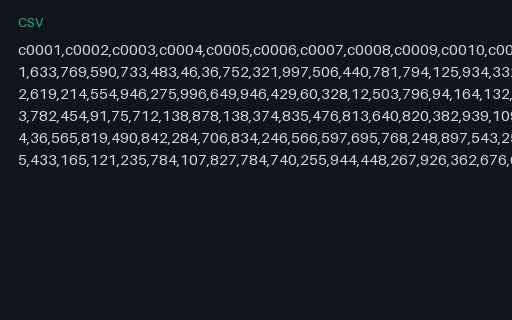
Preview of Wide CSV — 1000 Columns
csv
24.9 KB
Actual file preview for Wide CSV — 1000 Columns

Wide CSV — 1000 Columns

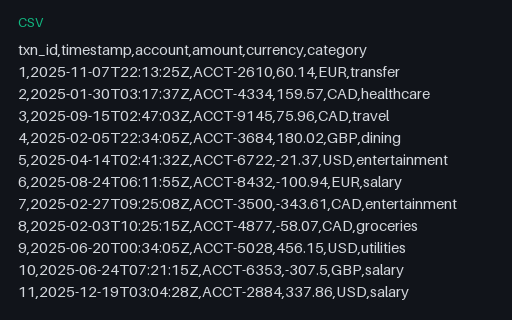
A CSV with 1000 columns and a handful of rows — a stress test for parsers, spreadsheet importers, and databases with column limits or per-row buffering assumptions. Deterministic (fixed seed).

File
CSV · Edge Cases · 5 rows
Preview of ZIP - Bounded High Compression Ratio
zip
4.4 KB
Actual file preview for ZIP - Bounded High Compression Ratio

ZIP - Bounded High Compression Ratio

A deliberately bounded compression-ratio fixture: 4474 bytes on disk expanding to exactly 4 MiB of zeros, roughly 937:1. It is not a decompression bomb - there is no nesting and no recursion, and the expanded size is a fixed 4 MiB - so it exercises a ratio guard or a streaming extractor's memory ceiling without being dangerous to open.

File
ZIP · Zip Payload · 2 members
Use case
Conversion testingCompression testing+1· Conversion set
Preview of TAR - Padded to a 10240-Byte Record
tar
10 KB
Actual file preview for TAR - Padded to a 10240-Byte Record

TAR - Padded to a 10240-Byte Record

The same three members followed by the end-of-archive blocks and then zero padding out to a whole 10240-byte record - tar's historical blocking factor of 20, still the default. The archive is 10240 bytes for 616 bytes of content, which is what makes tiny tarballs look so wasteful before compression.

File
TAR · Tar Stream · 3 members
Use case
Conversion testingPerformance testing· Conversion set
Preview of GLB — Interleaved Vertex Attributes (byteStride 32)
glb
13.6 KB
Actual file preview for GLB — Interleaved Vertex Attributes (byteStride 32)

GLB — Interleaved Vertex Attributes (byteStride 32)

Position, normal and UV packed into ONE bufferView with byteStride 32 and three accessors at offsets 0, 12 and 24 — the GPU-friendly layout, and the one a naive parser mis-reads because it assumes each accessor owns its view. Twinned here with a tightly-packed version of the same sphere.

File
GLB · Buffers
Use case
Conversion testingMesh processing QA+1· Conversion set
Preview of GLB — Tightly-packed Vertex Attributes
glb
13.7 KB
Actual file preview for GLB — Tightly-packed Vertex Attributes

GLB — Tightly-packed Vertex Attributes

The same sphere with every attribute in its own bufferView and no byteStride — the layout most exporters emit and most parsers assume. The control against which the interleaved twin in this group is diffed.

File
GLB · Buffers
Use case
Conversion testingMesh processing QA+1· Conversion set
Preview of GLB — Float32 Vertex Baseline
glb
73.5 KB
Actual file preview for GLB — Float32 Vertex Baseline

GLB — Float32 Vertex Baseline

An unquantised sphere: 32-bit floats for both positions and normals, 24 bytes of attribute data per vertex. The uncompressed reference for the quantized and gzip twins in this group.

File
GLB · Compression · 3,968 triangles
Use case
Conversion testingMesh processing QA+1· Conversion set
Preview of GLB — KHR_mesh_quantization Twin
glb
48.9 KB
Actual file preview for GLB — KHR_mesh_quantization Twin

GLB — KHR_mesh_quantization Twin

The same sphere with positions as normalised 16-bit and normals as normalised 8-bit integers under KHR_mesh_quantization — 66.6% of the float32 twin's bytes. The extension is in extensionsRequired, so a loader without support must refuse the file rather than render garbage.

File
GLB · Compression
Use case
Conversion testingMesh processing QA+1· Conversion set
Preview of GZ — Gzipped Float32 GLB
gz
21.5 KB
Actual file preview for GZ — Gzipped Float32 GLB

GZ — Gzipped Float32 GLB

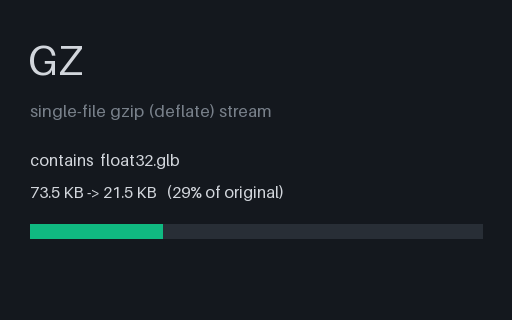
The float32 GLB from this group as a deterministic gzip stream (no embedded filename, mtime 0) — what a CDN actually sends when a viewer advertises `Accept-Encoding: gzip`. It compresses to 29.2% of its source against 55.6% for the quantized twin, which is the point of shipping both: quantisation halves the file on disk and then gives most of that back over the wire.

File
GZ · Compression · gzip (deflate)
Use case
Conversion testingPerformance testing· Conversion set
Preview of GZ — Gzipped Quantized GLB
gz
27.2 KB
Actual file preview for GZ — Gzipped Quantized GLB

GZ — Gzipped Quantized GLB

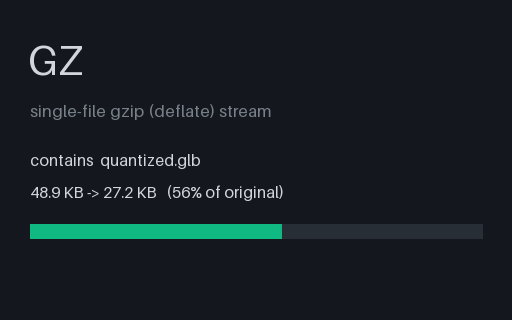
The quantized GLB from this group as a deterministic gzip stream (no embedded filename, mtime 0) — what a CDN actually sends when a viewer advertises `Accept-Encoding: gzip`. It compresses to 55.6% of its source against 29.2% for the float32 twin, which is the point of shipping both: quantisation halves the file on disk and then gives most of that back over the wire.

File
GZ · Compression · gzip (deflate)
Use case
Conversion testingPerformance testing· Conversion set
Preview of GLB — Sphere LOD 0 (16,128 triangles, very high)
glb
290.3 KB
Actual file preview for GLB — Sphere LOD 0 (16,128 triangles, very high)

GLB — Sphere LOD 0 (16,128 triangles, very high)

The same unit sphere at 16,128 triangles — level 0 of a four-step ladder that spans 202x from top to bottom. Because every level is generated analytically from the same surface rather than decimated, the ladder is an exact reference: any deviation you measure is your tool's, not the fixture's.

File
GLB · Lod · 16,128 triangles
Use case
Mesh decimation testingMesh processing QA+1· Conversion set
Preview of GLB — Sphere LOD 1 (3,968 triangles, high)
glb
73.5 KB
Actual file preview for GLB — Sphere LOD 1 (3,968 triangles, high)

GLB — Sphere LOD 1 (3,968 triangles, high)

The same unit sphere at 3,968 triangles — level 1 of a four-step ladder that spans 202x from top to bottom. Because every level is generated analytically from the same surface rather than decimated, the ladder is an exact reference: any deviation you measure is your tool's, not the fixture's.

File
GLB · Lod · 3,968 triangles
Use case
Mesh decimation testingMesh processing QA+1· Conversion set
Preview of GLB — Sphere LOD 2 (960 triangles, medium)
glb
19.1 KB
Actual file preview for GLB — Sphere LOD 2 (960 triangles, medium)

GLB — Sphere LOD 2 (960 triangles, medium)

The same unit sphere at 960 triangles — level 2 of a four-step ladder that spans 202x from top to bottom. Because every level is generated analytically from the same surface rather than decimated, the ladder is an exact reference: any deviation you measure is your tool's, not the fixture's.

File
GLB · Lod · 960 triangles
Use case
Mesh decimation testingMesh processing QA+1· Conversion set
Preview of GLB — Sphere LOD 3 (80 triangles, low)
glb
2.7 KB
Actual file preview for GLB — Sphere LOD 3 (80 triangles, low)

GLB — Sphere LOD 3 (80 triangles, low)

The same unit sphere at 80 triangles — level 3 of a four-step ladder that spans 202x from top to bottom. Because every level is generated analytically from the same surface rather than decimated, the ladder is an exact reference: any deviation you measure is your tool's, not the fixture's.

File
GLB · Lod · 80 triangles
Use case
Mesh decimation testingMesh processing QA+1· Conversion set
Preview of GLB — 64 Nodes Sharing One Mesh
glb
7.8 KB
Actual file preview for GLB — 64 Nodes Sharing One Mesh

GLB — 64 Nodes Sharing One Mesh

An 8x8 field of columns built from a single 12-triangle mesh referenced by 64 nodes with seeded random heights. Core-glTF instancing needs no extension: the file is tiny, and the interesting question is whether your renderer batches the 64 draws or issues them one by one.

File
GLB · Scene Graph
Use case
Conversion testingMesh processing QA+1· Conversion set
Preview of GLB — EXT_mesh_gpu_instancing (32 instances)
glb
3.5 KB
Actual file preview for GLB — EXT_mesh_gpu_instancing (32 instances)

GLB — EXT_mesh_gpu_instancing (32 instances)

Thirty-two copies of one cube expressed as instance attribute accessors on a single node under EXT_mesh_gpu_instancing — the extension that moves instancing off the scene graph and onto the GPU. A viewer without support shows exactly one cube at the origin, which is the tell.

File
GLB · Scene Graph
Use case
Conversion testingMesh processing QA+1· Conversion set
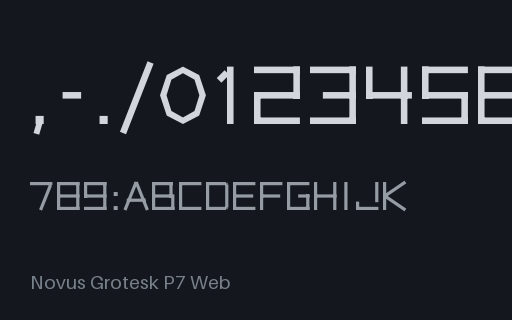
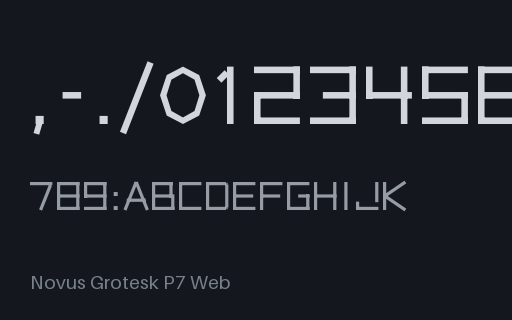
Preview of TTF — Partially Instanced Variable Font (wdth pinned, wght live)
ttf
11.2 KB
Actual file preview for TTF — Partially Instanced Variable Font (wdth pinned, wght live)

TTF — Partially Instanced Variable Font (wdth pinned, wght live)

The two-axis font with its width axis pinned to Condensed and its weight axis left live — the shipping shape for a site that wants one width but the whole weight range. For testing that a loader reads the reduced fvar rather than the original axis list. Original typeface, free to use.

File
TTF · Variable Axes
Use case
Conversion testingWeb assets+1· Conversion set
Preview of TTF — Full Face (subsetting baseline)
ttf
14.7 KB
Actual file preview for TTF — Full Face (subsetting baseline)

TTF — Full Face (subsetting baseline)

The complete face the rest of the subset set is cut from: the whole glyph repertoire with ligatures, kerning, contextual alternates, small caps, stylistic sets, figures, fractions, marks and localised forms intact. Measure it, then measure the cuts. Original typeface, free to use.

File
TTF · Subset
Use case
Conversion testingPerformance testing+1· Conversion set
Preview of WOFF2 — Full Face (subsetting baseline)
woff2
4.1 KB
Actual file preview for WOFF2 — Full Face (subsetting baseline)

WOFF2 — Full Face (subsetting baseline)

The full face as WOFF2 — the honest baseline for a subsetting benchmark, since comparing a subsetted WOFF2 against an unsubsetted TTF measures Brotli rather than the subsetter. Original typeface, free to use.

File
WOFF2 · Subset
Use case
Conversion testingPerformance testing+1· Conversion set
Preview of TTF — Subset: Latin Basic
ttf
13.9 KB
Actual file preview for TTF — Subset: Latin Basic

TTF — Subset: Latin Basic

The full face subset to U+0020-U+007E (printable ASCII) — the range a Latin-only page actually needs. Layout features are kept, so lookups whose glyphs were removed are the ones you can watch disappear. Original typeface, free to use.

File
TTF · Subset
Use case
Conversion testingPerformance testing+1· Conversion set
Preview of WOFF2 — Subset: Latin Basic
woff2
3.7 KB
Actual file preview for WOFF2 — Subset: Latin Basic

WOFF2 — Subset: Latin Basic

The latin basic subset in the container a site would serve, so a size comparison against the full WOFF2 measures the subset rather than the compressor. Original typeface, free to use.

File
WOFF2 · Subset
Use case
Conversion testingPerformance testing+1· Conversion set
Preview of TTF — Subset: Headline
ttf
3.2 KB
Actual file preview for TTF — Subset: Headline

TTF — Subset: Headline

The full face subset to the 8 codepoints of the string NOVUS 07 — the extreme case a headline-only web font gets cut down to. Layout features are kept, so lookups whose glyphs were removed are the ones you can watch disappear. Original typeface, free to use.

File
TTF · Subset
Use case
Conversion testingPerformance testing+1· Conversion set
Preview of WOFF2 — Subset: Headline
woff2
1.2 KB
Actual file preview for WOFF2 — Subset: Headline

WOFF2 — Subset: Headline

The headline subset in the container a site would serve, so a size comparison against the full WOFF2 measures the subset rather than the compressor. Original typeface, free to use.

File
WOFF2 · Subset
Use case
Conversion testingPerformance testing+1· Conversion set
Preview of TTF — Subset: Digits
ttf
5.6 KB
Actual file preview for TTF — Subset: Digits

TTF — Subset: Digits

The full face subset to U+0030-U+0039 (digits only) — a numeric-display cut, the shape a dashboard font ends up. Layout features are kept, so lookups whose glyphs were removed are the ones you can watch disappear. Original typeface, free to use.

File
TTF · Subset
Use case
Conversion testingPerformance testing+1· Conversion set
Preview of WOFF2 — Subset: Digits
woff2
1.5 KB
Actual file preview for WOFF2 — Subset: Digits

WOFF2 — Subset: Digits

The digits subset in the container a site would serve, so a size comparison against the full WOFF2 measures the subset rather than the compressor. Original typeface, free to use.

File
WOFF2 · Subset
Use case
Conversion testingPerformance testing+1· Conversion set
Preview of TTF — Subset with Layout Features Kept
ttf
11.4 KB
Actual file preview for TTF — Subset with Layout Features Kept

TTF — Subset with Layout Features Kept

A subset cut to just the characters the kerning, ligature, small-cap and figure probes need, keeping every OpenType layout feature whose glyphs survived. Half of a pair whose only difference is the layout tables — the pair that shows what a default subsetter setting silently costs you. Original typeface, free to use.

File
TTF · Subset
Use case
Conversion testingPerformance testing+1· Paired fixture
Preview of TTF — Subset with Layout Features Dropped
ttf
4 KB
Actual file preview for TTF — Subset with Layout Features Dropped

TTF — Subset with Layout Features Dropped

The same probe-character subset with every OpenType feature stripped — what many web-font pipelines produce by default. GSUB and GPOS survive as empty shells, so a tool that merely checks whether the tables exist reports the font as fully featured while nothing ligates, kerns, or turns into small caps. Original typeface, free to use.

File
TTF · Subset
Use case
Conversion testingPerformance testing+1· Paired fixture
Preview of TTF — Web Container Source, TrueType (glyf) Outlines
ttf
6.1 KB
Actual file preview for TTF — Web Container Source, TrueType (glyf) Outlines

TTF — Web Container Source, TrueType (glyf) Outlines

The uncompressed TrueType (glyf) source for this container set. Every WOFF and WOFF2 file in the group is packed from exactly these bytes, so a compression comparison is measuring the container and nothing else. Original typeface, free to use.

File
TTF · Web Compression
Use case
Conversion testingWeb assets+1· Conversion set
Preview of WOFF — TrueType (glyf) Outlines (49% of the raw sfnt)
woff
3 KB
Actual file preview for WOFF — TrueType (glyf) Outlines (49% of the raw sfnt)

WOFF — TrueType (glyf) Outlines (49% of the raw sfnt)

The same TrueType (glyf) face in a WOFF container, 49 percent of the raw sfnt size. Compare it against the other three containers in this group to see how much of a web font's weight is the format and how much is the design. Original typeface, free to use.

File
WOFF · Web Compression
Use case
Conversion testingWeb assets+1· Conversion set
Preview of WOFF2 — TrueType (glyf) Outlines (33% of the raw sfnt)
woff2
2 KB
Actual file preview for WOFF2 — TrueType (glyf) Outlines (33% of the raw sfnt)

WOFF2 — TrueType (glyf) Outlines (33% of the raw sfnt)

The same TrueType (glyf) face in a WOFF2 container, 33 percent of the raw sfnt size. Compare it against the other three containers in this group to see how much of a web font's weight is the format and how much is the design. Original typeface, free to use.

File
WOFF2 · Web Compression
Use case
Conversion testingWeb assets+1· Conversion set
Preview of OTF — Web Container Source, CFF (Type 2) Outlines
otf
4.7 KB
Actual file preview for OTF — Web Container Source, CFF (Type 2) Outlines

OTF — Web Container Source, CFF (Type 2) Outlines

The uncompressed CFF (Type 2) source for this container set. Every WOFF and WOFF2 file in the group is packed from exactly these bytes, so a compression comparison is measuring the container and nothing else. Original typeface, free to use.

File
OTF · Web Compression
Use case
Conversion testingWeb assets+1· Conversion set
Preview of WOFF — CFF (Type 2) Outlines (55% of the raw sfnt)
woff
2.6 KB
Actual file preview for WOFF — CFF (Type 2) Outlines (55% of the raw sfnt)

WOFF — CFF (Type 2) Outlines (55% of the raw sfnt)

The same CFF (Type 2) face in a WOFF container, 55 percent of the raw sfnt size. Compare it against the other three containers in this group to see how much of a web font's weight is the format and how much is the design. Original typeface, free to use.

File
WOFF · Web Compression
Use case
Conversion testingWeb assets+1· Conversion set
Preview of WOFF2 — CFF (Type 2) Outlines (45% of the raw sfnt)
woff2
2.1 KB
Actual file preview for WOFF2 — CFF (Type 2) Outlines (45% of the raw sfnt)

WOFF2 — CFF (Type 2) Outlines (45% of the raw sfnt)

The same CFF (Type 2) face in a WOFF2 container, 45 percent of the raw sfnt size. Compare it against the other three containers in this group to see how much of a web font's weight is the format and how much is the design. Original typeface, free to use.

File
WOFF2 · Web Compression
Use case
Conversion testingWeb assets+1· Conversion set
Preview of TTC — Three-Face Collection with Shared Tables
ttc
17.7 KB
Actual file preview for TTC — Three-Face Collection with Shared Tables

TTC — Three-Face Collection with Shared Tables

A TrueType Collection holding three faces of one family with identical tables stored once and referenced by offset from each face's table directory. For testing face-index selection, collection-aware loaders, and extractors that must not assume each face owns its tables. Original typeface, free to use.

File
TTC · Collection
Use case
Conversion testingPerformance testing+1· Paired fixture
Preview of TTC — The Same Three Faces with Tables Unshared
ttc
18.6 KB
Actual file preview for TTC — The Same Three Faces with Tables Unshared

TTC — The Same Three Faces with Tables Unshared

The same three faces in a collection that stores every table separately, so each face's directory points at its own copy. Identical rendering, a bigger file — the reference that makes the shared-table saving measurable rather than assumed. Original typeface, free to use.

File
TTC · Collection
Use case
Conversion testingPerformance testing· Paired fixture
Preview of traffic-advice.json (private prefetch proxy opt-in)
json
144 B
Actual file preview for traffic-advice.json (private prefetch proxy opt-in)

traffic-advice.json (private prefetch proxy opt-in)

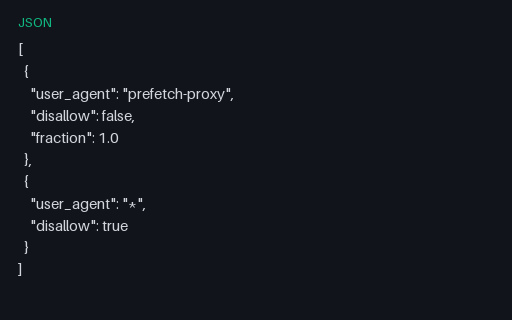
A traffic-advice document opting a fictional origin into private prefetch proxy traffic at full fraction while disallowing every other agent. For testing prefetch-proxy discovery and the JSON-array (not object) top level this format uses.

File
JSON · Well Known
Use case
Web assetsJSON parsing+1· Conversion set
Preview of JUnit XML — 240-Case Suite
xml
18.7 KB
Actual file preview for JUnit XML — 240-Case Suite

JUnit XML — 240-Case Suite

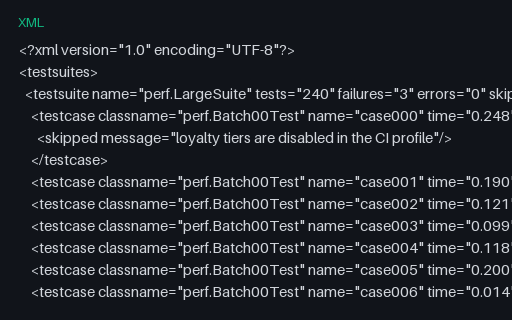
240 cases across six classes, three of them failing. Big enough to time a parser and to check that a report UI paginates or virtualises rather than rendering every row, but still small enough to read.

File
XML · Junit XML · UTF-8
Use case
Performance testingConversion testing+1· Conversion set
Preview of HAR — Page-Load Waterfall (5 Requests)
har
8.8 KB
Actual file preview for HAR — Page-Load Waterfall (5 Requests)

HAR — Page-Load Waterfall (5 Requests)

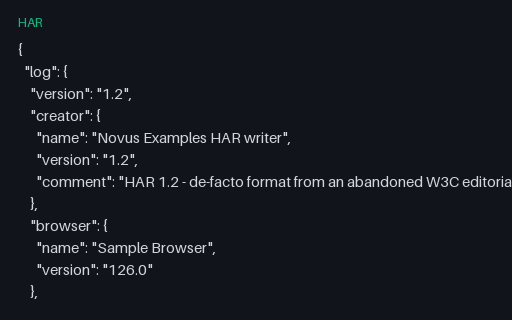
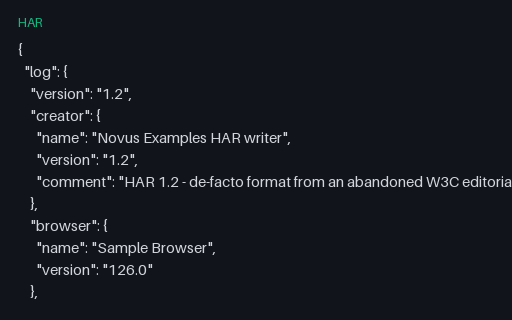
A five-request page load — document, stylesheet, script, image and favicon — across two fictional hosts, with full per-phase timings and an onLoad page timing. Every entry's time equals the sum of its non-negative timing phases, so a waterfall renderer can be checked arithmetically rather than by eye.

File
HAR · Har · 1 page
Use case
API testingPerformance testing+1· Conversion set
Preview of HAR — JSON API Session (GET, POST, PUT, DELETE)
har
8.2 KB
Actual file preview for HAR — JSON API Session (GET, POST, PUT, DELETE)

HAR — JSON API Session (GET, POST, PUT, DELETE)

A four-call REST session against a fictional API host, with JSON request bodies in postData, an Authorization header carrying an obvious SAMPLE placeholder token, and a 204 response that has no body at all. The right shape for testing a HAR-to-mock-server or HAR-to-code converter.

File
HAR · Har · UTF-8
Use case
API testingPerformance testing+1· Conversion set
Preview of HAR — Redirect Chain (301, 302, 200)
har
5.6 KB
Actual file preview for HAR — Redirect Chain (301, 302, 200)

HAR — Redirect Chain (301, 302, 200)

An http URL that redirects to https and then to a query-carrying cart page, with redirectURL populated on both hops. Tools that count entries as page views report three here when the user saw one page.

File
HAR · Har · UTF-8
Use case
API testingPerformance testing+1· Conversion set
Preview of HAR — HTTP Error Responses (401 to 500)
har
9.6 KB
Actual file preview for HAR — HTTP Error Responses (401 to 500)

HAR — HTTP Error Responses (401 to 500)

Five failing requests covering authentication, authorisation, a missing resource, rate limiting with a Retry-After header, and a server error that returns HTML instead of the JSON the client asked for. The last one is the case that breaks clients which parse by status code rather than by content type.

File
HAR · Har · UTF-8
Use case
API testingPerformance testing+1· Conversion set
Preview of HAR — Cookie Set, Sent and Cleared
har
7.6 KB
Actual file preview for HAR — Cookie Set, Sent and Cleared

HAR — Cookie Set, Sent and Cleared

A full session-cookie lifecycle: set at login, echoed on the next request, then expired at logout with Max-Age=0. Both the header and the parsed cookies array are present, and every value — including the form password field — is an obvious SAMPLE placeholder rather than a credential.

File
HAR · Har · UTF-8
Use case
API testingPerformance testing+1· Conversion set
Preview of HAR — Server-Bound Waterfall (Wait Dominates)
har
7.4 KB
Actual file preview for HAR — Server-Bound Waterfall (Wait Dominates)

HAR — Server-Bound Waterfall (Wait Dominates)

Four API calls in which the wait phase — time to first byte — accounts for almost all of the elapsed time, the signature of a server-bound rather than network-bound page. Use it to check that a performance report attributes the cost to the server instead of blaming connection setup.

File
HAR · Har · UTF-8
Use case
API testingPerformance testing+1· Conversion set
Preview of HAR — URL-Encoded Form POST
har
3.3 KB
Actual file preview for HAR — URL-Encoded Form POST

HAR — URL-Encoded Form POST

One form submission whose postData carries both the parsed params array and the raw urlencoded text — and the two must agree. The notes field contains a comma and an ampersand, so a decoder that splits before unescaping produces seven fields instead of five.

File
HAR · Har · UTF-8
Use case
API testingPerformance testing+1· Conversion set
Preview of HAR — Multipart File Upload
har
3.3 KB
Actual file preview for HAR — Multipart File Upload

HAR — Multipart File Upload

A two-part multipart/form-data upload: a text file part with a fileName and a plain field part. The body uses CRLF between MIME parts because RFC 7578 requires it, even though the surrounding HAR document is LF-terminated — a distinction that matters when a replay tool rewrites the body.

File
HAR · Har · UTF-8
Use case
API testingPerformance testing+1· Conversion set
Preview of HAR — Base64-Encoded Binary Body
har
2.4 KB
Actual file preview for HAR — Base64-Encoded Binary Body

HAR — Base64-Encoded Binary Body

A PNG response whose body is carried as base64 with content.encoding set accordingly. content.size is the DECODED byte count, not the length of the base64 string, which is the field readers most often get wrong when computing transfer weight.

File
HAR · Har · UTF-8
Use case
API testingPerformance testing+1· Conversion set
Preview of HAR — Compressed Response and Transfer Size
har
2.8 KB
Actual file preview for HAR — Compressed Response and Transfer Size

HAR — Compressed Response and Transfer Size

A gzip-compressed JSON response where content.size is the uncompressed length, bodySize is the bytes on the wire, and content.compression is the saving between them. It also carries the non-standard _transferSize field browsers add, which readers must tolerate rather than reject.

File
HAR · Har · UTF-8
Use case
API testingPerformance testing+1· Conversion set
Preview of HAR — Two Pages with Page Timings
har
5.5 KB
Actual file preview for HAR — Two Pages with Page Timings

HAR — Two Pages with Page Timings

Two navigations in one capture, with entries bound to their page through pageref. The second page's onLoad is -1, the HAR convention for a timing that never happened, which naive code averages in as zero and reports as an impossibly fast load.

File
HAR · Har · 2 pages
Use case
API testingPerformance testing+1· Conversion set
Preview of HAR — Cache State Before and After
har
4.7 KB
Actual file preview for HAR — Cache State Before and After

HAR — Cache State Before and After

A conditional request answered 304 with full beforeRequest and afterRequest cache state, next to a first-time fetch whose beforeRequest is null. The null is the documented way to say "not in the cache", and readers that treat it as a missing object rather than an explicit absence lose the distinction.

File
HAR · Har · UTF-8
Use case
API testingPerformance testing+1· Conversion set
Preview of HAR — HTTP/2 Request with Connection Detail
har
2.7 KB
Actual file preview for HAR — HTTP/2 Request with Connection Detail

HAR — HTTP/2 Request with Connection Detail

An HTTP/2 entry with lowercase pseudo-headers, an httpVersion of "h2" rather than "HTTP/2.0", an ssl phase inside connect, and three underscore-prefixed custom fields. Version strings are not standardised across writers, so anything matching on "HTTP/1.1" misses this entry entirely.

File
HAR · Har · UTF-8
Use case
API testingPerformance testing+1· Conversion set
Preview of HAR — Query String and Header Edge Cases
har
3 KB
Actual file preview for HAR — Query String and Header Edge Cases

HAR — Query String and Header Edge Cases

One request whose query string encodes a space as %20 in one parameter and as + in another, includes a parameter with an empty value, and carries an Accept-Language header with quality values. The parsed queryString array is the answer key for whatever a URL parser produces from the raw URL.

File
HAR · Har · UTF-8
Use case
API testingPerformance testing+1· Conversion set
Preview of Load Test — Run Summary with Thresholds (JSON)
json
1.7 KB
Actual file preview for Load Test — Run Summary with Thresholds (JSON)

Load Test — Run Summary with Thresholds (JSON)

A load-test run summary in the shape a threshold-checking CI step consumes: totals, per-scenario percentiles, and three named thresholds each carrying its limit, the observed value and a pass flag. Publishing the limit next to the observation is what lets a gate be re-evaluated without rerunning the test.

File
JSON · Performance
Use case
Performance testingJSON parsing+1· Conversion set
Preview of Load Test — Per-Request Log (CSV)
csv
23.4 KB
Actual file preview for Load Test — Per-Request Log (CSV)

Load Test — Per-Request Log (CSV)

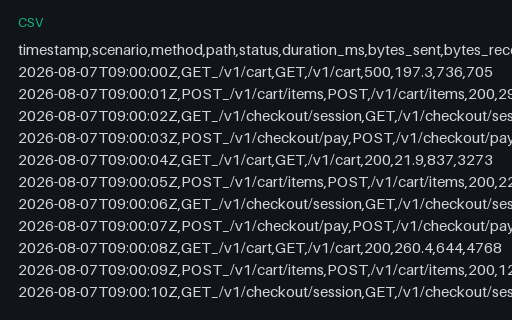
Three hundred individual request records with timestamp, scenario, status and duration — the raw log a percentile calculation has to be computed from rather than read off. A handful of 4xx and 5xx responses are mixed in so an error-rate calculation has something to find.

File
CSV · Performance · 300 rows
Use case
Performance testingCSV parsing+1· Conversion set
Preview of Load Test — Latency Percentiles by Scenario (CSV)
csv
308 B
Actual file preview for Load Test — Latency Percentiles by Scenario (CSV)

Load Test — Latency Percentiles by Scenario (CSV)

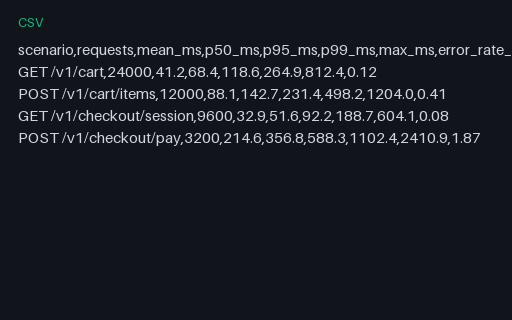
The percentile table a performance report renders as a chart, with mean, p50, p95, p99 and max for each of the four scenarios. The same numbers appear inside the JSON summary in this group, so a chart built from either source can be diffed against the other.

File
CSV · Performance · 4 rows
Use case
Performance testingCSV parsing+1· Conversion set
Preview of Performance Budget — Page and API Limits (JSON)
json
1.5 KB
Actual file preview for Performance Budget — Page and API Limits (JSON)

Performance Budget — Page and API Limits (JSON)

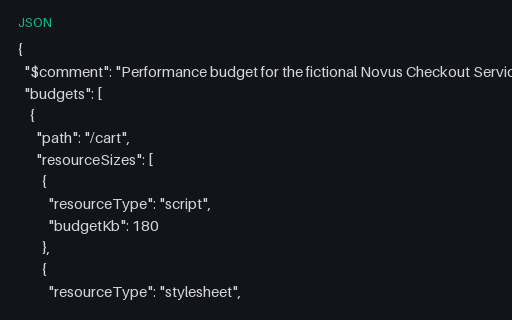
A budget file pairing per-path resource-size and timing limits with API latency budgets, including a glob path that must be matched rather than compared for equality. It is the configuration side of the load-test results in this group: the limits a run is judged against.

File
JSON · Performance
Use case
Performance testingConfig parsing+1· Conversion set
Preview of OTLP Trace — 48-Span Linear Chain (json)
json
38.1 KB
Actual file preview for OTLP Trace — 48-Span Linear Chain (json)

OTLP Trace — 48-Span Linear Chain (json)

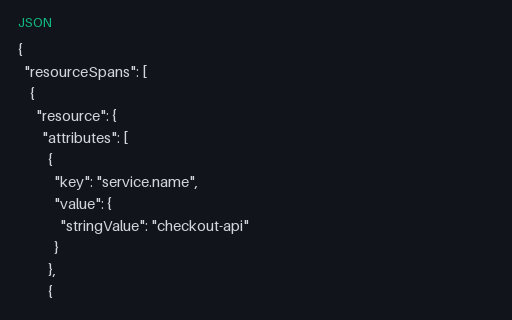
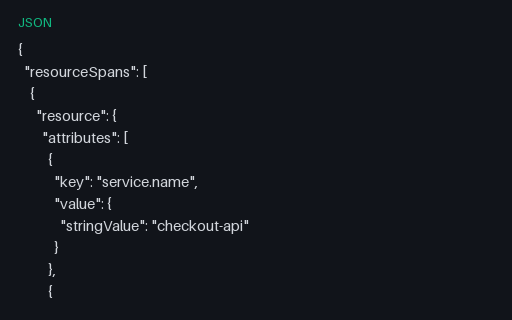
A single-service trace 48 levels deep — a recursive GraphQL-style resolver where every span is the child of the one before it. A depth fixture for waterfall renderers, tree-layout code and any parser that recurses over parentage.

File
JSON · Traces
Use case
ObservabilityJSON parsing+1· Conversion set
Preview of OTLP Trace — 60-Way Parallel Fan-Out (json)
json
51.1 KB
Actual file preview for OTLP Trace — 60-Way Parallel Fan-Out (json)

OTLP Trace — 60-Way Parallel Fan-Out (json)

One root span with 60 overlapping children — a scatter-gather query across database shards. The counterpart to the deep-chain fixture: shallow but very wide, which is what breaks waterfall layouts that assume spans do not overlap in time.

File
JSON · Traces
Use case
ObservabilityJSON parsing+1· Conversion set
Preview of Prometheus Exposition — 2,000-Series Cardinality Explosion (prom)
prom
299.8 KB
Actual file preview for Prometheus Exposition — 2,000-Series Cardinality Explosion (prom)

Prometheus Exposition — 2,000-Series Cardinality Explosion (prom)

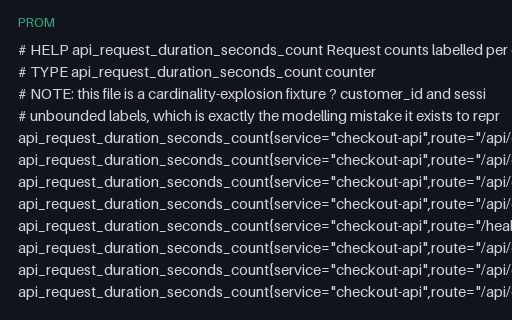
A single metric family blown up to 2,000 series by two unbounded labels — customer_id and session_id — which is the most common way a metrics bill and a TSDB both fall over. A load fixture for scrape parsing and a worked example for cardinality-limit rules.

File
PROM · Metrics
Preview of Structured Log — High-Cardinality Label Fields (jsonl)
jsonl
58 KB
Actual file preview for Structured Log — High-Cardinality Label Fields (jsonl)

Structured Log — High-Cardinality Label Fields (jsonl)

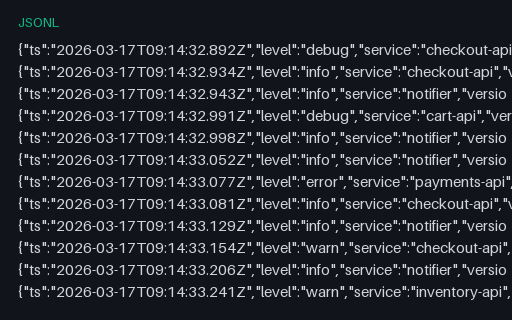
Every record carries five fields that are unique to it — session, customer, device, pod name and container ID. Harmless as log text, ruinous the moment they are promoted to indexed labels, which is the mistake this fixture exists to make measurable.

File
JSONL · Logs
Use case
ObservabilityLog parsing+1· Conversion set
Preview of Structured Log — One Oversized Record Between Normal Ones (jsonl)
jsonl
75.3 KB
Actual file preview for Structured Log — One Oversized Record Between Normal Ones (jsonl)

Structured Log — One Oversized Record Between Normal Ones (jsonl)

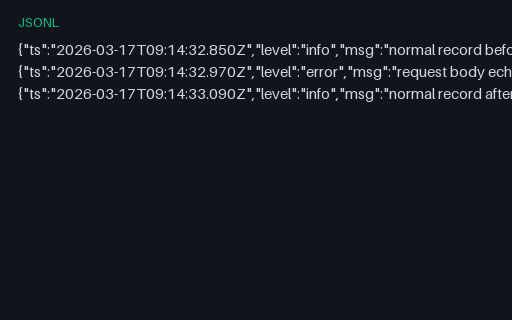
A single record of about 75 KB — a request body accidentally logged — sitting between two ordinary ones. Most shippers cap a line at 16 or 64 KB and either split it into invalid JSON fragments or drop the records around it; this file makes which one happen visible.

File
JSONL · Logs
Use case
ObservabilityLog parsing+1· Conversion set
Preview of CPU Profile — Folded Stacks, Baseline (txt)
txt
1.2 KB
Actual file preview for CPU Profile — Folded Stacks, Baseline (txt)

CPU Profile — Folded Stacks, Baseline (txt)

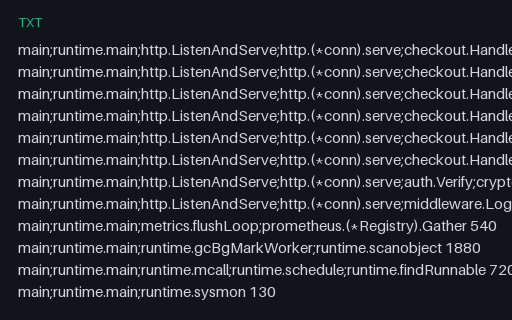
A CPU profile in the folded-stack format every flamegraph tool reads: one line per unique stack, frames separated by semicolons, then a space and a sample count. Twelve stacks up to seven frames deep, with the runtime's GC and scheduler work included as real profiles have.

File
TXT · Profiles
Use case
ObservabilityPerformance testing+1· Paired fixture
Preview of CPU Profile — Folded Stacks After a Regression (txt)
txt
1.3 KB
Actual file preview for CPU Profile — Folded Stacks After a Regression (txt)

CPU Profile — Folded Stacks After a Regression (txt)

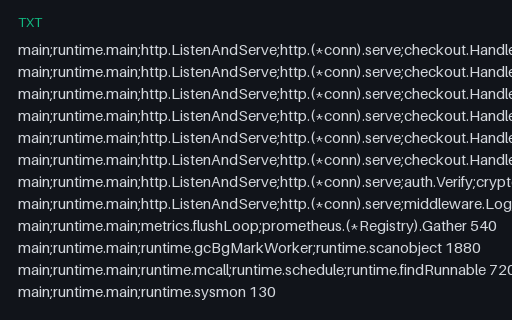
The same workload after a change: JSON decoding costs four times as much and gains a new reflect frame, while cache lookups get cheaper. Paired with the baseline so a differential flamegraph can be scored against a known regression and a known improvement.

File
TXT · Profiles
Use case
ObservabilityPerformance testing+1· Paired fixture
Preview of Allocation Profile — Folded Stacks Weighted in Bytes (txt)
txt
404 B
Actual file preview for Allocation Profile — Folded Stacks Weighted in Bytes (txt)

Allocation Profile — Folded Stacks Weighted in Bytes (txt)

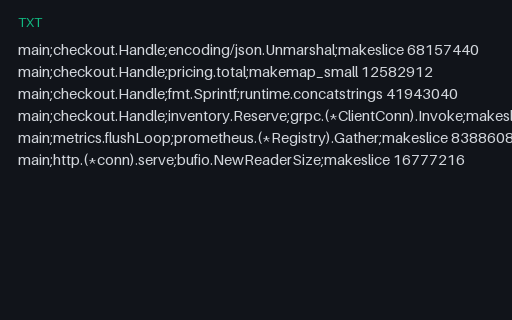
An allocation profile in the same folded syntax as the CPU profiles, but weighted in bytes rather than samples. The format carries no unit, so a viewer that assumes samples renders 65 MB of allocation as 68 million samples — which is what this fixture is for.

File
TXT · Profiles
Use case
ObservabilityPerformance testing+1· Conversion set
Preview of Wall-Clock Profile — Per-Thread Folded Stacks (txt)
txt
498 B
Actual file preview for Wall-Clock Profile — Per-Thread Folded Stacks (txt)

Wall-Clock Profile — Per-Thread Folded Stacks (txt)

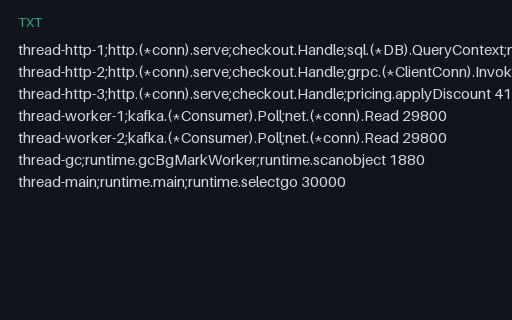
A 30-second wall-clock profile with the thread name as the root frame, so time blocked in reads is visible instead of invisible. Off-CPU time dominates — the shape that tells you a service is waiting, not computing, which a CPU profile alone cannot show.

File
TXT · Profiles
Use case
ObservabilityPerformance testing+1· Conversion set
Preview of Profile — 200-Frame Recursive Stack (txt)
txt
13.5 KB
Actual file preview for Profile — 200-Frame Recursive Stack (txt)

Profile — 200-Frame Recursive Stack (txt)

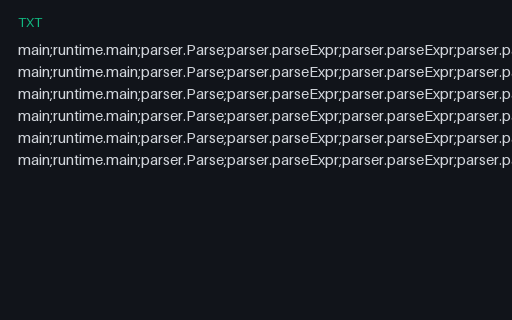
A recursive-descent parser profiled mid-recursion: stacks up to 204 frames deep where one frame repeats 200 times, on lines over 3,000 characters. Flamegraph renderers with a fixed depth limit truncate this silently, and line-length limits split it into nonsense.

File
TXT · Profiles
Use case
ObservabilityPerformance testing+1· Conversion set
Preview of Heap Profile — In-Use Bytes by Allocation Site (txt)
txt
244 B
Actual file preview for Heap Profile — In-Use Bytes by Allocation Site (txt)

Heap Profile — In-Use Bytes by Allocation Site (txt)

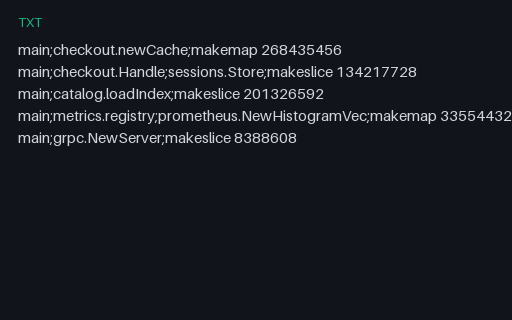
A heap profile measuring bytes still live at the sample point, not bytes ever allocated — which is why its shape differs from the allocation profile of the same process. 620 MB retained across five sites, with an unbounded session cache at the top.

File
TXT · Profiles
Use case
ObservabilityPerformance testing+1· Conversion set
Preview of Speedscope — Sampled Profile with a Shared Frame Table (json)
json
2.2 KB
Actual file preview for Speedscope — Sampled Profile with a Shared Frame Table (json)

Speedscope — Sampled Profile with a Shared Frame Table (json)

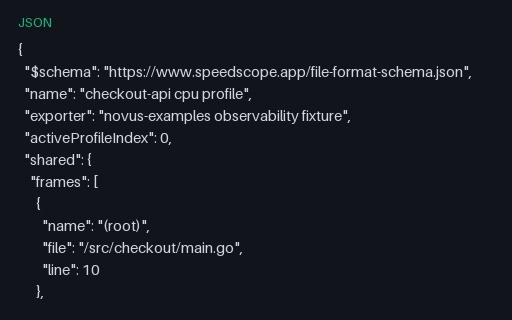
A speedscope sampled profile: one shared frame table with source locations, then stacks expressed as arrays of frame indices with per-sample weights in nanoseconds. The index indirection is the whole design, and resolving it wrong produces a plausible but wrong flamegraph.

File
JSON · Profiles · 9 frames
Use case
ObservabilityJSON parsing+1· Conversion set
Preview of Speedscope — Evented Profile with Open and Close Events (json)
json
1.8 KB
Actual file preview for Speedscope — Evented Profile with Open and Close Events (json)

Speedscope — Evented Profile with Open and Close Events (json)

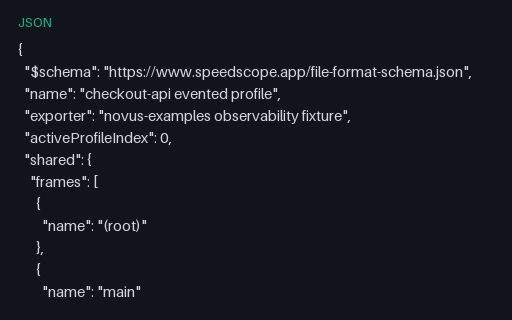
The evented half of the speedscope format — explicit O and C events that must nest like brackets, rather than sampled stacks. Tracing profilers emit this shape, and an unbalanced or out-of-order close is the corruption a loader has to detect.

File
JSON · Profiles
Use case
ObservabilityJSON parsing+1· Conversion set
Preview of Chrome DevTools CPU Profile — Node Tree with Sample Deltas (json)
json
2.8 KB
Actual file preview for Chrome DevTools CPU Profile — Node Tree with Sample Deltas (json)

Chrome DevTools CPU Profile — Node Tree with Sample Deltas (json)

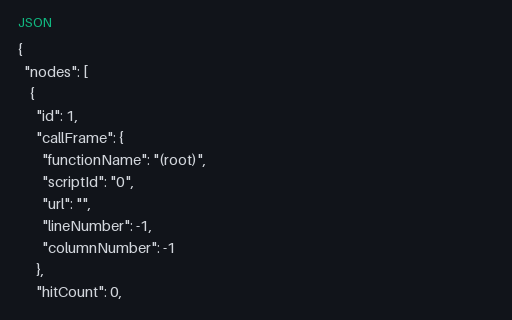
The .cpuprofile shape V8 emits: a node tree with call frames, a samples array of node IDs and a parallel timeDeltas array, plus the synthesized (idle), (program) and (garbage collector) nodes. Counting those synthetic frames as application time is the classic misreading.

File
JSON · Profiles
Use case
ObservabilityJSON parsing+1· Conversion set
Preview of pprof — Top Report Text Output (txt)
txt
2 KB
Actual file preview for pprof — Top Report Text Output (txt)

pprof — Top Report Text Output (txt)

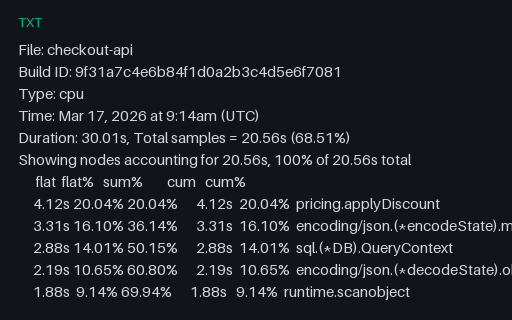
The text report pprof prints for the same profile as the folded fixtures: a metadata header, then flat and cumulative columns where frames that are never a leaf carry zero flat time and near-total cumulative time. Column-aligned output with a bare 0 rather than 0s, which is where naive column parsing fails.

File
TXT · Profiles · 28 rows
Use case
ObservabilityPerformance testing+1· Conversion set
Preview of pprof — Annotated Source Listing (txt)
txt
1.1 KB
Actual file preview for pprof — Annotated Source Listing (txt)

pprof — Annotated Source Listing (txt)

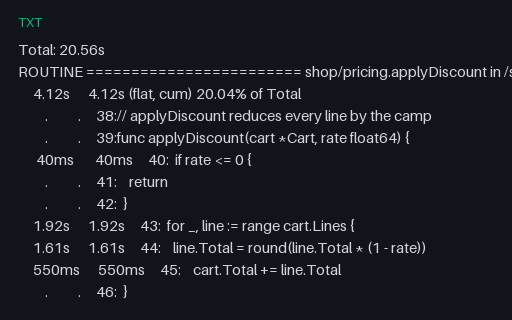
Line-level profile output: two routines with per-source-line flat and cumulative cost, a dot for lines that cost nothing, and units that switch between seconds and milliseconds within one column. Source lines keep their real tabs, which most column parsers do not survive.

File
TXT · Profiles
Use case
ObservabilityPerformance testing+1· Conversion set
Preview of Linux perf script — Sample Records with Call Chains (txt)
txt
2.6 KB
Actual file preview for Linux perf script — Sample Records with Call Chains (txt)

Linux perf script — Sample Records with Call Chains (txt)

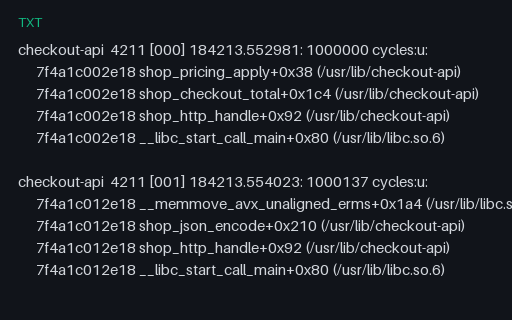
Raw perf script output — a header line per sample followed by tab-indented call-chain frames with addresses, symbols, offsets and DSO paths, samples separated by blank lines. The input side of stackcollapse, including unresolved frames a symbolizer could not name.

File
TXT · Profiles
Use case
ObservabilityPerformance testing+1· Conversion set
Preview of Shapefile — Towns Index (.shx)
shx
140 B
Actual file preview for Shapefile — Towns Index (.shx)

Shapefile — Towns Index (.shx)

The index that lets a reader seek directly to record N of the .shp instead of walking the file. Its header duplicates the .shp header exactly, and a mismatch between the two is the most common way a hand-edited shapefile goes wrong.

File
SHX · Shapefile · 5 records
Use case
GeospatialSerialization testing+1· Conversion set
Preview of Shapefile — Roads Index (.shx)
shx
124 B
Actual file preview for Shapefile — Roads Index (.shx)

Shapefile — Roads Index (.shx)

Unlike the point index, these entries have different lengths because each PolyLine holds a different number of vertices. That makes it the useful case for testing seek logic — a reader that assumes a fixed stride reads the first record correctly and then garbage.

File
SHX · Shapefile · 3 records
Use case
GeospatialSerialization testing+1· Conversion set
Preview of Shapefile — Parcels Index (.shx)
shx
124 B
Actual file preview for Shapefile — Parcels Index (.shx)

Shapefile — Parcels Index (.shx)

The parcel index, whose second entry is markedly longer than the others because that record carries two rings. Use it together with the roads index to check that seek logic handles multi-part records as well as multi-record files.

File
SHX · Shapefile · 3 records
Use case
GeospatialSerialization testing+1· Conversion set
Preview of MBTiles — Raster Tile Pyramid, Zoom 4 to 8
mbtiles
16 KB
Actual file preview for MBTiles — Raster Tile Pyramid, Zoom 4 to 8

MBTiles — Raster Tile Pyramid, Zoom 4 to 8

A small raster tile pyramid covering the invented territory, one flat colour per zoom level so a wrongly addressed tile is obvious on sight. The row axis follows the TMS convention, which is flipped relative to the XYZ scheme web maps use — the single most common reason an MBTiles layer renders upside down.

File
MBTILES · Geopackage
Use case
GeospatialData import+1· Conversion set