
TAR - Padded to a 10240-Byte Record
The same three members followed by the end-of-archive blocks and then zero padding out to a whole 10240-byte record - tar's historical blocking factor of 20, still the default. The archive is 10240 bytes for 616 bytes of content, which is what makes tiny tarballs look so wasteful before compression.
- README.txt
- app.log
- app.1.log
Specifications
- Seed
- 20260807
- Members
- 3
- Block Size
- 512
- Blocking Factor
- 20
- Record Bytes
- 10240
- File Bytes
- 10240
- Trailing Zero Bytes
- 6144
- Why
- tar's historical default writes whole tape records, not whole blocks
Testing contract
Expected to pass- Scenario
- Extract every member and compare the file size against the sum of the member sizes.
- Expected result
- All 3 members extract intact, the file is exactly 10240 bytes - a whole multiple of 10240 - and the padding after the end-of-archive blocks is all zeros.
What is a .tar file?
TAR (Tape Archive) is a Unix archive format that concatenates files with their metadata into a single uncompressed stream of fixed-size blocks. It preserves permissions, ownership, and directory structure but applies no compression itself. It is usually paired with a compressor such as gzip or xz.
How to use this file
Use an example TAR to test archive extraction, metadata and permission preservation, streaming block parsing, and pipelines that combine tar with external compression.
How to use this file for testing
“TAR - Padded to a 10240-Byte Record” is a deterministic Novus Examples fixture for Conversion testing, Performance testing. The same content exported across many formats and linked as a group, so you can convert one and diff against the expected twin.
Documented properties for this file: seed 20260807. Compare results against paired or grouped companions on this page when present (clean↔damaged, searchable↔scanned, or format twins) so scores stay reproducible across runs.
Download the file once, keep the path stable in CI or local scripts, and treat the spec table as the contract: dimensions, seeds, field lists, and roles are intentional. Corrupt or invalid samples are labelled as such — expect parsers to fail loudly rather than silently accept them.
Archive fixtures are documented down to their member list (shown on this page) and are deliberately safe — no zip bombs, executables, or hidden payloads. Test extractors against nested, unicode, empty, and encrypted variants.
Code examples
tar -tf record-padded.tar       # list
tar -xf record-padded.tar -C out/  # extract
Related files
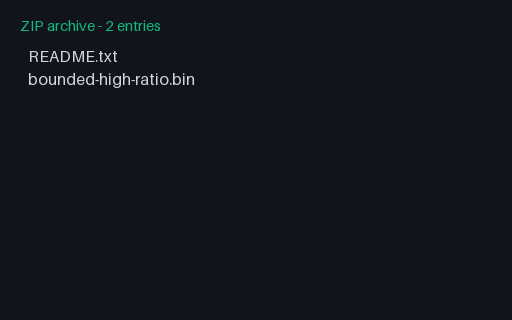
- zipZIP - Bounded High Compression RatioA deliberately bounded compression-ratio fixture: 4474 bytes on disk expanding to exactly 4 MiB of zeros, roughly 937:1. It is not a decompression bomb - there is no nesting and no recursion, and the expanded size is a fixed 4 MiB - so it exercises a ratio guard or a streaming extractor's memory ceiling without being dangerous to open.
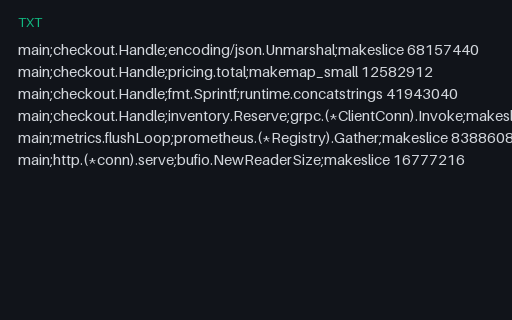
- txtAllocation Profile — Folded Stacks Weighted in Bytes (txt)An allocation profile in the same folded syntax as the CPU profiles, but weighted in bytes rather than samples. The format carries no unit, so a viewer that assumes samples renders 65 MB of allocation as 68 million samples — which is what this fixture is for.
- glbGLB — 64 Nodes Sharing One MeshAn 8x8 field of columns built from a single 12-triangle mesh referenced by 64 nodes with seeded random heights. Core-glTF instancing needs no extension: the file is tiny, and the interesting question is whether your renderer batches the 64 draws or issues them one by one.

- glbGLB — EXT_mesh_gpu_instancing (32 instances)Thirty-two copies of one cube expressed as instance attribute accessors on a single node under EXT_mesh_gpu_instancing — the extension that moves instancing off the scene graph and onto the GPU. A viewer without support shows exactly one cube at the origin, which is the tell.

- glbGLB — Float32 Vertex BaselineAn unquantised sphere: 32-bit floats for both positions and normals, 24 bytes of attribute data per vertex. The uncompressed reference for the quantized and gzip twins in this group.

- glbGLB — Interleaved Vertex Attributes (byteStride 32)Position, normal and UV packed into ONE bufferView with byteStride 32 and three accessors at offsets 0, 12 and 24 — the GPU-friendly layout, and the one a naive parser mis-reads because it assumes each accessor owns its view. Twinned here with a tightly-packed version of the same sphere.

Generated by generation/archives_p7.py. Free for any use, no attribution required — license.