
JPEG Quality 10 (512px)
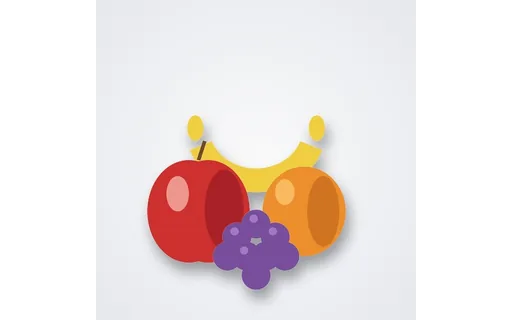
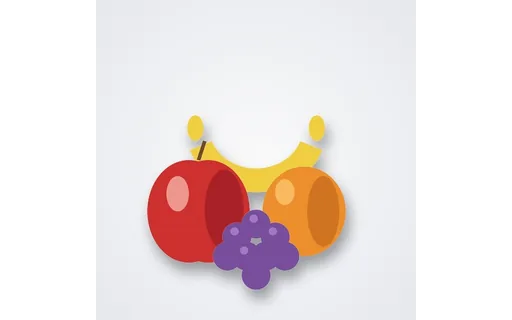
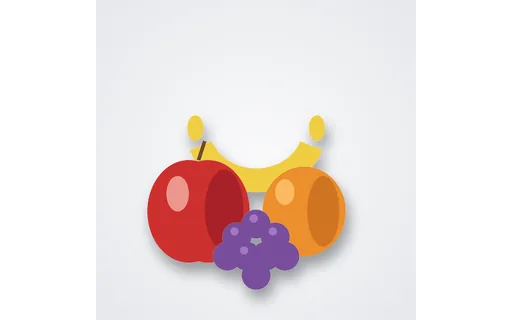
The same 512px source saved at JPEG quality 10 — part of a q10/50/90 ladder for comparing compression artefacts at a glance.
- File
- JPG · Edge Cases · 512 × 512 px
- Use case
- Compression testingConversion testing· Conversion set

The same source saved at quality 10/50/90 for comparing compression artefacts and quality settings.

The same 512px source saved at JPEG quality 10 — part of a q10/50/90 ladder for comparing compression artefacts at a glance.

The same 512px source saved at JPEG quality 50 — part of a q10/50/90 ladder for comparing compression artefacts at a glance.

The same 512px source saved at JPEG quality 90 — part of a q10/50/90 ladder for comparing compression artefacts at a glance.

The fruit still life as a baseline (sequential) JPEG — paired with a progressive JPEG of identical content for testing decode order and progressive-rendering support.

The same photo as a progressive JPEG (loads coarse-to-fine) — the twin of the baseline JPEG, for testing progressive decoding and byte-order handling.

256×256 bicubic downscale further JPEG-compressed at quality 35 — a harder super-resolution input with artefacts.

256×256 bicubic downscale further JPEG-compressed at quality 35 — a harder super-resolution input with artefacts.

Lossless PNG ground truth for JPEG blocking / ringing artefact repair tests.

Fruit still life saved at JPEG quality 5 — heavy blocking/ringing for artefact-removal and enhance tools.

Fruit still life saved at JPEG quality 10 — heavy blocking/ringing for artefact-removal and enhance tools.

Fruit still life saved at JPEG quality 15 — heavy blocking/ringing for artefact-removal and enhance tools.

Fruit still life saved at JPEG quality 25 — heavy blocking/ringing for artefact-removal and enhance tools.

Fruit still life saved at JPEG quality 40 — heavy blocking/ringing for artefact-removal and enhance tools.

A text file compressed with Zstandard (.zst) — the container-free codec on its own — for testing zstd decompression and codec detection.

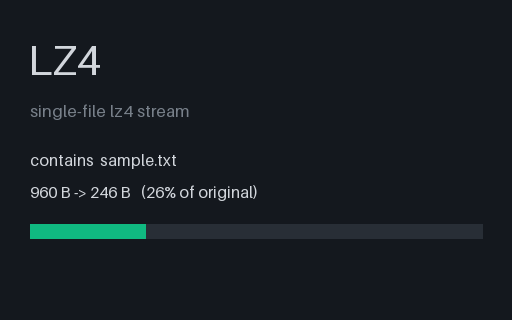
A text file compressed with the LZ4 frame format (.lz4) — the container-free codec on its own — for testing LZ4 decompression and codec detection.

A ZIP whose every member uses compression method 0 (stored). Its twin holds byte-identical content under the other method, so an extractor, a size estimator, or a repacking pipeline can be compared on the same payload with only the storage method changed.

A ZIP whose every member uses compression method 8 (deflate). Its twin holds byte-identical content under the other method, so an extractor, a size estimator, or a repacking pipeline can be compared on the same payload with only the storage method changed.

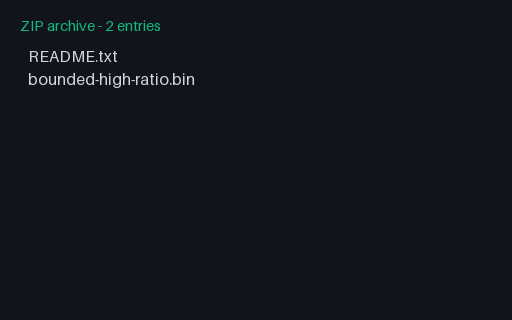
A deliberately bounded compression-ratio fixture: 4474 bytes on disk expanding to exactly 4 MiB of zeros, roughly 937:1. It is not a decompression bomb - there is no nesting and no recursion, and the expanded size is a fixed 4 MiB - so it exercises a ratio guard or a streaming extractor's memory ceiling without being dangerous to open.

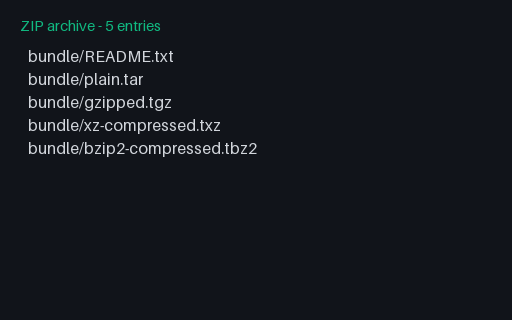
One ZIP holding the same two-member tar in four containers - plain, gzip, xz and bzip2 - so a recursive lister can be checked on four codecs in one pass. The already-compressed members are stored rather than deflated, which is what a competent writer does and what a naive one does not.

A tar carrying three ZIPs: two byte-identical and a third holding the same content stored rather than deflated. A deduplicating packer should notice the first two are the same object; a content-addressed one should notice all three extract to the same files.

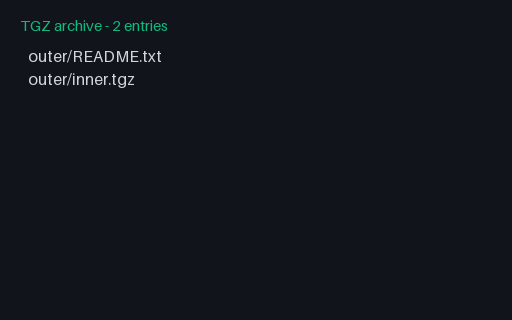
A gzipped tar whose second member is another gzipped tar. Tools that apply decompression greedily - gunzip until the bytes stop being gzip - skip straight past the outer tar and report the inner archive's two members as if they were the whole thing.

The empty tar under bzip2. Its payload is 1024 identical bytes, which is the run-length case bzip2's block sorter treats specially, so this doubles as the smallest sane bzip2 stream to test a decoder against.

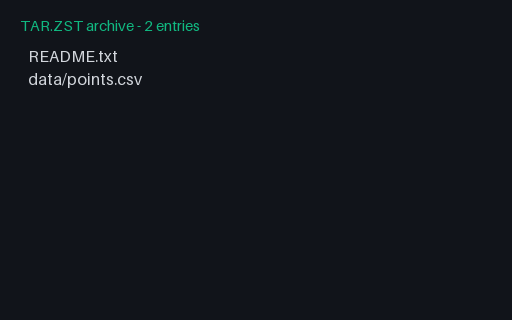
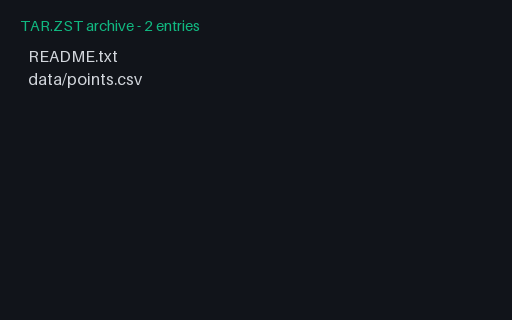
Valid Zstandard-compressed TAR source 01 with 2 safe members for compound-suffix detection and extraction Stable P8 artifact p8-convert-tar-zst-01.

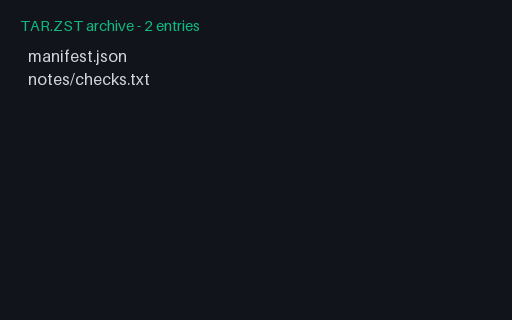
Valid Zstandard-compressed TAR source 02 with 2 safe members for compound-suffix detection and extraction Stable P8 artifact p8-convert-tar-zst-02.

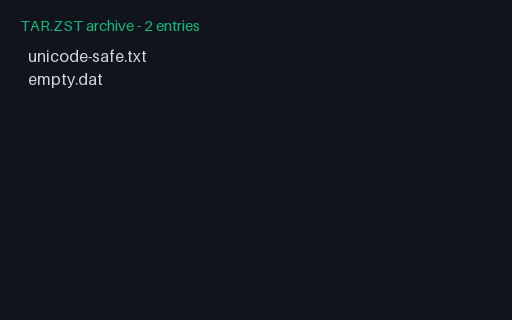
Valid Zstandard-compressed TAR source 03 with 2 safe members for compound-suffix detection and extraction Stable P8 artifact p8-convert-tar-zst-03.

Tiny intentionally corrupt TAR.ZST with preserved Zstandard magic and a deliberately damaged frame-header byte so strict decompressors reject it before extraction Stable P8 artifact p8-convert-tar-zst-intentionally-corrupt.

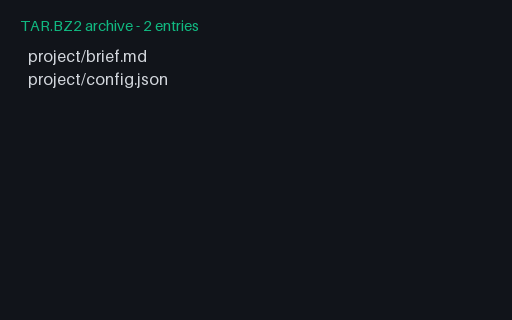
Canonical compound-suffix source for the same deterministic bzip2-compressed TAR member set Stable P8 artifact p8-convert-tar-bz2.

Alias-suffix twin for the same deterministic bzip2-compressed TAR member set Stable P8 artifact p8-convert-tbz2-alias.

Canonical compound-suffix source for the same deterministic XZ-compressed TAR member set Stable P8 artifact p8-convert-tar-xz.


Alias-suffix twin for the same deterministic XZ-compressed TAR member set Stable P8 artifact p8-convert-txz-alias.

Existing-format TGZ control carrying the same two canonical members used by the new compound archive formats Stable P8 artifact p8-convert-tgz-alias.

Existing-format ZIP extraction control for comparing member-path and hash behavior with the compressed-TAR cohort Stable P8 artifact p8-convert-zip-extraction-control.

Valid single-file Microsoft Cabinet using uncompressed CFDATA for bounded legacy extraction tests Stable P8 artifact p8-convert-legacy-cab.

Valid RAR4 archive with two stored members and fixed metadata for legacy extraction tests Stable P8 artifact p8-convert-legacy-rar.

Existing-format ZIP/TXT media control combining a plain README and a WebVTT sidecar for nested media extraction checks Stable P8 artifact p8-convert-legacy-archive-media-control.

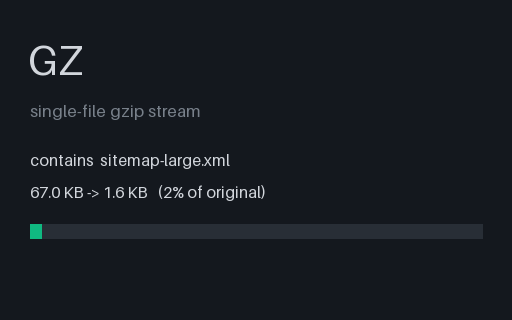
A 500-URL sitemap served the way large sites serve them - gzip-compressed as sitemap-large.xml.gz. The gzip header carries mtime 0 and no embedded filename, so the bytes are stable across regenerations. For testing that a crawler decompresses .xml.gz sitemaps before parsing.
We use Google Analytics and show ads via Adsterra. Non-essential cookies and ad scripts run only after you allow the matching categories. See our cookie policy.