md
140 BLegal Markdown: Dpa Definitions Sample
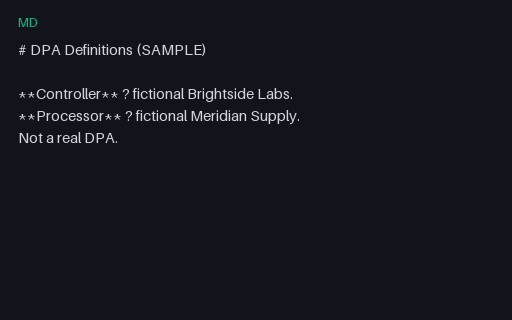
Fictional SAMPLE legal/policy markdown (dpa-definitions-sample), not legal advice.
- File
- MD · Legal
- Use case
- Editor testingConversion testing· Conversion set
Find files, editable templates and browser test targets by what you need to make or test. Explore complete business kits for connected records, templates and expected results.
Page 118 of 221; 24 results per page.
Fictional SAMPLE legal/policy markdown (dpa-definitions-sample), not legal advice.
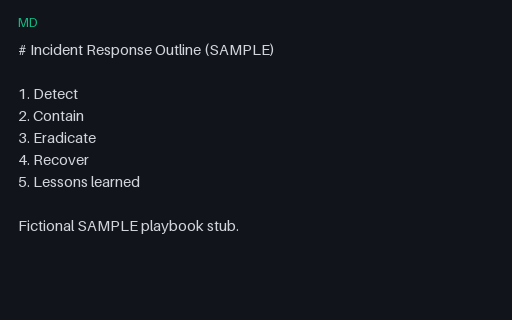
Fictional SAMPLE legal/policy markdown (incident-response-outline), not legal advice.

Fictional SAMPLE legal/policy markdown (retention-policy-sample), not legal advice.
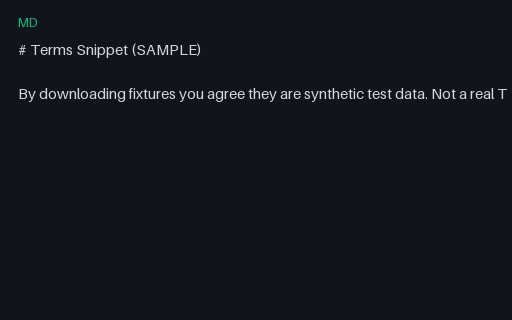
Fictional SAMPLE legal/policy markdown (terms-snippet-sample), not legal advice.
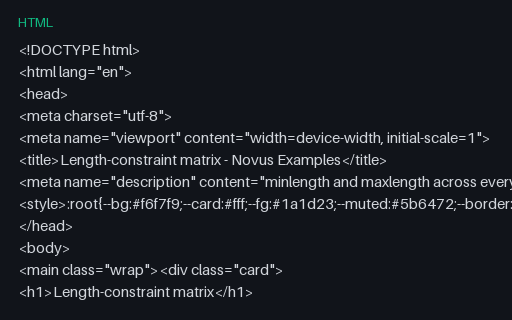
Textual controls carrying explicit minlength and maxlength bounds - including the exact-length and maximum-only cases, and a textarea whose counter hint and attribute must agree - for testing length validation and truncation behaviour.

A 50-minute science lesson plan with learning objectives, materials, a timed activity table, and an assessment: a realistic teaching template you can adapt to any topic.
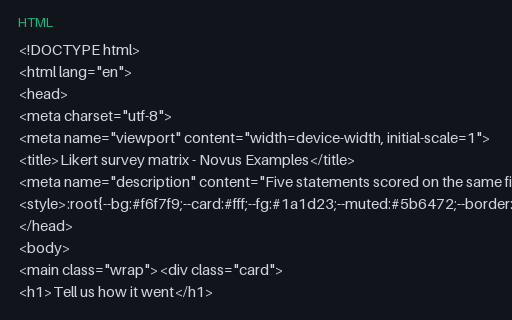
A five-by-five Likert matrix: five statements, each a radio group over the same five points. Twenty-five radio controls that resolve to five fields is the densest grouping case in the catalog.
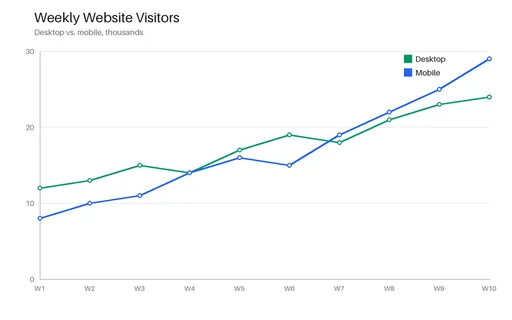
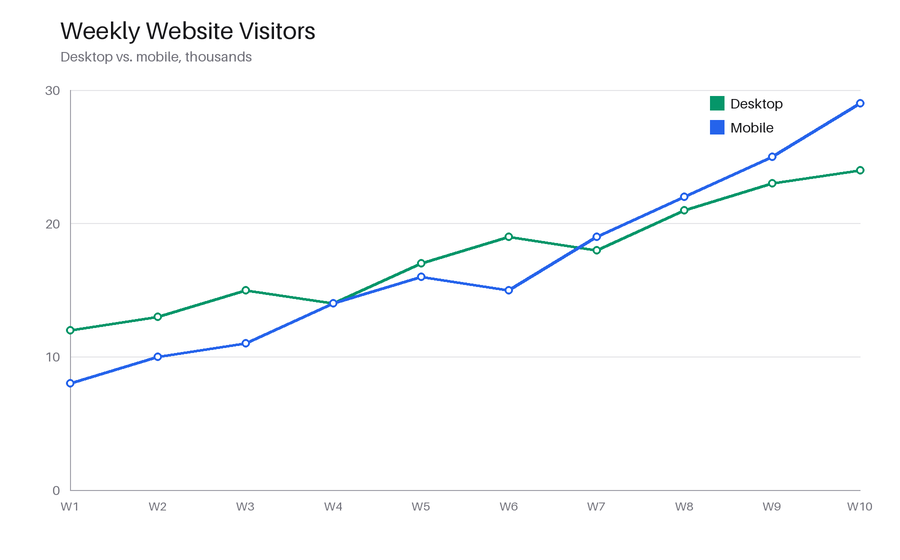
A two-series line chart (desktop vs. mobile visitors) with markers, a legend, and gridlines, for testing chart parsing, trend extraction, and image pipelines against a known plot.

64×64 linear 16-bit checkerboard TIFF for bit-depth and downsample tests.

64×64 linear 16-bit greyscale TIFF with deflate: Wave H depth for high bit-depth loaders.

LZW twin of the Wave H linear 16-bit greyscale TIFF.

A linear 16-bit greyscale TIFF ramp (0–65535). Not a PQ HDR master, for testing high bit-depth TIFF loaders and 16→8 truncation.

A 16-bit TIFF biased into the upper code values (near clip), for highlight-rolloff and tone-map tests on linear data.

Linear 16-bit TIFF with a dark edge and near-clip field, tone-map edge case.
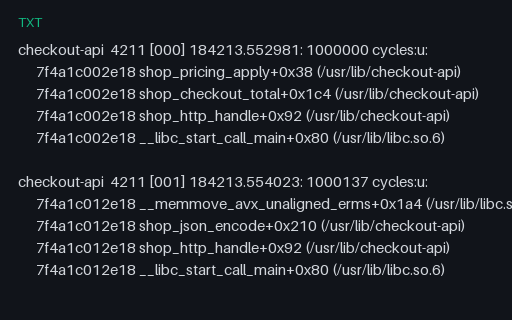
Raw perf script output: a header line per sample followed by tab-indented call-chain frames with addresses, symbols, offsets and DSO paths, samples separated by blank lines. The input side of stackcollapse, including unresolved frames a symbolizer could not name.
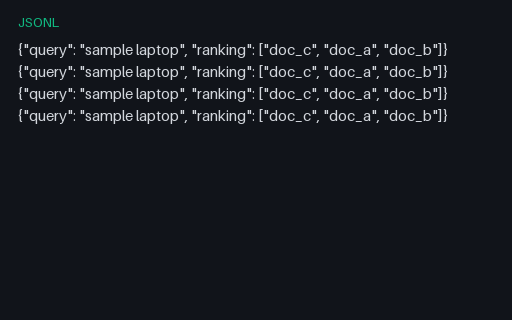
Listwise ranked doc lists for nDCG and listwise loss tests.
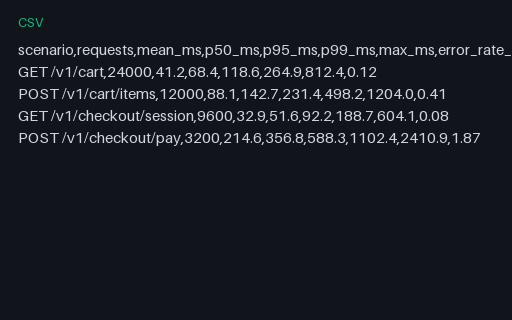
The percentile table a performance report renders as a chart, with mean, p50, p95, p99 and max for each of the four scenarios. The same numbers appear inside the JSON summary in this group, so a chart built from either source can be diffed against the other.
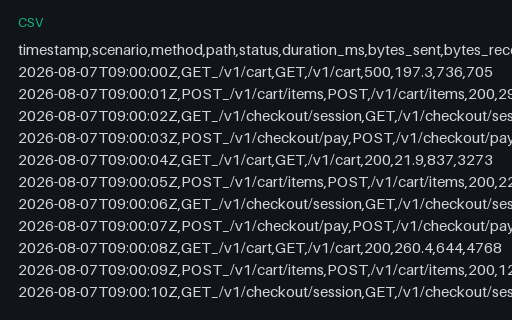
Three hundred individual request records with timestamp, scenario, status and duration: the raw log a percentile calculation has to be computed from rather than read off. A handful of 4xx and 5xx responses are mixed in so an error-rate calculation has something to find.
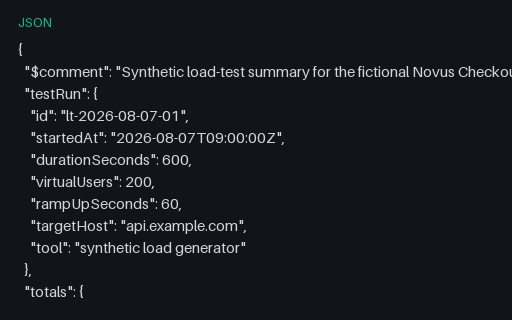
A load-test run summary in the shape a threshold-checking CI step consumes: totals, per-scenario percentiles, and three named thresholds each carrying its limit, the observed value and a pass flag. Publishing the limit next to the observation is what lets a gate be re-evaluated without rerunning the test.
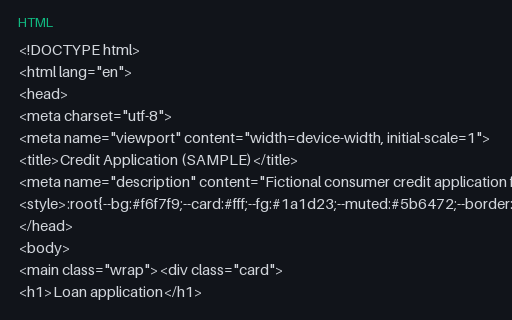
Income, employment, and amount fields for credit-application form testing. Entirely fictional SAMPLE data.
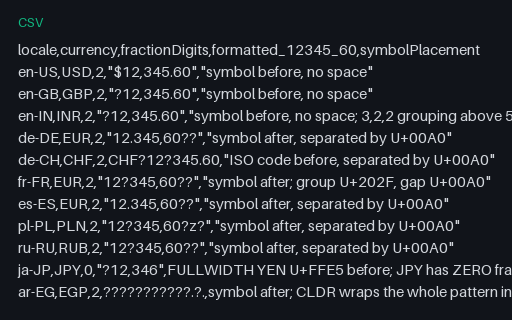
12345.60 in each locale's own currency, with the fraction-digit count and the symbol placement that produced it. JPY takes zero decimals and rounds; six rows separate the amount from the symbol with U+00A0 rather than a plain space; and ar-EG puts the amount in Arabic-Indic digits.
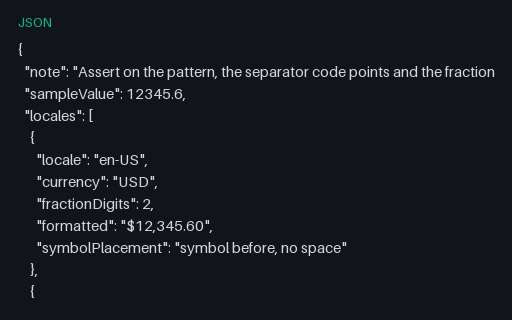
The structured currency table with the three traps spelled out: minor units belong to the CURRENCY not the locale (JPY 0, USD 2, KWD/BHD/JOD 3), the gap before a trailing symbol is U+00A0 in six of these locales, and CLDR's ar-EG pattern contains an invisible U+200F that breaks naive equality assertions.
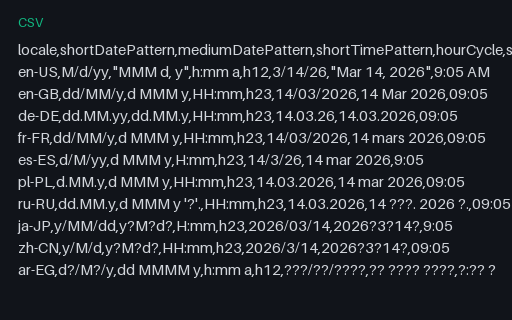
Short and medium date patterns, the short time pattern and the hour cycle for ten locales, each with the rendering of 2026-03-14T09:05. The ar-EG patterns contain U+200F between their fields and ru-RU's medium pattern ends in a quoted literal, so neither is the plain ASCII it appears to be.
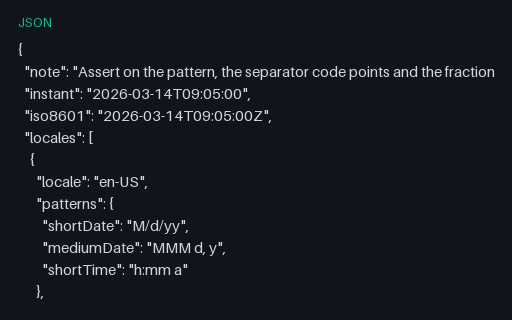
The structured date table plus the four traps worth their own test: day/month ambiguity in short dates, the RLM embedded in CLDR's Arabic pattern, quoted literal text inside the Russian pattern, and the localized day-period marker that a 12-hour formatter must not drop.
We use Google Analytics and show ads via Adsterra. Non-essential cookies and ad scripts run only after you allow the matching categories. See our cookie policy.