
Locale Date and Time Patterns — ten locales (CSV)
Short and medium date patterns, the short time pattern and the hour cycle for ten locales, each with the rendering of 2026-03-14T09:05. The ar-EG patterns contain U+200F between their fields and ru-RU's medium pattern ends in a quoted literal, so neither is the plain ASCII it appears to be.
locale,shortDatePattern,mediumDatePattern,shortTimePattern,hourCycle,shortDateExample,mediumDateExample,shortTimeExample
en-US,M/d/yy,"MMM d, y",h:mm a,h12,3/14/26,"Mar 14, 2026",9:05 AM
en-GB,dd/MM/y,d MMM y,HH:mm,h23,14/03/2026,14 Mar 2026,09:05
de-DE,dd.MM.yy,dd.MM.y,HH:mm,h23,14.03.26,14.03.2026,09:05
fr-FR,dd/MM/y,d MMM y,HH:mm,h23,14/03/2026,14 mars 2026,09:05
es-ES,d/M/yy,d MMM y,H:mm,h23,14/3/26,14 mar 2026,9:05
pl-PL,d.MM.y,d MMM y,HH:mm,h23,14.03.2026,14 mar 2026,09:05
ru-RU,dd.MM.y,d MMM y 'г'.,HH:mm,h23,14.03.2026,14 мар. 2026 г.,09:05
ja-JP,y/MM/dd,y年M月d日,H:mm,h23,2026/03/14,2026年3月14日,9:05
zh-CN,y/M/d,y年M月d日,HH:mm,h23,2026/3/14,2026年3月14日,09:05
ar-EG,d/M/y,dd MMMM y,h:mm a,h12,١٤/٣/٢٠٢٦,١٤ مارس ٢٠٢٦,٩:٠٥ ص
Specifications
- Rows
- 10
- Columns
- 8
- Instant
- 2026-03-14T09:05:00
- Hour Cycles
- h12, h23
- Assert On
- patterns and hour cycle; examples are illustrative
- Delimiter
- ,
- Header
- true
- Seed
- 20260807
- Wave
- p7
- Line Endings
- LF
Testing contract
Reference control- Scenario
- Format the given instant with each locale's pattern and compare the field order and separators.
- Expected result
- 14/03/2026 under en-GB and 3/14/26 under en-US resolve the same instant to opposite field orders; the ar-EG pattern string is longer than its visible characters because of the embedded RLM.
What is a .csv file?
CSV (Comma-Separated Values) is a plain-text tabular format where rows are lines and fields are separated by commas, with quoting rules for values that contain delimiters, quotes, or newlines. It has no formal type system and depends on encoding and dialect conventions. It is the most portable format for tabular data exchange.
How to use this file
Use an example CSV to test parsers against quoting and embedded-delimiter edge cases, header handling, encoding detection, and import pipelines into databases or spreadsheets.
How to use this file for testing
“Locale Date and Time Patterns — ten locales (CSV)” is a deterministic Novus Examples fixture for Internationalization, CSV parsing, Localization catalogs. Parallel text and accented, multi-script content — for testing translation pipelines, Unicode handling, and localization tooling.
Documented properties for this file: seed 20260807 · 10 rows · 8 columns · LF. Compare results against paired or grouped companions on this page when present (clean↔damaged, searchable↔scanned, or format twins) so scores stay reproducible across runs.
Download the file once, keep the path stable in CI or local scripts, and treat the spec table as the contract: dimensions, seeds, field lists, and roles are intentional. Corrupt or invalid samples are labelled as such — expect parsers to fail loudly rather than silently accept them.
Translation-catalog fixtures carry the same message set across formats, each with its native placeholder syntax. Test your i18n loader, catalog converter, or translation-memory tool, and use the RTL and CJK variants to check bidirectional text and Unicode handling.
Load the catalog with your i18n framework and verify placeholder interpolation and plural handling; the RTL and CJK variants exercise bidirectional text and font fallback.
Code examples
import pandas as pd

df = pd.read_csv("date-time-formats.csv")
print(df.head())
print(df.dtypes)
Related files
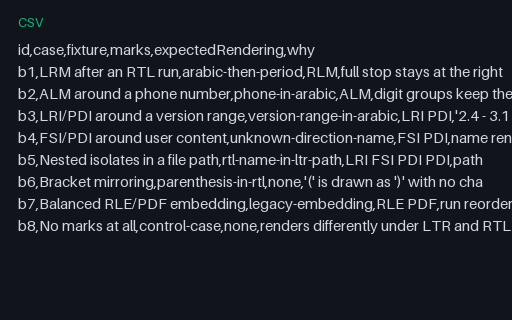
- csvBidi Test-Case Matrix — eight rendering casesA flat index of the bidi cases in this wave — which mark each one uses, what it should render as, and why the neutral characters involved need help. Row b8 is the control case with no marks, against which the other seven are compared.
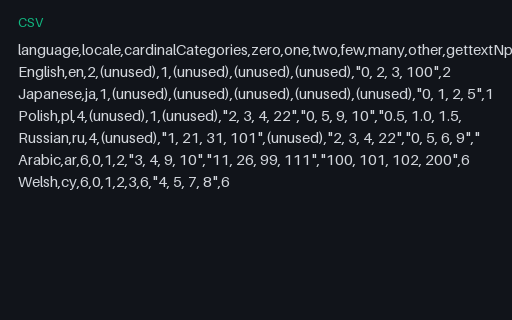
- csvCLDR Plural-Category Matrix — six languagesOne row per language, one column per CLDR plural category, filled with the smallest integers that select it — the sheet to hand a translator or a PM when explaining why 'one' and 'other' is not enough. Japanese needs one form and Welsh needs six.
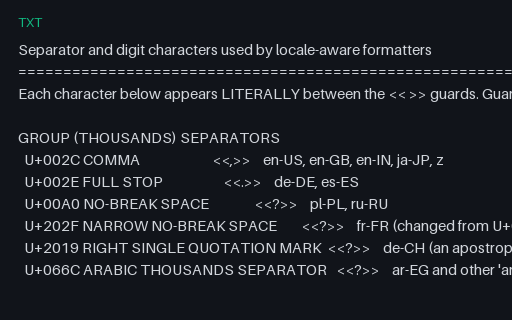
- txtLocale Separator and Digit Characters — literal specimensEvery separator, sign and digit set a locale-aware formatter has to survive, each present literally between ASCII guards: the no-break and narrow-no-break spaces, de-CH's U+2019 group separator, the Arabic decimal and thousands separators, the four numbering systems' digits, and CLDR's U+2212 MINUS SIGN, which is not the ASCII hyphen.
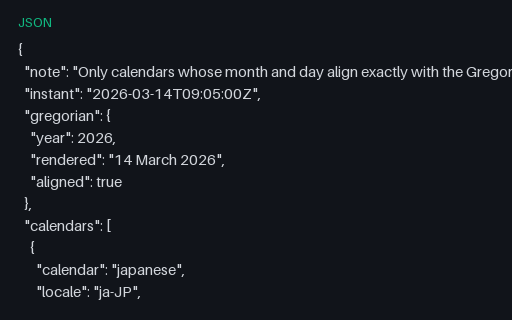
- jsonNon-Gregorian Calendar Eras — Japanese, ROC, Buddhist, Hijri, HebrewEra and era-year for one instant across five calendar systems. The three whose months and days align with the Gregorian calendar — Japanese (Reiwa 8), ROC (Minguo 115) and Thai Buddhist (2569) — carry a full rendered date; the Hijri and Hebrew entries carry the year only, because their day and month depend on the calculation variant and, for Hijri, on observation. Saying so is the point of the fixture.
- resx.NET RESX — composite format strings (Arabic (Egypt))A Arabic (Egypt) resource file built around composite format strings — {0:N2}, {2:P1}, {0:C}, {0:d} and {0:t} — whose rendered output depends entirely on CultureInfo. Includes a whitespace-significant resource guarded by xml:space, and documents the suffixed-key convention .NET falls back on because String.Format has no plural selector.
- resx.NET RESX — composite format strings (English (United States))A English (United States) resource file built around composite format strings — {0:N2}, {2:P1}, {0:C}, {0:d} and {0:t} — whose rendered output depends entirely on CultureInfo. Includes a whitespace-significant resource guarded by xml:space, and documents the suffixed-key convention .NET falls back on because String.Format has no plural selector.
Generated by generation/localization_p7.py. Free for any use, no attribution required — license.