Calendar Scheduling Lifecycle - REQUEST (ICS)
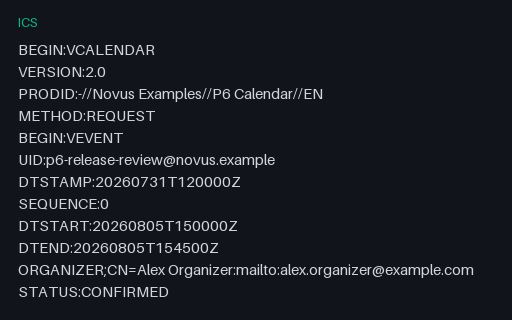
The invitation that starts a scheduling lifecycle, using stable UID and organizer/attendee identities.
- File
- ICS · Calendar Contacts · UTF-8
- Use case
- Calendar parsingConversion testing· Conversion set
Find files, editable templates and browser test targets by what you need to make or test. Explore complete business kits for connected records, templates and expected results.
Page 26 of 221; 24 results per page.

The invitation that starts a scheduling lifecycle, using stable UID and organizer/attendee identities.

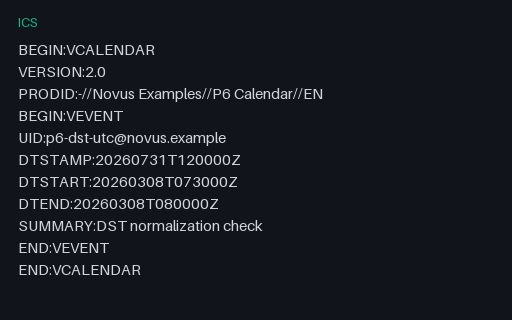
The UTC representation of the Toronto event, providing an exact normalization target for calendar importers.

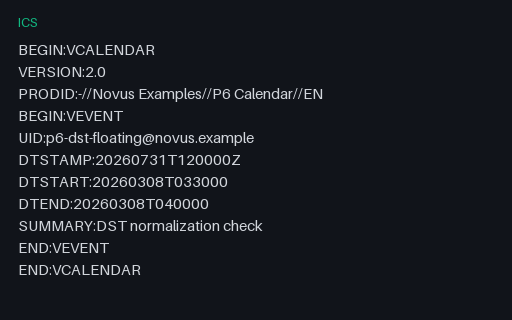
A floating-time variant with no TZID or Z suffix, for verifying that parsers do not silently reinterpret local wall time as UTC.

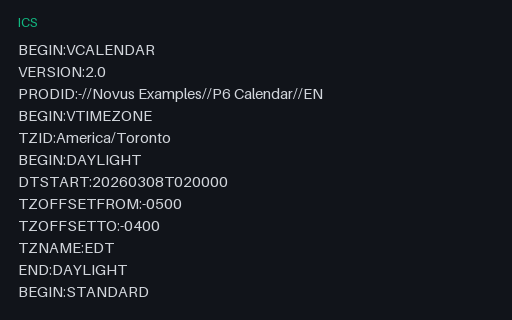
A TZID-qualified event immediately after Toronto's spring-forward boundary, with an explicit VTIMEZONE definition.

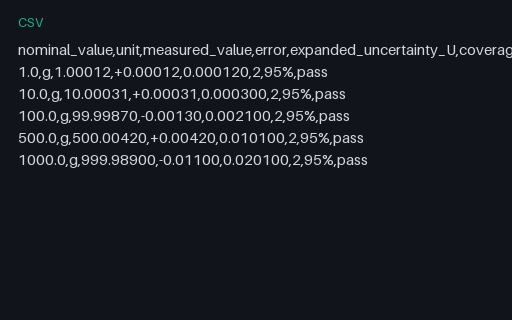
Five calibration points with the nominal value, the measured value, the signed error and the expanded uncertainty at k=2 with its confidence level stated. It is a synthetic illustration of the layout, not an accredited certificate, and nothing in it refers to a real instrument or laboratory.

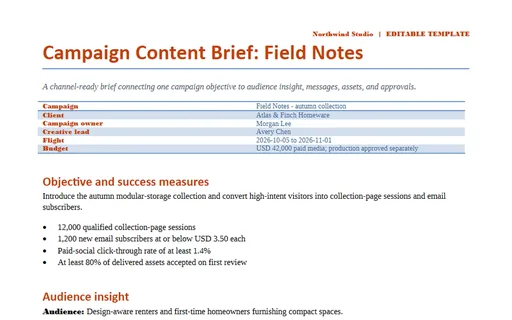
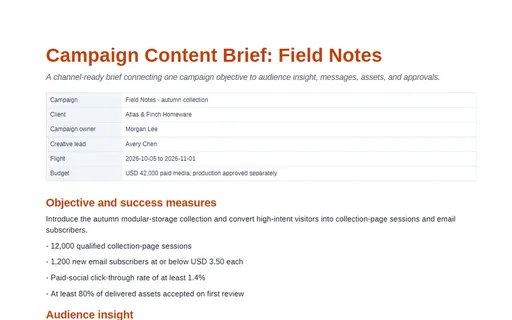
A channel-ready brief connecting one campaign objective to audience insight, messages, assets, and approvals. This editable Word edition carries the complete shared family model with styled sections and print-safe tables.

A channel-ready brief connecting one campaign objective to audience insight, messages, assets, and approvals. This UTF-8 Markdown twin preserves the same headings, lists, checkboxes, and GFM tables in portable plain text.

A channel-ready brief connecting one campaign objective to audience insight, messages, assets, and approvals. This print-ready PDF twin is designed for page-rendering, extraction, and cross-format comparison tests.

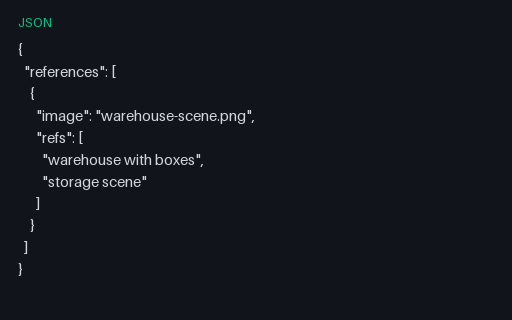
Manifest linking Wave F scene PNGs to per-language caption JSONL files.

Multiple reference captions per image for BLEU/CIDEr caption eval.

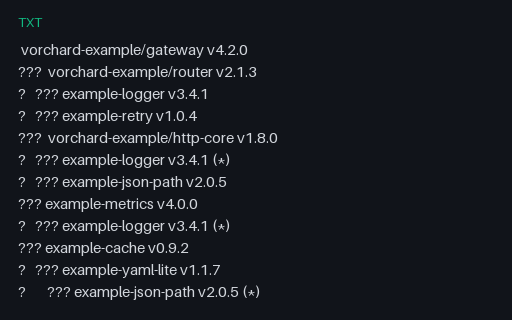
Cargo's tree output, which writes versions with a leading `v` and marks already-shown subtrees with `(*)`: close enough to npm's tree to fool a parser, different enough to break one. Every package, version, hash and licence is fictional: the tree describes nothing real.

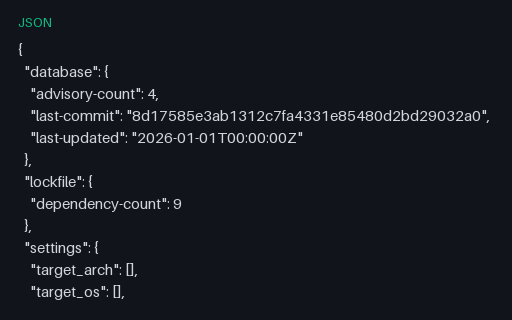
A cargo-audit report that shows three findings while a fourth is on the ignore list, plus an unmaintained-crate warning, so a gate must decide whether warnings count against it. Advisory identifiers use the invented NOVUS-SAMPLE namespace with SAMPLE-CVE aliases; no identifier here refers to a published CVE, GHSA or OSV record, and no package named exists.

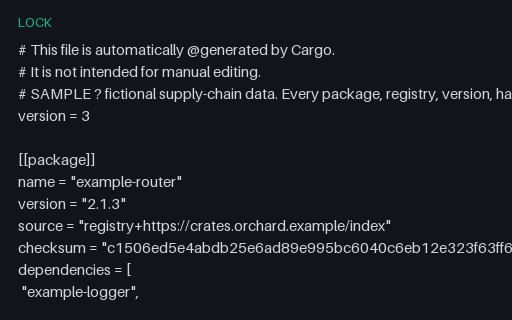
The same fictional Rust tree pinned by a version 3 Cargo.lock, for testing that a reader keys on the declared version rather than assuming the newest format. Every package, version, hash and licence is fictional: the tree describes nothing real.

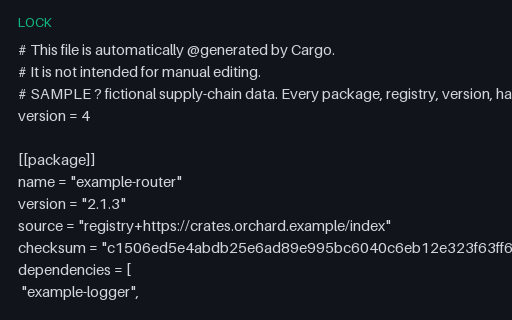
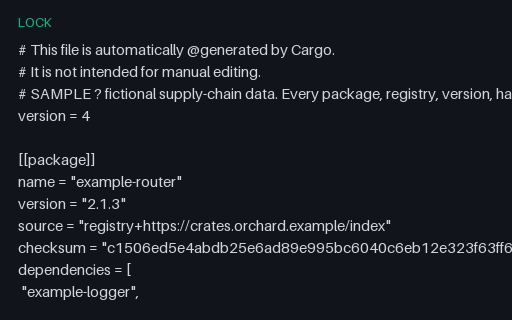
A Rust Cargo.lock in the version 4 format: TOML [[package]] tables with a registry source, a sha256-shaped checksum and a name-only dependencies array that resolves against the other tables. Every package, version, hash and licence is fictional: the tree describes nothing real.

An intentionally corrupt Cargo.lock: a valid version 4 lockfile cut off inside a [[package]] table so the final key/value pair is incomplete. Small on purpose. Every package, version, hash and licence is fictional: the tree describes nothing real.

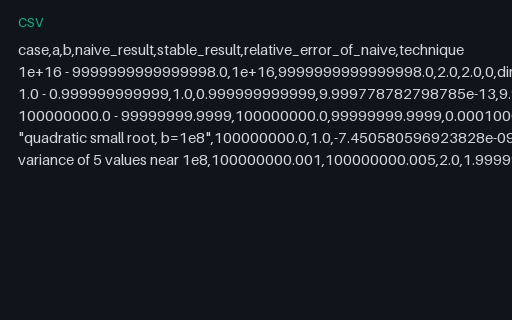
Five computations done twice, once with the obvious formula and once with the numerically stable one, with the relative error of the naive version alongside. The one-pass variance row is the memorable one: five values a millisecond apart near 1e8 can produce a negative variance.

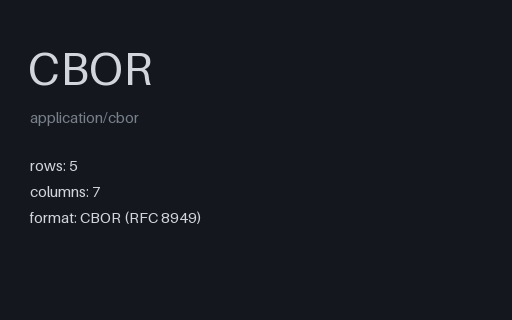
The records as CBOR: the IETF concise binary object representation used in IoT and COSE/WebAuthn. For testing CBOR decoders and JSON↔CBOR conversion.

A CBZ comic archive: a ZIP of sequentially named JPEG pages, the standard container for digital comics. Built from generated pages; for testing comic readers and CBZ→PDF conversion.

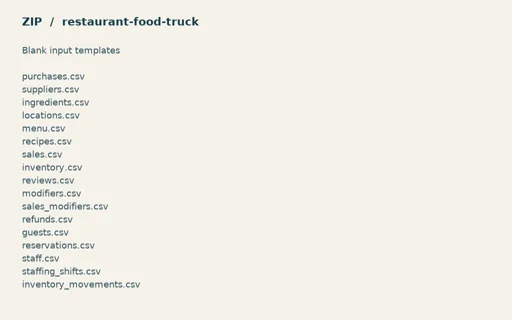
Blank input table templates for Cedar Street Tacos. 18 header-only CSV templates and one setup guide. No filled sample records or executable content.

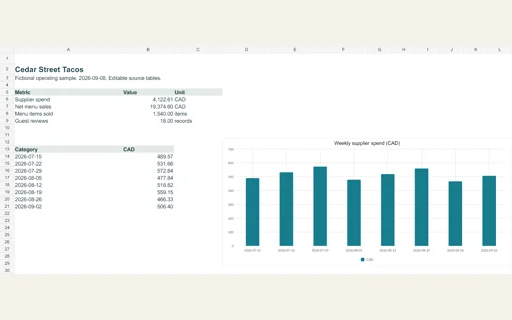
Editable operating workbook for Cedar Street Tacos. Native sheets preserve 375 source records, 4 calculated headline metrics and one editable chart. Supplier spend=4,122.61 CAD; Net menu sales=19,374.60 CAD; Menu items sold=1,540.00 items; Guest reviews=18.00 records. The first worksheet holds 96 compatible purchase rows.

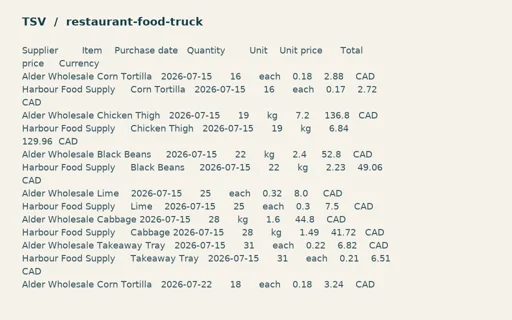
Equivalent purchase import TSV for Cedar Street Tacos. 96 data rows, 8 columns and 96 expected accepted rows.

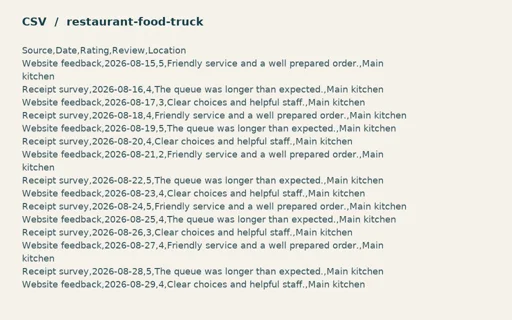
Guest review import CSV for Cedar Street Tacos. 18 data rows, 5 columns and 18 expected accepted rows.

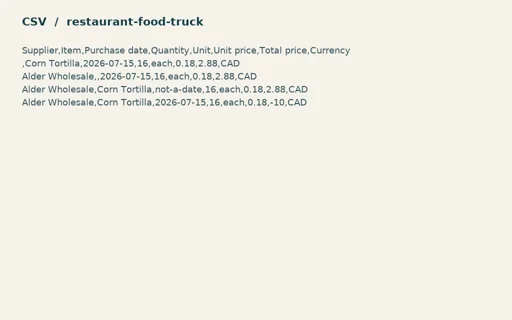
Intentionally invalid purchase import for Cedar Street Tacos. 4 data rows, 8 columns and 0 expected accepted rows.

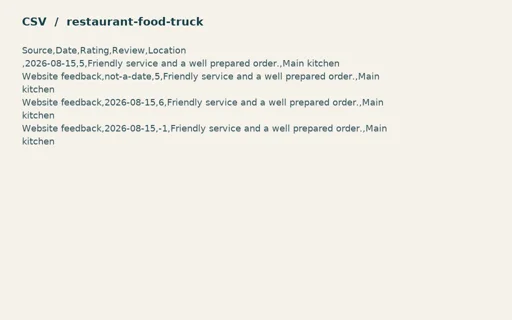
Intentionally invalid review import for Cedar Street Tacos. 4 data rows, 5 columns and 0 expected accepted rows.
We use Google Analytics and show ads via Adsterra. Non-essential cookies and ad scripts run only after you allow the matching categories. See our cookie policy.