
cargo tree Output
Cargo's tree output, which writes versions with a leading `v` and marks already-shown subtrees with `(*)` — close enough to npm's tree to fool a parser, different enough to break one. Every package, version, hash and licence is fictional — the tree describes nothing real.
 vorchard-example/gateway v4.2.0
├──  vorchard-example/router v2.1.3
│   ├── example-logger v3.4.1
│   └── example-retry v1.0.4
├──  vorchard-example/http-core v1.8.0
│   ├── example-logger v3.4.1 (*)
│   └── example-json-path v2.0.5
├── example-metrics v4.0.0
│   └── example-logger v3.4.1 (*)
├── example-cache v0.9.2
│   └── example-yaml-lite v1.1.7
│       └── example-json-path v2.0.5 (*)
└── example-crypto-shim v1.2.0
Specifications
- Seed
- 51200
- Sample Only
- true
- Tool
- cargo tree (shape)
- Version Prefix
- v
- Omitted Marker
- (*)
- Drawing
- box-drawing characters
- Line Endings
- LF
Testing contract
Reference control- Scenario
- Reuse one tree parser across cargo tree and npm ls output.
- Expected result
- Parser handles the `name v1.2.3` form here and the `name@1.2.3` form in the npm fixture, producing the same edge set from both.
What is a .txt file?
TXT is a plain-text file containing unformatted character data with no styling or structure beyond line breaks. Its interpretation depends on character encoding, most commonly UTF-8, and on line-ending convention. It is the most universal and portable text container.
How to use this file
Use an example TXT to test encoding detection, line-ending (LF versus CRLF) handling, and any tool that reads or streams raw text input.
How to use this file for testing
“cargo tree Output” is a deterministic Novus Examples fixture for Log parsing, Graph data, Conversion testing. Access logs and JSON-lines application logs — for testing log parsers, tailers, and ingestion pipelines.
Documented properties for this file: seed 51200 · LF. Compare results against paired or grouped companions on this page when present (clean↔damaged, searchable↔scanned, or format twins) so scores stay reproducible across runs.
Download the file once, keep the path stable in CI or local scripts, and treat the spec table as the contract: dimensions, seeds, field lists, and roles are intentional. Corrupt or invalid samples are labelled as such — expect parsers to fail loudly rather than silently accept them.
SBOM, lockfile, provenance, and advisory fixtures describe the same fabricated component tree across formats, so a converter or scanner can be diffed against a known answer. Every package name, version, hash, and advisory ID is invented — never treat a finding here as real.
Related files
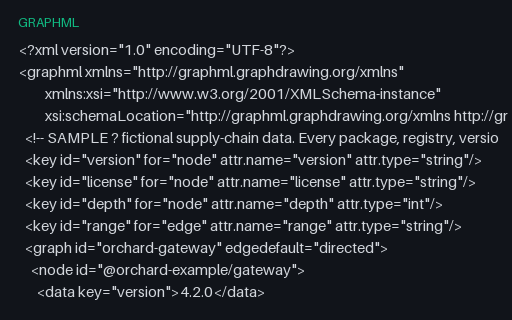
- graphmlDependency Graph (GraphML)The dependency graph in GraphML, with typed attribute keys for node version, licence and depth and for edge range — the interchange format graph databases and analysis tools import. Every package, version, hash and licence is fictional — the tree describes nothing real.
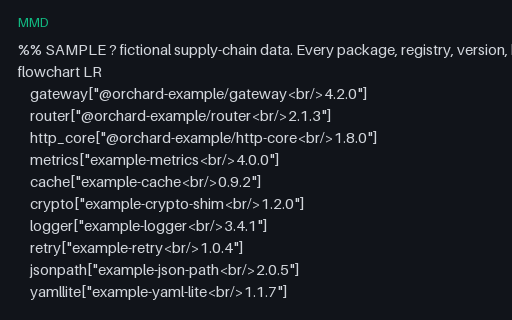
- mmdDependency Graph (Mermaid Flowchart)The dependency graph as Mermaid, for embedding in Markdown documentation — labelled edges carry the declared range and a classDef highlights the two diamond joins. Every package, version, hash and licence is fictional — the tree describes nothing real.
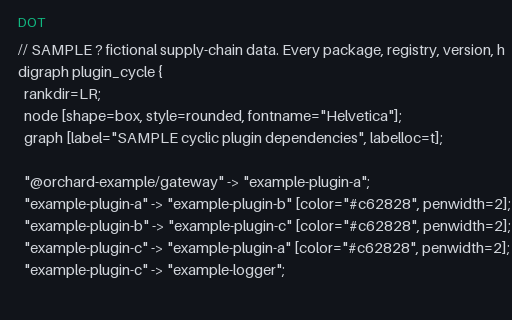
- dotDependency Graph With a Cycle (Graphviz DOT)The cyclic plugin graph as DOT, with the three cycle edges highlighted. Graphviz renders it happily, which is exactly why a topological sort must be the thing that rejects it. Every package, version, hash and licence is fictional — the tree describes nothing real.
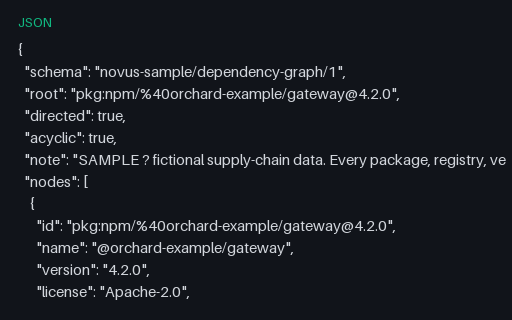
- jsonDependency Graph With Diamond Dependencies (JSON)An explicit node/edge dependency graph with in-degree, out-degree and depth precomputed, plus a diamonds array naming the two shared nodes and their parents — the reference answer for any graph builder run against the SBOMs and lockfiles here. Every package, version, hash and licence is fictional — the tree describes nothing real.
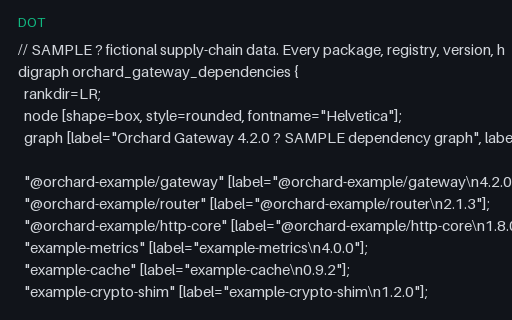
- dotDependency Graph With Diamonds (Graphviz DOT)The same diamond graph as Graphviz DOT, with edge labels carrying the declared semver range and the two diamond joins filled — renderable to SVG and diffable against the JSON twin. Every package, version, hash and licence is fictional — the tree describes nothing real.
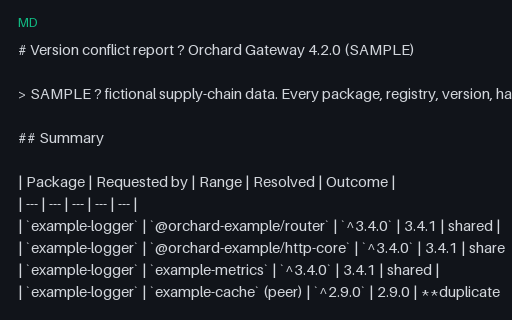
- mdVersion Conflict and Diamond Report (Markdown)The written explanation of both diamonds in this category — the one that resolves to a single shared node and the peer conflict that forces a nested duplicate — with the four assertions a resolver test should make. Every package, version, hash and licence is fictional — the tree describes nothing real.
Generated by generation/supply_chain.py. Free for any use, no attribution required — license.