Skip to content
Novus Examples

Explore the test library

Find files, editable templates and browser test targets by what you need to make or test. Explore complete business kits for connected records, templates and expected results.

5297 results

Page 185 of 221; 24 results per page.

Show the canonical directory
Preview of TAR - GNU Long Name Record
tar
10 KB
Actual file preview for TAR - GNU Long Name Record

TAR - GNU Long Name Record

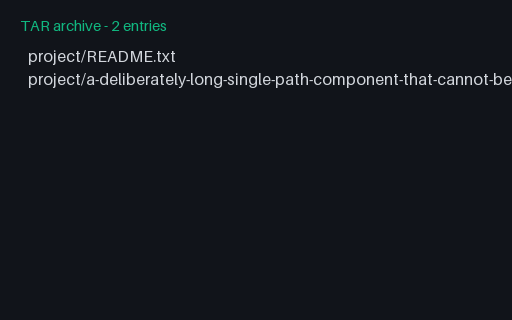
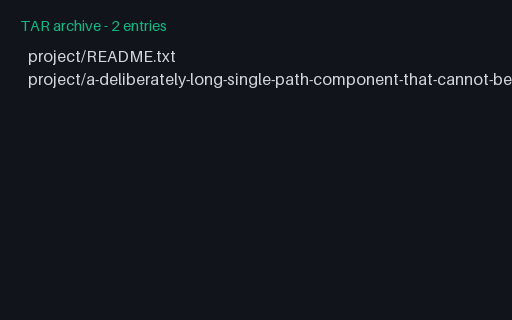
A 125-character path whose long component contains no slash at all, so the USTAR prefix field cannot store it. This archive uses a preceding 'L' (GNUTYPE_LONGNAME) record whose payload is the full path. Its group siblings encode the same class of path with the other two mechanisms.

File
TAR · Tar Format · 2 members
Use case
Conversion testingError handling· Conversion set
Preview of TAR - Hard Link Member
tar
10 KB
Actual file preview for TAR - Hard Link Member

TAR - Hard Link Member

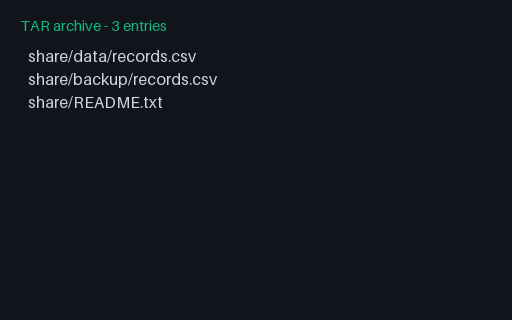
share/backup/records.csv is a hard link to a member that appears earlier in the stream, so its content is stored exactly once. Order matters: a reader that extracts members out of sequence, or that copies content instead of linking, changes both the on-disk byte count and the inode relationship the archive is describing.

File
TAR · Tar Records · 3 members
Use case
Conversion testingMetadata testing· Conversion set
Preview of TAR - Large UID/GID (GNU base-256)
tar
10 KB
Actual file preview for TAR - Large UID/GID (GNU base-256)

TAR - Large UID/GID (GNU base-256)

The uid and gid fields hold 7 octal digits, so they top out at 2097151. This member is owned by uid 3000000, which needs GNU base-256 encoding: the field's high bit is set and the remaining bytes are a big-endian integer. Its group sibling encodes the same ownership the other way, so a reader can be checked against both without a second variable.

File
TAR · Tar Records · 2 members
Use case
Conversion testingMetadata testing+1· Conversion set
Preview of TAR - Large UID/GID (PAX records)
tar
10 KB
Actual file preview for TAR - Large UID/GID (PAX records)

TAR - Large UID/GID (PAX records)

The uid and gid fields hold 7 octal digits, so they top out at 2097151. This member is owned by uid 3000000, which needs PAX uid=/gid= records in an 'x' extended header, with the classic field left at its maximum. Its group sibling encodes the same ownership the other way, so a reader can be checked against both without a second variable.

File
TAR · Tar Records · 2 members
Use case
Conversion testingMetadata testing+1· Conversion set
Preview of TAR - Missing End-of-Archive Blocks
tar
3 KB
Actual file preview for TAR - Missing End-of-Archive Blocks

TAR - Missing End-of-Archive Blocks

A tar that ends immediately after its last member, with none of the two 512-byte zero blocks the format calls for. Plenty of writers do this and GNU tar reads it with a warning; readers that treat a missing end marker as a truncated archive reject three perfectly good members.

File
TAR · Tar Stream · 3 members
Use case
Conversion testingError handling· Conversion set

Preview of TAR - Old GNU Sparse File
tar
3.5 KB
Actual file preview for TAR - Old GNU Sparse File

TAR - Old GNU Sparse File

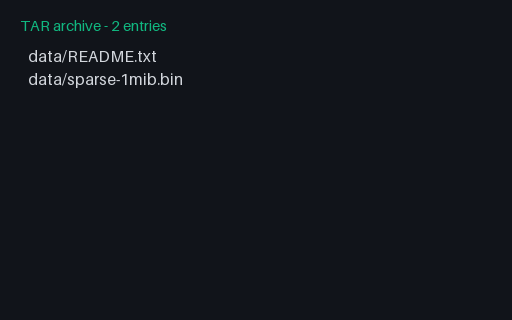
A 1 MiB file with a 1047552-byte hole in the middle, stored the old GNU way: typeflag 'S' and a four-slot sparse map written into the header block itself. Only 1024 bytes are actually in the stream, so a reader that ignores the map reconstructs a 1024-byte file instead of a 1 MiB one.

File
TAR · Tar Sparse · 2 members
Use case
Conversion testingMetadata testing· Conversion set
Preview of TAR - Owner Names Longer Than the Header Field
tar
10 KB
Actual file preview for TAR - Owner Names Longer Than the Header Field

TAR - Owner Names Longer Than the Header Field

The uname and gname fields in a tar header are 32 bytes. This archive's second member is owned by a 44-character service-account name, which only fits because PAX moves it into an extended header. A USTAR writer would have truncated it to 31 characters and lost the distinction between two similarly-named accounts.

File
TAR · Tar Records · 2 members
Use case
Conversion testingMetadata testing· Conversion set
Preview of TAR - Padded to a 10240-Byte Record
tar
10 KB
Actual file preview for TAR - Padded to a 10240-Byte Record

TAR - Padded to a 10240-Byte Record

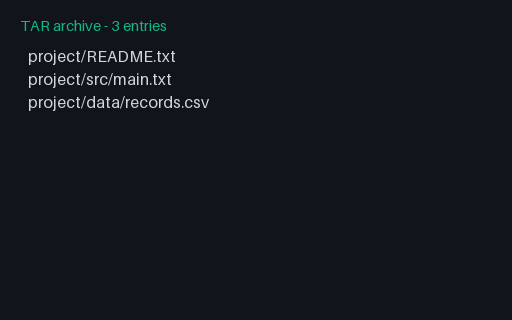
The same three members followed by the end-of-archive blocks and then zero padding out to a whole 10240-byte record - tar's historical blocking factor of 20, still the default. The archive is 10240 bytes for 616 bytes of content, which is what makes tiny tarballs look so wasteful before compression.

File
TAR · Tar Stream · 3 members
Use case
Conversion testingPerformance testing· Conversion set
Preview of TAR - PAX Format
tar
10 KB
Actual file preview for TAR - PAX Format

TAR - PAX Format

The 2001 POSIX format: anything the classic header cannot express moves into an 'x' extended header of UTF-8 key=value records placed immediately before the member it describes. Here each member carries atime and ctime records, which is why this archive is structurally different from its USTAR twin rather than byte-identical to it. All three archives in this group hold byte-identical members with identical ownership and modification times, so any other difference a reader reports between them comes from the header encoding alone.

File
TAR · Tar Format · 3 members
Use case
Conversion testingMetadata testing· Conversion set
Preview of TAR - PAX Global Extended Header
tar
10 KB
Actual file preview for TAR - PAX Global Extended Header

TAR - PAX Global Extended Header

A PAX 'g' global extended header leads the stream, carrying archive-wide key=value records including a vendor-prefixed pair. Readers must apply it to every following member and must not list it as a file - a mistake that shows up as a phantom entry named 'pax_global_header'.

File
TAR · Tar Format · 3 members
Use case
Conversion testingMetadata testing· Conversion set
Preview of TAR - PAX GNU.sparse 1.0
tar
5 KB
Actual file preview for TAR - PAX GNU.sparse 1.0

TAR - PAX GNU.sparse 1.0

The same 1 MiB sparse file in the modern encoding: an 'x' extended header declares GNU.sparse 1.0 and the real name and size, and the segment map is decimal text at the beginning of the member's own data rather than in the header. A reader that honours the records must also strip the GNUSparseFile.0/ prefix from the name it reports.

File
TAR · Tar Sparse · 2 members
Use case
Conversion testingMetadata testing· Conversion set
Preview of TAR - PAX Path Header
tar
10 KB
Actual file preview for TAR - PAX Path Header

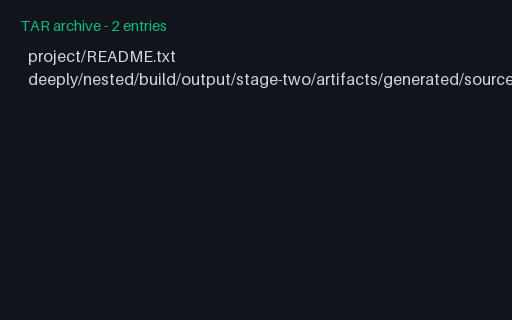
TAR - PAX Path Header

A 125-character path whose long component contains no slash at all, so the USTAR prefix field cannot store it. This archive uses a preceding 'x' extended header carrying a path= record in UTF-8. Its group siblings encode the same class of path with the other two mechanisms.

File
TAR · Tar Format · 2 members
Use case
Conversion testingError handling· Conversion set

Preview of TAR - PAX UTF-8 Member Names
tar
10 KB
Actual file preview for TAR - PAX UTF-8 Member Names

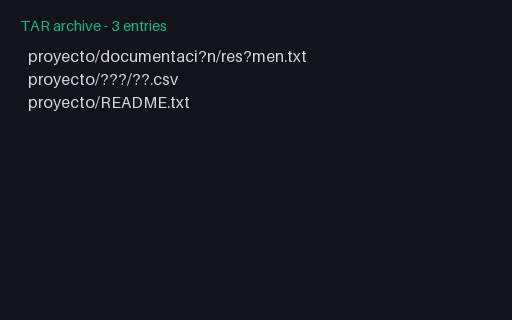
TAR - PAX UTF-8 Member Names

PAX is the only tar variant that says what encoding its names are in: extended-header records are UTF-8 by definition. These three members carry accented Spanish and Japanese path components, so a reader that applies a locale-dependent guess instead of trusting the format produces mojibake on exactly this file.

File
TAR · Tar Format · 3 members
Use case
Conversion testingEncoding detection· Conversion set
Preview of TAR - Symlink Member
tar
10 KB
Actual file preview for TAR - Symlink Member

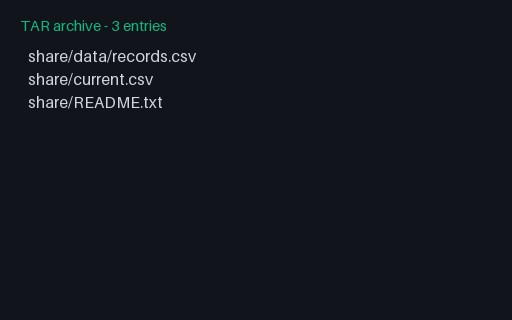
TAR - Symlink Member

share/current.csv is a symbolic link: typeflag '2', size 0, and the target carried in the header's 100-byte linkname field rather than in any data blocks. The target is relative and stays inside the archive, so extraction is safe with or without symlink support.

File
TAR · Tar Records · 3 members
Use case
Conversion testingMetadata testing· Conversion set
Preview of TAR - Trailing Data After the End Blocks
tar
4.2 KB
Actual file preview for TAR - Trailing Data After the End Blocks

TAR - Trailing Data After the End Blocks

A complete tar with 218 bytes of plain text appended after the end-of-archive blocks. A reader must stop at those blocks; one that keeps scanning finds a block whose checksum does not verify and may report the whole archive as corrupt instead of ignoring bytes that were never part of it.

File
TAR · Tar Stream · 3 members
Use case
Conversion testingError handling· Conversion set

Preview of TAR - Uncompressed
tar
10 KB
Actual file preview for TAR - Uncompressed

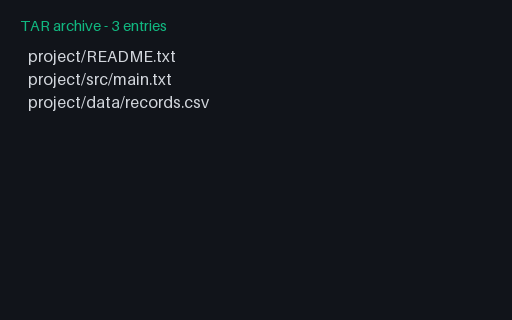
TAR - Uncompressed

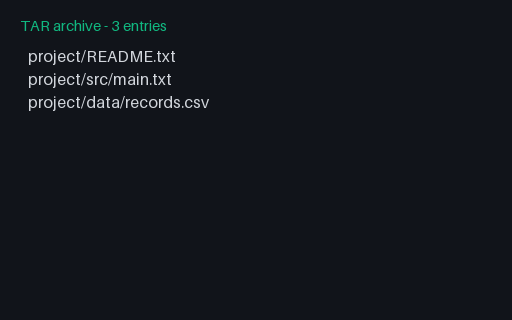
A uncompressed USTAR of a small source tree, for testing tar extraction and the TAR container. Member timestamps are fixed for reproducibility.

File
TAR · Tarball · 4 members
Preview of TAR - USTAR Format
tar
10 KB
Actual file preview for TAR - USTAR Format

TAR - USTAR Format

The 1988 POSIX format: 512-byte headers, octal numeric fields, names split across a 155-byte prefix and a 100-byte name, and no mechanism at all for anything that does not fit - including the access and change times its siblings carry. All three archives in this group hold byte-identical members with identical ownership and modification times, so any other difference a reader reports between them comes from the header encoding alone.

File
TAR · Tar Format · 3 members
Use case
Conversion testingMetadata testing· Conversion set
Preview of TAR - USTAR Prefix-Split Path
tar
10 KB
Actual file preview for TAR - USTAR Prefix-Split Path

TAR - USTAR Prefix-Split Path

A 141-character path stored the only way plain USTAR can store one: split at a slash across the header's 155-byte prefix field and its 100-byte name field. Readers that ignore the prefix field report the truncated tail and write the file to the wrong place.

File
TAR · Tar Format · 2 members
Use case
Conversion testingError handling· Conversion set
Preview of TAR Containing Three ZIP Archives
tar
5.5 KB
Actual file preview for TAR Containing Three ZIP Archives

TAR Containing Three ZIP Archives

A tar carrying three ZIPs: two byte-identical and a third holding the same content stored rather than deflated. A deduplicating packer should notice the first two are the same object; a content-addressed one should notice all three extract to the same files.

File
TAR · Nested Mixed · 4 members
Use case
Conversion testingCompression testing· Conversion set

Preview of TAR.BZ2 - Bzip2 Tarball
tbz2
668 B
Actual file preview for TAR.BZ2 - Bzip2 Tarball

TAR.BZ2 - Bzip2 Tarball

A bzip2-compressed tar of a small source tree, for testing tar extraction and the TBZ2 container. Member timestamps are fixed for reproducibility.

File
TBZ2 · Tarball · 4 members
Preview of TAR.GZ - Gzip Tarball
tgz
637 B
Actual file preview for TAR.GZ - Gzip Tarball

TAR.GZ - Gzip Tarball

A gzip-compressed tar of a small source tree, for testing tar extraction and the TGZ container. Member timestamps are fixed for reproducibility.

File
TGZ · Tarball · 4 members
Preview of TAR.XZ - XZ Tarball
txz
716 B
Actual file preview for TAR.XZ - XZ Tarball

TAR.XZ - XZ Tarball

A xz/LZMA-compressed tar of a small source tree, for testing tar extraction and the TXZ container. Member timestamps are fixed for reproducibility.

File
TXZ · Tarball · 4 members
Preview of TAR.ZST: intentionally corrupt frame header
tar.zst
157 B
Actual file preview for TAR.ZST: intentionally corrupt frame header

TAR.ZST: intentionally corrupt frame header

Tiny intentionally corrupt TAR.ZST with preserved Zstandard magic and a deliberately damaged frame-header byte so strict decompressors reject it before extraction Stable P8 artifact p8-convert-tar-zst-intentionally-corrupt.

File
TAR.ZST · P8 Convert · 2 members
Use case
Conversion testingCompression testing· Conversion set