
TAR - PAX UTF-8 Member Names
PAX is the only tar variant that says what encoding its names are in: extended-header records are UTF-8 by definition. These three members carry accented Spanish and Japanese path components, so a reader that applies a locale-dependent guess instead of trusting the format produces mojibake on exactly this file.
- resúmen.txt
- 記録.csv
- README.txt
Specifications
- Seed
- 20260807
- Tar Format
- PAX (POSIX.1-2001)
- Members
- 3
- Name Encoding
- UTF-8, declared by the format rather than guessed
- Scripts
- Latin-1 accents, Japanese
- Contrast
- USTAR has no encoding declaration at all - the bytes are just bytes
Testing contract
Expected to pass- Scenario
- List the archive with a reader configured for a non-UTF-8 locale.
- Expected result
- All three paths still decode to their UTF-8 originals, because PAX declares the encoding; a reader that applies the locale codec instead returns mojibake.
What is a .tar file?
TAR (Tape Archive) is a Unix archive format that concatenates files with their metadata into a single uncompressed stream of fixed-size blocks. It preserves permissions, ownership, and directory structure but applies no compression itself. It is usually paired with a compressor such as gzip or xz.
How to use this file
Use an example TAR to test archive extraction, metadata and permission preservation, streaming block parsing, and pipelines that combine tar with external compression.
How to use this file for testing
“TAR - PAX UTF-8 Member Names” is a deterministic Novus Examples fixture for Conversion testing, Encoding detection. The same content exported across many formats and linked as a group, so you can convert one and diff against the expected twin.
Documented properties for this file: seed 20260807. Compare results against paired or grouped companions on this page when present (clean↔damaged, searchable↔scanned, or format twins) so scores stay reproducible across runs.
Download the file once, keep the path stable in CI or local scripts, and treat the spec table as the contract: dimensions, seeds, field lists, and roles are intentional. Corrupt or invalid samples are labelled as such — expect parsers to fail loudly rather than silently accept them.
Archive fixtures are documented down to their member list (shown on this page) and are deliberately safe — no zip bombs, executables, or hidden payloads. Test extractors against nested, unicode, empty, and encrypted variants.
Code examples
tar -tf pax-utf8-names.tar       # list
tar -xf pax-utf8-names.tar -C out/  # extract
Related files
- zipZIP - CP437 Legacy Name EncodingThe legacy twin: names encoded in IBM CP437 with the language-encoding flag clear, which is what the ZIP spec says an un-flagged name means. Decoding these bytes as UTF-8 produces mojibake or an outright decode error, which is exactly the bug this file is for.
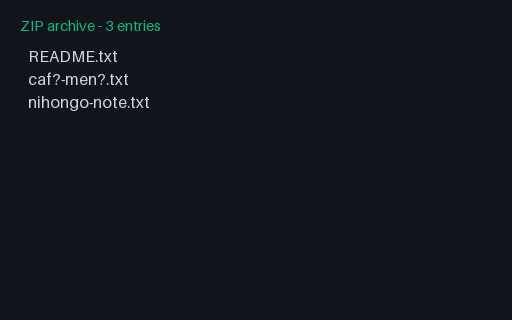
- zipZIP - Info-ZIP Unicode Path Extra FieldThe third way a ZIP carries a non-ASCII name: an ASCII-safe name in the header plus an Info-ZIP Unicode Path extra field (0x7075) holding the real UTF-8 name and a CRC32 of the header name. A reader must prefer the extra field, but only while that CRC still matches the header name it was computed from.
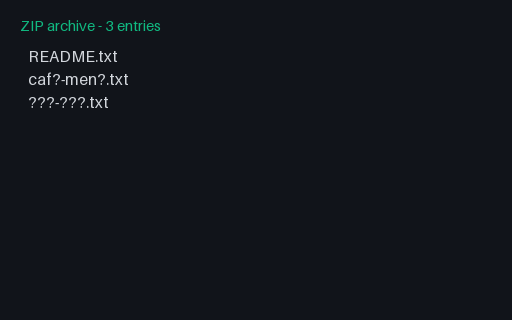
- zipZIP - UTF-8 Name Flag SetMember names stored as UTF-8 with general-purpose bit 11 (the language-encoding flag) set, which is the modern, unambiguous way to carry a non-ASCII filename in a ZIP. Its CP437 twin encodes the same archive the legacy way, so a reader's encoding heuristic can be compared against a case where the answer is declared.
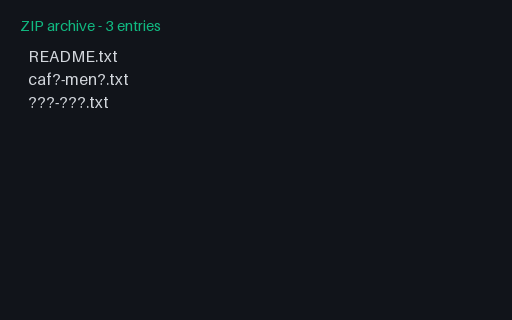
- emlEML — Base64: Accented UTF-8 BodyA base64 text/plain message in utf-8 carrying the identical body to the quoted-printable twin beside it. Base64 is opaque to whitespace and line-start characters, so it is the reference side of the pair when a QP decoder is suspect.
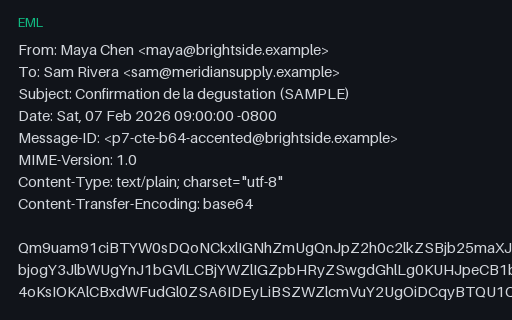
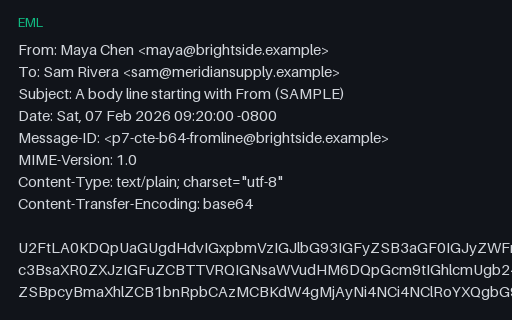
- emlEML — Base64: From-Line and Lone DotA base64 text/plain message in utf-8 carrying the identical body to the quoted-printable twin beside it. Base64 is opaque to whitespace and line-start characters, so it is the reference side of the pair when a QP decoder is suspect.
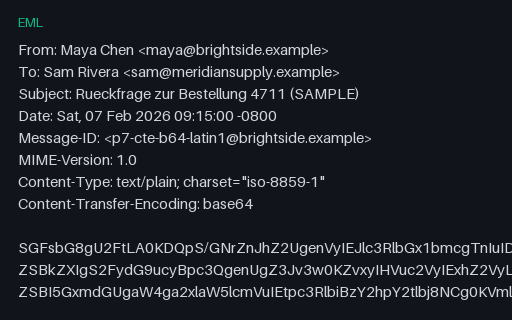
- emlEML — Base64: ISO-8859-1 BodyA base64 text/plain message in iso-8859-1 carrying the identical body to the quoted-printable twin beside it. Base64 is opaque to whitespace and line-start characters, so it is the reference side of the pair when a QP decoder is suspect.
Generated by generation/archives_p7.py. Free for any use, no attribution required — license.