Skip to content
Novus Examples

Explore the test library

Search files, editable visual templates, and live browser targets from one registry-backed directory. Filtered query views stay crawlable for links but are deliberately noindex; the stable taxonomy pages below remain the canonical search surfaces.

402 results

Page 12 of 17; 24 results per page.

Show the canonical directory
Preview of Multi-Track Subtitles — SDH and Standard (MKV)
mkv
27 KB
Actual file preview for Multi-Track Subtitles — SDH and Standard (MKV)

Multi-Track Subtitles — SDH and Standard (MKV)

Standard subtitles and SDH (Subtitles for the Deaf and Hard of Hearing) as two separate English tracks, distinguished only by the `hearing_impaired` disposition. The SDH track adds the non-speech information a deaf viewer would otherwise lose — the tone that is playing, the marker that is moving — in square brackets above each line. Because both tracks are tagged `eng`, any picker that keys on language alone shows two identical-looking entries. That is exactly the bug this file exists to surface: the flag is the only thing that separates them, and it is the thing most often dropped in a remux.

File
MKV · Subtitle Tracks · 8s
Use case
Media accessibilitySubtitle testing+2· Conversion set
Preview of Multi-Track Subtitles — Styled ASS Track (MKV)
mkv
27.1 KB
Actual file preview for Multi-Track Subtitles — Styled ASS Track (MKV)

Multi-Track Subtitles — Styled ASS Track (MKV)

An ASS subtitle track that carries its own styling — two named styles, alternating cue by cue, one bottom-centred and one top-centred in italic teal. ASS is the only widely-used soft subtitle format that survives a remux with its positioning and colour intact. The useful test is what happens on the way out. Convert this to SubRip or to WebVTT and the styling is silently discarded — the cues remain, so the conversion reports success while half the information is gone. Converting to MP4 is worse still: mov_text keeps neither the styles nor the positions.

File
MKV · Subtitle Tracks · 8s
Use case
Media accessibilitySubtitle testing+2· Conversion set
Preview of Multi-Track Subtitles — Three Languages (MKV)
mkv
27.9 KB
Actual file preview for Multi-Track Subtitles — Three Languages (MKV)

Multi-Track Subtitles — Three Languages (MKV)

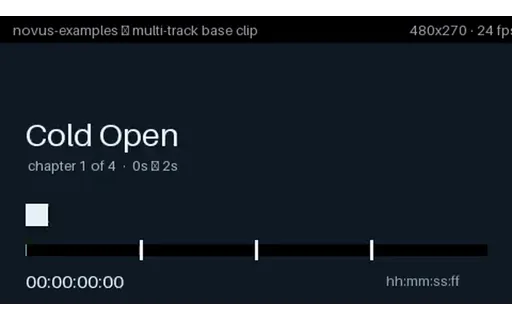
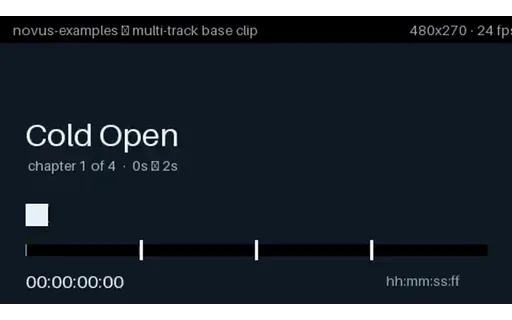
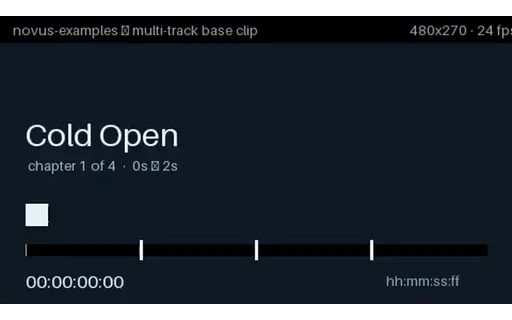
One MKV carrying three soft subtitle tracks — English, Spanish and Japanese — each with a real ISO 639-2 language tag and a human track title, and English flagged as the default. Every cue names its own second and its own chapter, and the picture burns in a matching timecode, so you can confirm the right track is displaying without trusting the player's own menu labels. Single-track sample files never exercise the code that actually breaks: track enumeration, language-tag mapping and default selection. This is the smallest file that does.

File
MKV · Subtitle Tracks · 480x270
Use case
Media accessibilitySubtitle testing+2· Conversion set
Preview of Multi-Track Subtitles — Two mov_text Tracks (MP4)
mp4
29.2 KB
Actual file preview for Multi-Track Subtitles — Two mov_text Tracks (MP4)

Multi-Track Subtitles — Two mov_text Tracks (MP4)

Two soft subtitle tracks inside an MP4, in mov_text — the 3GPP Timed Text format that is the only subtitle codec MP4 officially carries. Safari and QuickTime read these natively; most other browsers ignore them entirely and expect a sidecar WebVTT track instead, which is the single most common reason subtitles appear on an iPhone and nowhere else. Compare with the MKV in this group: the cue text is identical, but mov_text drops all styling and positioning, so this is also the file to test a lossy subtitle conversion against.

File
MP4 · Subtitle Tracks · 8s
Use case
Media accessibilitySubtitle testing+2· Conversion set
Preview of OGV — Ogg Theora Clip
ogv
66.6 KB
Actual file preview for OGV — Ogg Theora Clip

OGV — Ogg Theora Clip

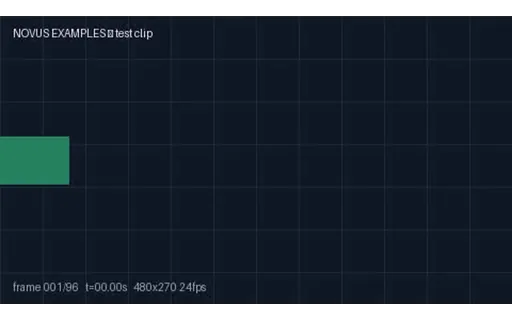
The clip as Ogg Theora — a fully open, royalty-free format. Browser-playable; for testing Theora decoding and Ogg video conversion.

File
OGV · Ogv · 480x270
Preview of Pixel Format — 10-bit 4:2:0
mkv
17.7 KB
Actual file preview for Pixel Format — 10-bit 4:2:0

Pixel Format — 10-bit 4:2:0

10-bit 4:2:0 HEVC. Ten bits per component gives 1024 levels instead of 256, which is what removes banding from smooth gradients. Now the norm for HDR and for high-quality SDR encodes. Shipped in Matroska rather than MP4 on purpose: an exotic pixel format in an .mp4 would be advertised as browser-playable and then fail to decode. Every clip in this group is the same picture, so the pixel format is the only variable.

File
MKV · Pixel Format · 480x270
Use case
Video codecsConversion testing+1· Conversion set
Preview of Pixel Format — 10-bit 4:2:2
mkv
19.2 KB
Actual file preview for Pixel Format — 10-bit 4:2:2

Pixel Format — 10-bit 4:2:2

10-bit 4:2:2 HEVC. The professional acquisition and mezzanine format — enough chroma for keying and enough bit depth for grading. Shipped in Matroska rather than MP4 on purpose: an exotic pixel format in an .mp4 would be advertised as browser-playable and then fail to decode. Every clip in this group is the same picture, so the pixel format is the only variable.

File
MKV · Pixel Format · 480x270
Use case
Video codecsConversion testing+1· Conversion set
Preview of Pixel Format — 10-bit 4:4:4
mkv
17.5 KB
Actual file preview for Pixel Format — 10-bit 4:4:4

Pixel Format — 10-bit 4:4:4

10-bit 4:4:4 HEVC. Full chroma at 10 bits. Effectively an intermediate format only; almost nothing decodes it in hardware. Shipped in Matroska rather than MP4 on purpose: an exotic pixel format in an .mp4 would be advertised as browser-playable and then fail to decode. Every clip in this group is the same picture, so the pixel format is the only variable.

File
MKV · Pixel Format · 480x270
Use case
Video codecsConversion testing+1· Conversion set
Preview of Pixel Format — 12-bit 4:2:0
mkv
15.4 KB
Actual file preview for Pixel Format — 12-bit 4:2:0

Pixel Format — 12-bit 4:2:0

12-bit 4:2:0 HEVC. Twelve bits, at the top of what HEVC's Main 12 profile supports. Cinema and scientific capture; included as the limit case that finds decoders which silently truncate to 8 bits. Shipped in Matroska rather than MP4 on purpose: an exotic pixel format in an .mp4 would be advertised as browser-playable and then fail to decode. Every clip in this group is the same picture, so the pixel format is the only variable.

File
MKV · Pixel Format · 480x270
Use case
Video codecsConversion testing+1· Conversion set
Preview of Pixel Format — 8-bit 4:2:0
mkv
18.2 KB
Actual file preview for Pixel Format — 8-bit 4:2:0

Pixel Format — 8-bit 4:2:0

8-bit 4:2:0 HEVC. The universal delivery format. Chroma is stored at quarter resolution, which is invisible on photographic content and very visible on saturated text and thin graphic edges. Shipped in Matroska rather than MP4 on purpose: an exotic pixel format in an .mp4 would be advertised as browser-playable and then fail to decode. Every clip in this group is the same picture, so the pixel format is the only variable.

File
MKV · Pixel Format · 480x270
Use case
Video codecsConversion testing+1· Conversion set
Preview of Pixel Format — 8-bit 4:2:2
mkv
19.8 KB
Actual file preview for Pixel Format — 8-bit 4:2:2

Pixel Format — 8-bit 4:2:2

8-bit 4:2:2 HEVC. Chroma at half horizontal resolution — the broadcast and mezzanine standard. Survives one round of chroma keying and colour correction far better than 4:2:0. Shipped in Matroska rather than MP4 on purpose: an exotic pixel format in an .mp4 would be advertised as browser-playable and then fail to decode. Every clip in this group is the same picture, so the pixel format is the only variable.

File
MKV · Pixel Format · 480x270
Use case
Video codecsConversion testing+1· Conversion set
Preview of Pixel Format — 8-bit 4:4:4
mkv
17.8 KB
Actual file preview for Pixel Format — 8-bit 4:4:4

Pixel Format — 8-bit 4:4:4

8-bit 4:4:4 HEVC. No chroma subsampling at all. Necessary for screen content and graphics, and the only format where coloured text stays clean, but unsupported by most hardware decoders. Shipped in Matroska rather than MP4 on purpose: an exotic pixel format in an .mp4 would be advertised as browser-playable and then fail to decode. Every clip in this group is the same picture, so the pixel format is the only variable.

File
MKV · Pixel Format · 480x270
Use case
Video codecsConversion testing+1· Conversion set
Preview of Rotation Metadata — 180°
mp4
23.2 KB
Actual file preview for Rotation Metadata — 180°

Rotation Metadata — 180°

A 180-degree rotation carried in the container's display matrix while the coded pixels stay in their original orientation — exactly what a phone writes when you record holding it sideways. A player that ignores the matrix shows it upside down. Thumbnailers and transcoders that read dimensions from the video stream rather than the display matrix get this wrong constantly.

File
MP4 · Rotation · H.264 (libx264)
Use case
Video codecsConversion testing+1· Conversion set
Preview of Rotation Metadata — 270°
mp4
23.2 KB
Actual file preview for Rotation Metadata — 270°

Rotation Metadata — 270°

A 270-degree rotation carried in the container's display matrix while the coded pixels stay in their original orientation — exactly what a phone writes when you record holding it sideways. A player that ignores the matrix shows this 270x480 clip as 480x270, on its side. Thumbnailers and transcoders that read dimensions from the video stream rather than the display matrix get this wrong constantly.

File
MP4 · Rotation · H.264 (libx264)
Use case
Video codecsConversion testing+1· Conversion set
Preview of Rotation Metadata — 90°
mp4
23.2 KB
Actual file preview for Rotation Metadata — 90°

Rotation Metadata — 90°

A 90-degree rotation carried in the container's display matrix while the coded pixels stay in their original orientation — exactly what a phone writes when you record holding it sideways. A player that ignores the matrix shows this 270x480 clip as 480x270, on its side. Thumbnailers and transcoders that read dimensions from the video stream rather than the display matrix get this wrong constantly.

File
MP4 · Rotation · H.264 (libx264)
Use case
Video codecsConversion testing+1· Conversion set
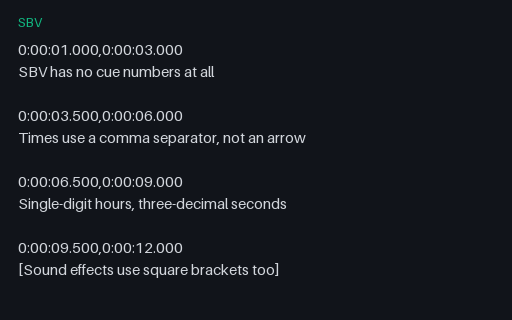
Preview of SBV — YouTube Timing Without Cue Indices
sbv
253 B
Actual file preview for SBV — YouTube Timing Without Cue Indices

SBV — YouTube Timing Without Cue Indices

SubViewer/SBV as YouTube exports it: no cue indices, a comma rather than an arrow between start and end, and single-digit hours. Superficially similar enough to SubRip that format detection by eye fails, which makes it a good test of sniffing logic — a parser that guesses SubRip from the timestamps then trips on the missing index.

File
SBV · Captions Edge · 4 cues
Use case
Subtitle parsingVideo QA· Conversion set
Preview of Scan — Interlaced, Bottom Field First
mkv
28.5 KB
Actual file preview for Scan — Interlaced, Bottom Field First

Scan — Interlaced, Bottom Field First

The same interlacing with the opposite field order, the DV and SD convention. Deinterlacing with the wrong field order makes motion jitter backwards — a subtle, very common bug that this pair makes reproducible. In Matroska rather than MP4 so the catalog renders a poster instead of advertising an inline player — combing artefacts are best judged from a still anyway.

File
MKV · Scan · 480x270
Use case
Video codecsConversion testing+1· Conversion set
Preview of Scan — Interlaced, Top Field First
mkv
28.7 KB
Actual file preview for Scan — Interlaced, Top Field First

Scan — Interlaced, Top Field First

Alternate lines carry alternate instants, with the top field displayed first — the HD broadcast convention. Shown progressively it combs on every moving edge. In Matroska rather than MP4 so the catalog renders a poster instead of advertising an inline player — combing artefacts are best judged from a still anyway.

File
MKV · Scan · 480x270
Use case
Video codecsConversion testing+1· Conversion set
Preview of Scan — Progressive
mkv
24.6 KB
Actual file preview for Scan — Progressive

Scan — Progressive

Whole frames, captured and displayed at once — the reference for this group and how essentially all modern video is shot. In Matroska rather than MP4 so the catalog renders a poster instead of advertising an inline player — combing artefacts are best judged from a still anyway.

File
MKV · Scan · 480x270
Use case
Video codecsConversion testing+1· Conversion set
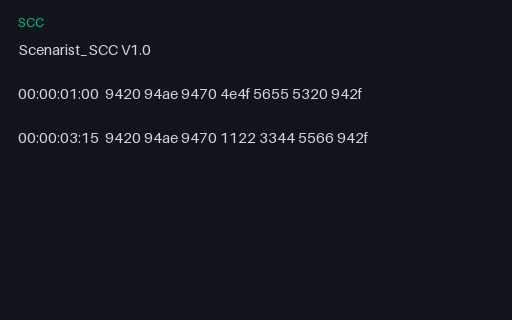
Preview of SCC — Broadcast CEA-608 Captions
scc
308 B
Actual file preview for SCC — Broadcast CEA-608 Captions

SCC — Broadcast CEA-608 Captions

Broadcast closed captions as Scenarist SCC: SMPTE timecodes followed by hexadecimal CEA-608 byte pairs, with odd parity set on every byte as the standard requires. Uses pop-on mode — RCL to load, ENM to clear non-displayed memory, a preamble address code for row 15, the character pairs, then EOC to display. This is the fixture that exposes decoders which treat captions as text: the parity bits, the two-byte control codes and the frame-accurate timecodes all have to be handled.

File
SCC · Captions Formats
Use case
Subtitle parsingCaption encoding+2· Conversion set
Preview of SCC — Intentionally Corrupt: Wrong Parity Bytes
scc
115 B
Actual file preview for SCC — Intentionally Corrupt: Wrong Parity Bytes

SCC — Intentionally Corrupt: Wrong Parity Bytes

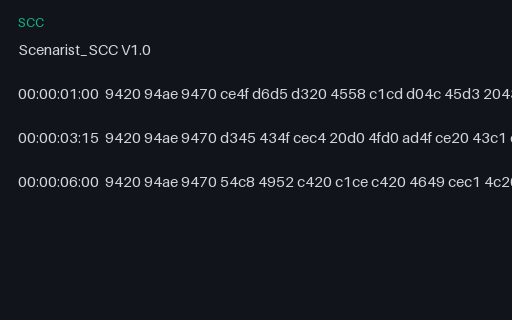
An intentionally corrupt SCC file whose first caption is valid but whose second carries byte pairs with the wrong parity. CEA-608 requires odd parity in bit 7 of every byte, and broadcast decoders use it to detect transmission errors. Tests whether a decoder checks parity at all, and whether it drops just the bad caption or the whole file.

File
SCC · Captions Corrupt
Use case
Subtitle parsingVideo QA· Conversion set
Preview of SCTE-35 — Splice Insert (Break End / Return to Network)
xml
472 B
Actual file preview for SCTE-35 — Splice Insert (Break End / Return to Network)

SCTE-35 — Splice Insert (Break End / Return to Network)

The matching return cue for the break-start splice_insert in this group: the same spliceEventId with outOfNetworkIndicator false, signalling the feed is coming back from the ad break. It carries no BreakDuration because the return is explicit rather than automatic. Pairing start and end cues by event id is exactly what an ad-insertion implementation has to get right, and this is the pair to test it on.

File
XML · Ad Signalling
Use case
Ad insertionStreaming manifests+1· Conversion set
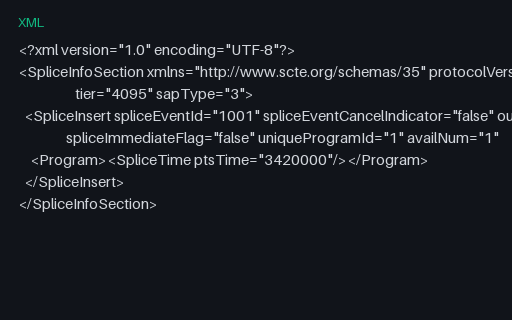
Preview of SCTE-35 — Splice Insert (Break Start)
xml
528 B
Actual file preview for SCTE-35 — Splice Insert (Break Start)

SCTE-35 — Splice Insert (Break Start)

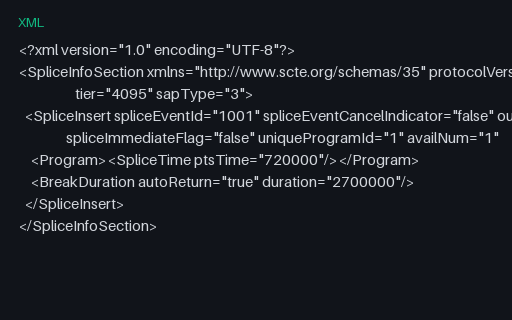
An SCTE-35 splice_insert as XML: the cue that tells a downstream packager a linear ad break starts. outOfNetworkIndicator marks entry into the break, ptsTime is 8 seconds on the 90 kHz PTS clock, and the 30-second break auto-returns. This is the signal a manifest manipulator converts into an HLS EXT-X-CUE-OUT or a new DASH period.

File
XML · Ad Signalling
Use case
Ad insertionStreaming manifests+1· Conversion set
Preview of SCTE-35 — Time Signal With Segmentation Descriptor
xml
801 B
Actual file preview for SCTE-35 — Time Signal With Segmentation Descriptor

SCTE-35 — Time Signal With Segmentation Descriptor

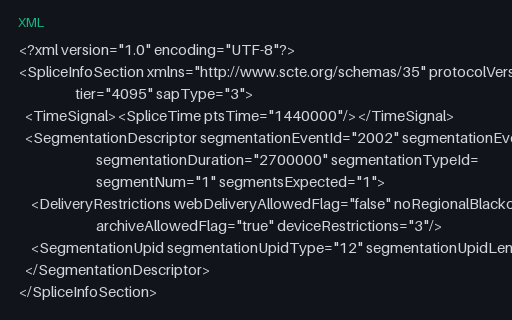
The modern SCTE-35 form: a time_signal command carrying a segmentation descriptor rather than a bare splice_insert. Type 34 marks a provider placement opportunity start, and the delivery restrictions declare that this break may not be filled for web delivery — the field that ad-insertion logic is supposed to honour and frequently ignores. Includes a base64 UPID identifying the content.

File
XML · Ad Signalling · 2700000 (30.0s)
Use case
Ad insertionStreaming manifests+1· Conversion set