
security.txt (RFC 9116)
An RFC 9116 security.txt with Contact, Expires, Encryption, and Policy fields — normally served at /.well-known/security.txt, for testing security.txt parsers.
# security.txt (RFC 9116) - sample fixture
Contact: mailto:security@example.com
Contact: https://example.com/security/report
Expires: 2027-01-01T00:00:00.000Z
Encryption: https://example.com/pgp-key.txt
Acknowledgments: https://example.com/security/thanks
Preferred-Languages: en
Canonical: https://example.com/.well-known/security.txt
Policy: https://example.com/security/policy
Hiring: https://example.com/careers
Specifications
- Format
- security.txt (RFC 9116)
- Location
- /.well-known/
- Data
- fictional sample
What is a .txt file?
TXT is a plain-text file containing unformatted character data with no styling or structure beyond line breaks. Its interpretation depends on character encoding, most commonly UTF-8, and on line-ending convention. It is the most universal and portable text container.
How to use this file
Use an example TXT to test encoding detection, line-ending (LF versus CRLF) handling, and any tool that reads or streams raw text input.
How to use this file for testing
“security.txt (RFC 9116)” is a deterministic Novus Examples fixture for Web assets, Editor testing. Favicons, web app manifests, service workers, robots and sitemap files, Open Graph images, and .well-known resources — for testing web tooling, crawlers, PWA installers, and asset pipelines.
Documented properties for this file: security.txt (RFC 9116). Compare results against paired or grouped companions on this page when present (clean↔damaged, searchable↔scanned, or format twins) so scores stay reproducible across runs.
Download the file once, keep the path stable in CI or local scripts, and treat the spec table as the contract: dimensions, seeds, field lists, and roles are intentional. Corrupt or invalid samples are labelled as such — expect parsers to fail loudly rather than silently accept them.
Web-platform fixtures are standards-compliant samples against fictional example.com data. Test crawlers, PWA installers and manifest validators, favicon/icon pipelines, service-worker registration, or .well-known parsers against the documented structure.
Related files
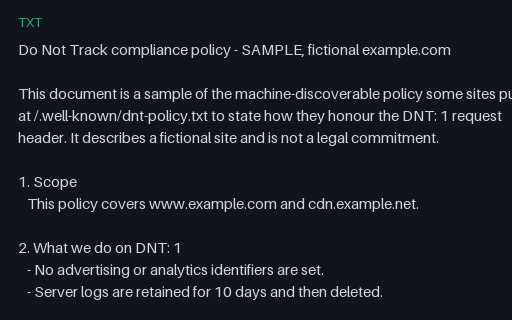
- txtdnt-policy.txt (Do Not Track compliance statement)A sample machine-discoverable Do Not Track policy of the kind served at /.well-known/dnt-policy.txt, stating retention windows, exceptions and a contact for a fictional site. For testing crawlers and privacy scanners that look for the document and read its version header.
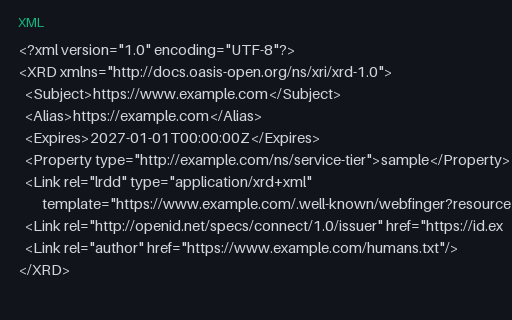
- xmlhost-meta (XRD, XML form)Host metadata in its original XRD form: a subject, an alias, an expiry, one property, and three Link elements including an lrdd template with a {uri} placeholder. Paired with the JRD twin that carries exactly the same data.
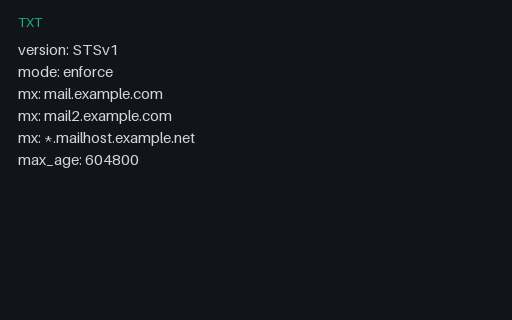
- txtmta-sts.txt (RFC 8461 SMTP MTA-STS policy)An SMTP MTA-STS policy in enforce mode listing three MX patterns, one of them a wildcard, with a seven-day max_age. RFC 8461 specifies CRLF line endings, so this fixture is written with them deliberately - for testing policy parsers that split on bare LF.
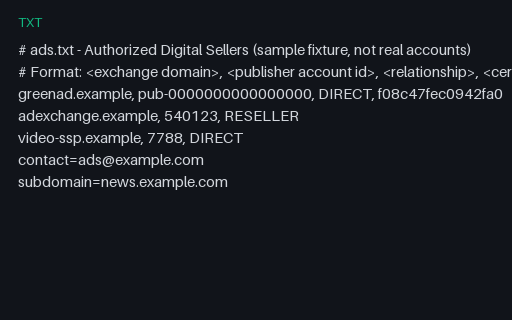
- txtads.txtAn IAB ads.txt listing authorised digital sellers with account IDs and relationships (sample data) — for testing ads.txt parsers and ad-fraud tooling.
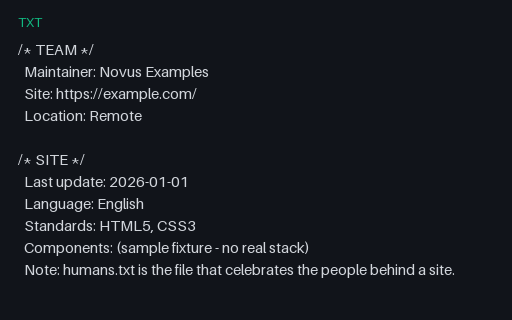
- txthumans.txtA humans.txt crediting the people and stack behind a site, in the conventional TEAM/SITE block format — for testing plain-text metadata parsers.
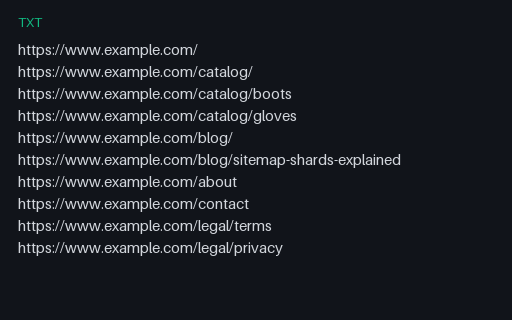
- txtPlain-text sitemap (one URL per line)The plain-text sitemap format the sitemaps.org protocol also accepts: one absolute URL per line, no markup, UTF-8 encoded. For testing that a crawler supports the text form as well as XML.
Generated by generation/web_assets.py. Free for any use, no attribution required — license.