
host-meta (XRD, XML form)
Host metadata in its original XRD form: a subject, an alias, an expiry, one property, and three Link elements including an lrdd template with a {uri} placeholder. Paired with the JRD twin that carries exactly the same data.
<?xml version="1.0" encoding="UTF-8"?>
<XRD xmlns="http://docs.oasis-open.org/ns/xri/xrd-1.0">
  <Subject>https://www.example.com</Subject>
  <Alias>https://example.com</Alias>
  <Expires>2027-01-01T00:00:00Z</Expires>
  <Property type="http://example.com/ns/service-tier">sample</Property>
  <Link rel="lrdd" type="application/xrd+xml"
        template="https://www.example.com/.well-known/webfinger?resource={uri}"/>
  <Link rel="http://openid.net/specs/connect/1.0/issuer" href="https://id.example.com"/>
  <Link rel="author" href="https://www.example.com/humans.txt"/>
</XRD>
Specifications
- Seed
- 70400
- Site
- example.com (fictional)
- Format
- XRD 1.0 (RFC 6415)
- Links
- 3
- Aliases
- 1
- Properties
- 1
- Location
- /.well-known/host-meta
Testing contract
Expected to pass- Scenario
- Discover the WebFinger endpoint for a host from its host-meta document.
- Expected result
- The lrdd Link resolves to https://www.example.com/.well-known/webfinger?resource={uri} with the placeholder left for substitution, and the XRD namespace is matched by URI rather than by element prefix.
What is a .xml file?
XML (Extensible Markup Language) is a verbose, self-describing markup language using nested tags, attributes, and namespaces to represent structured, hierarchical data. It supports schemas, entities, and validation and underlies many document and data formats. It remains common in enterprise, publishing, and interchange contexts.
How to use this file
Use an example XML file to test parsers, namespace and schema validation, XPath queries, and protection against entity-expansion and external-entity attacks.
How to use this file for testing
“host-meta (XRD, XML form)” is a deterministic Novus Examples fixture for Web assets, Metadata testing, Editor testing. Favicons, web app manifests, service workers, robots and sitemap files, Open Graph images, and .well-known resources — for testing web tooling, crawlers, PWA installers, and asset pipelines.
Documented properties for this file: seed 70400 · XRD 1.0 (RFC 6415). Compare results against paired or grouped companions on this page when present (clean↔damaged, searchable↔scanned, or format twins) so scores stay reproducible across runs.
Download the file once, keep the path stable in CI or local scripts, and treat the spec table as the contract: dimensions, seeds, field lists, and roles are intentional. Corrupt or invalid samples are labelled as such — expect parsers to fail loudly rather than silently accept them.
Web-platform fixtures are standards-compliant samples against fictional example.com data. Test crawlers, PWA installers and manifest validators, favicon/icon pipelines, service-worker registration, or .well-known parsers against the documented structure.
Code examples
import xml.etree.ElementTree as ET

tree = ET.parse("host-meta.xml")
root = tree.getroot()
print(root.tag, [c.tag for c in root][:5])
Related files
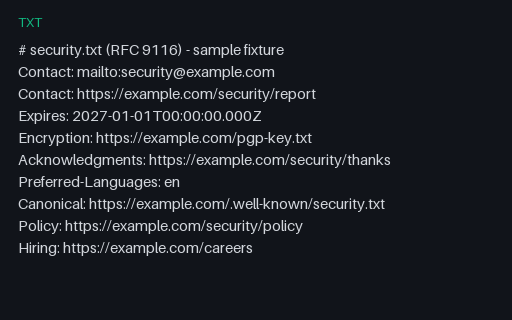
- txtsecurity.txt (RFC 9116)An RFC 9116 security.txt with Contact, Expires, Encryption, and Policy fields — normally served at /.well-known/security.txt, for testing security.txt parsers.
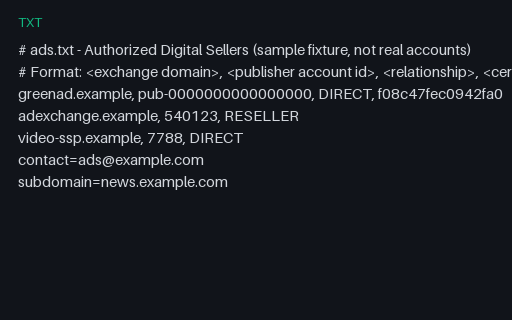
- txtads.txtAn IAB ads.txt listing authorised digital sellers with account IDs and relationships (sample data) — for testing ads.txt parsers and ad-fraud tooling.
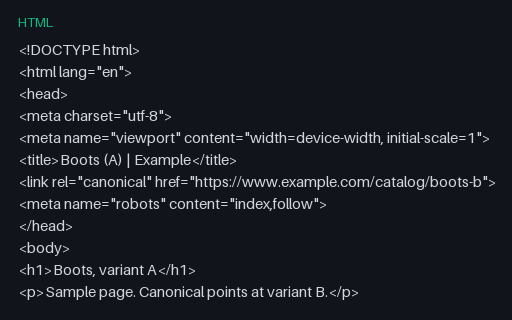
- htmlHTML canonical loop, page A (deliberately invalid)Page A of a deliberately invalid two-page canonical loop: A declares B canonical while B declares A canonical, so no page in the pair is its own canonical. For testing that a crawler detects the cycle instead of following it forever.
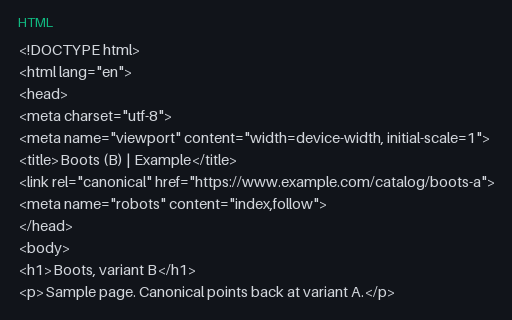
- htmlHTML canonical loop, page B (deliberately invalid)Page B of the deliberately invalid canonical loop, closing the cycle by naming page A as its canonical. Ships with page A so the loop can actually be traversed rather than described.
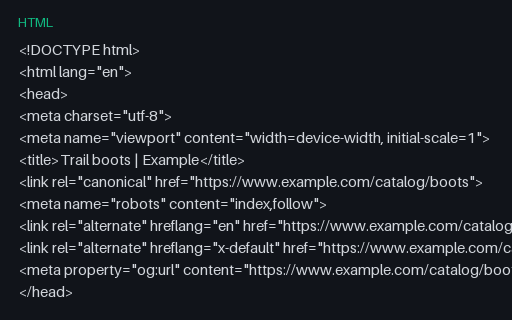
- htmlHTML head with a self-referential canonicalThe baseline every canonical audit should pass: one self-referential canonical, an indexable robots meta, matching hreflang self-reference and an og:url that agrees with all of them. For use as the comparison reference against the conflicting pages in this set.
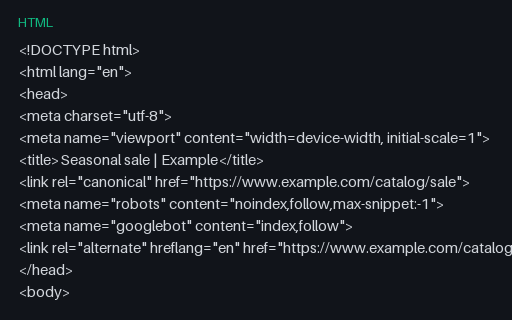
- htmlHTML where canonical and robots noindex conflictA page that names itself canonical while telling robots not to index it, and then contradicts that again with an agent-specific googlebot meta that permits indexing. For testing directive precedence when a page argues with itself.
Generated by generation/web_p7.py. Free for any use, no attribution required — license.