
ads.txt
An IAB ads.txt listing authorised digital sellers with account IDs and relationships (sample data) — for testing ads.txt parsers and ad-fraud tooling.
# ads.txt - Authorized Digital Sellers (sample fixture, not real accounts)
# Format: <exchange domain>, <publisher account id>, <relationship>, <certification authority id>
greenad.example, pub-0000000000000000, DIRECT, f08c47fec0942fa0
adexchange.example, 540123, RESELLER
video-ssp.example, 7788, DIRECT
contact=ads@example.com
subdomain=news.example.com
Specifications
- Format
- ads.txt
- Encoding
- UTF-8
- Data
- fictional example.com
What is a .txt file?
TXT is a plain-text file containing unformatted character data with no styling or structure beyond line breaks. Its interpretation depends on character encoding, most commonly UTF-8, and on line-ending convention. It is the most universal and portable text container.
How to use this file
Use an example TXT to test encoding detection, line-ending (LF versus CRLF) handling, and any tool that reads or streams raw text input.
How to use this file for testing
“ads.txt” is a deterministic Novus Examples fixture for Web assets, Editor testing. Favicons, web app manifests, service workers, robots and sitemap files, Open Graph images, and .well-known resources — for testing web tooling, crawlers, PWA installers, and asset pipelines.
Documented properties for this file: UTF-8 · ads.txt. Compare results against paired or grouped companions on this page when present (clean↔damaged, searchable↔scanned, or format twins) so scores stay reproducible across runs.
Download the file once, keep the path stable in CI or local scripts, and treat the spec table as the contract: dimensions, seeds, field lists, and roles are intentional. Corrupt or invalid samples are labelled as such — expect parsers to fail loudly rather than silently accept them.
Web-platform fixtures are standards-compliant samples against fictional example.com data. Test crawlers, PWA installers and manifest validators, favicon/icon pipelines, service-worker registration, or .well-known parsers against the documented structure.
Related files
- txthumans.txtA humans.txt crediting the people and stack behind a site, in the conventional TEAM/SITE block format — for testing plain-text metadata parsers.
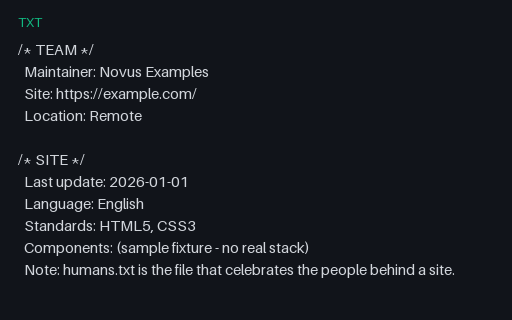
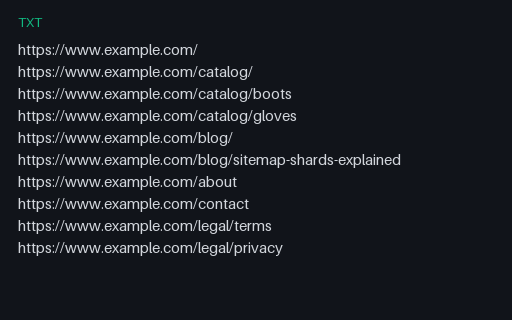
- txtPlain-text sitemap (one URL per line)The plain-text sitemap format the sitemaps.org protocol also accepts: one absolute URL per line, no markup, UTF-8 encoded. For testing that a crawler supports the text form as well as XML.
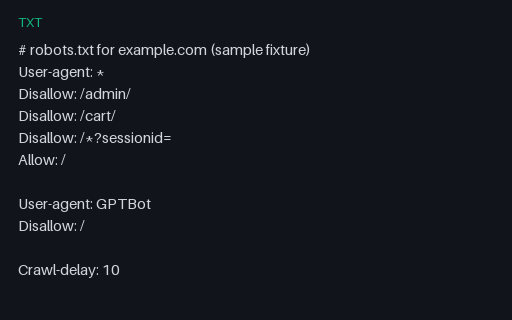
- txtrobots.txtA robots.txt with wildcard and per-agent rules, a crawl-delay, and a sitemap reference — for testing robots parsers and crawler policy handling.
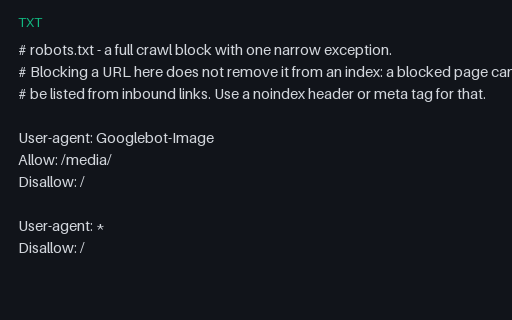
- txtrobots.txt - block everything except one pathA robots.txt that disallows the entire site for every crawler while allowing one media path for a single image agent. For testing full-block handling and the common misconception that a Disallow removes a URL from a search index.
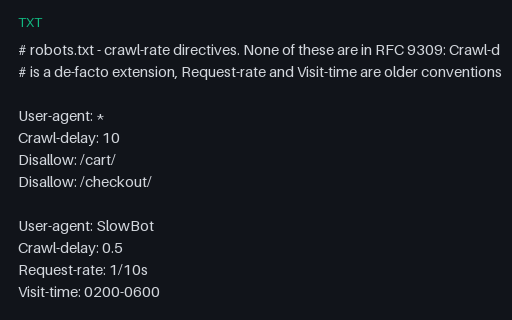
- txtrobots.txt - Crawl-delay, Request-rate and Visit-timeA robots.txt carrying three different crawl-rate hints - an integer Crawl-delay, a fractional one alongside Request-rate and Visit-time, and a very large one - none of which are part of RFC 9309. For testing that a crawler reads or ignores rate hints without dropping the Disallow rules that share the group.
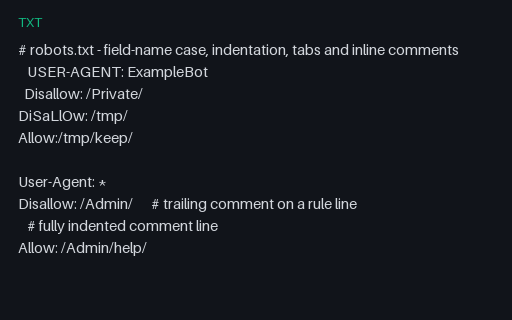
- txtrobots.txt - field case, tabs and indentationA robots.txt using upper-case, mixed-case and indented field names, a tab-indented rule, a value with no space after the colon, and both trailing and full-line comments. For testing that field names are treated case-insensitively while path values stay case-sensitive.
Generated by generation/web_assets.py. Free for any use, no attribution required — license.