
dnt-policy.txt (Do Not Track compliance statement)
A sample machine-discoverable Do Not Track policy of the kind served at /.well-known/dnt-policy.txt, stating retention windows, exceptions and a contact for a fictional site. For testing crawlers and privacy scanners that look for the document and read its version header.
Do Not Track compliance policy - SAMPLE, fictional example.com

This document is a sample of the machine-discoverable policy some sites publish
at /.well-known/dnt-policy.txt to state how they honour the DNT: 1 request
header. It describes a fictional site and is not a legal commitment.

1. Scope
   This policy covers www.example.com and cdn.example.net.

2. What we do on DNT: 1
   - No advertising or analytics identifiers are set.
   - Server logs are retained for 10 days and then deleted.
   - No profile is built and no data is shared with third parties.

3. Exceptions
   - Security logs for suspected abuse are kept for 30 days.
   - Aggregate counts with no identifiers are retained indefinitely.

4. Third parties
   Every third party embedded on the site is contractually required to follow
   this policy or is not embedded at all.

5. Contact
   privacy@example.com

Version: 1.0
Updated: 2026-01-01
Specifications
- Seed
- 70400
- Site
- example.com (fictional)
- Format
- DNT policy statement
- Sections
- 5
- Version
- 1.0
- Location
- /.well-known/dnt-policy.txt
- Line Endings
- LF
Testing contract
Expected to pass- Scenario
- Discover and read a site's DNT policy document.
- Expected result
- The file is retrieved as text/plain, its Version and Updated headers parse to 1.0 and 2026-01-01, and the five numbered sections survive intact.
What is a .txt file?
TXT is a plain-text file containing unformatted character data with no styling or structure beyond line breaks. Its interpretation depends on character encoding, most commonly UTF-8, and on line-ending convention. It is the most universal and portable text container.
How to use this file
Use an example TXT to test encoding detection, line-ending (LF versus CRLF) handling, and any tool that reads or streams raw text input.
How to use this file for testing
“dnt-policy.txt (Do Not Track compliance statement)” is a deterministic Novus Examples fixture for Web assets, Editor testing, Metadata testing. Favicons, web app manifests, service workers, robots and sitemap files, Open Graph images, and .well-known resources — for testing web tooling, crawlers, PWA installers, and asset pipelines.
Documented properties for this file: seed 70400 · LF · DNT policy statement. Compare results against paired or grouped companions on this page when present (clean↔damaged, searchable↔scanned, or format twins) so scores stay reproducible across runs.
Download the file once, keep the path stable in CI or local scripts, and treat the spec table as the contract: dimensions, seeds, field lists, and roles are intentional. Corrupt or invalid samples are labelled as such — expect parsers to fail loudly rather than silently accept them.
Web-platform fixtures are standards-compliant samples against fictional example.com data. Test crawlers, PWA installers and manifest validators, favicon/icon pipelines, service-worker registration, or .well-known parsers against the documented structure.
Related files
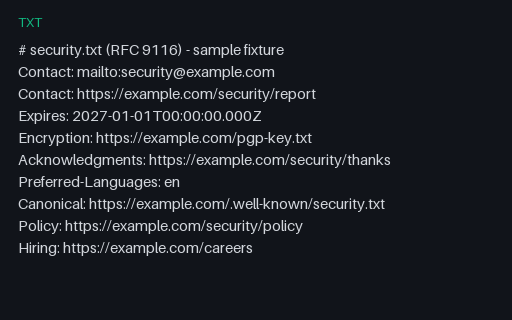
- txtsecurity.txt (RFC 9116)An RFC 9116 security.txt with Contact, Expires, Encryption, and Policy fields — normally served at /.well-known/security.txt, for testing security.txt parsers.
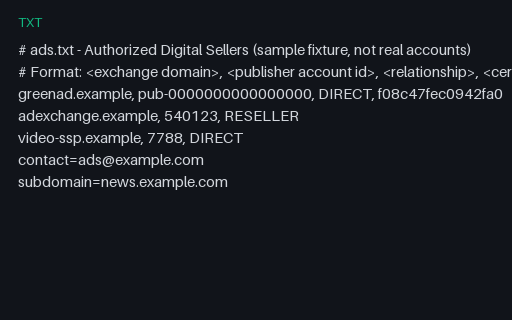
- txtads.txtAn IAB ads.txt listing authorised digital sellers with account IDs and relationships (sample data) — for testing ads.txt parsers and ad-fraud tooling.
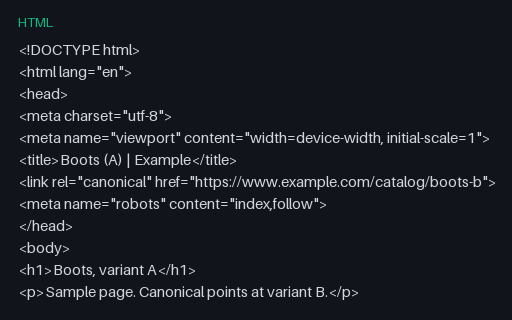
- htmlHTML canonical loop, page A (deliberately invalid)Page A of a deliberately invalid two-page canonical loop: A declares B canonical while B declares A canonical, so no page in the pair is its own canonical. For testing that a crawler detects the cycle instead of following it forever.
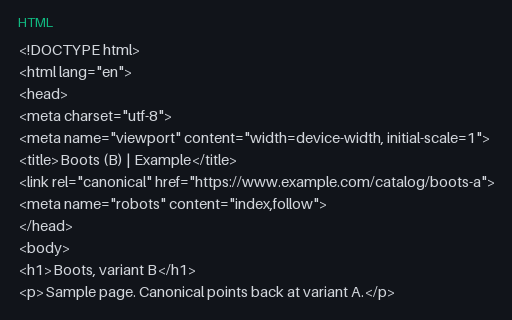
- htmlHTML canonical loop, page B (deliberately invalid)Page B of the deliberately invalid canonical loop, closing the cycle by naming page A as its canonical. Ships with page A so the loop can actually be traversed rather than described.
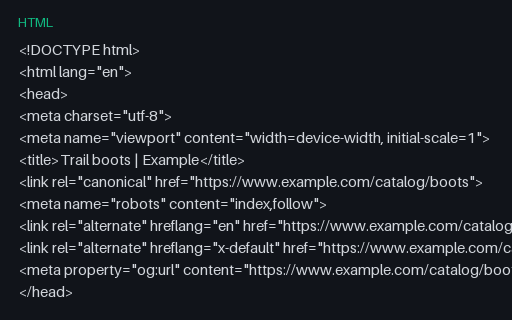
- htmlHTML head with a self-referential canonicalThe baseline every canonical audit should pass: one self-referential canonical, an indexable robots meta, matching hreflang self-reference and an og:url that agrees with all of them. For use as the comparison reference against the conflicting pages in this set.
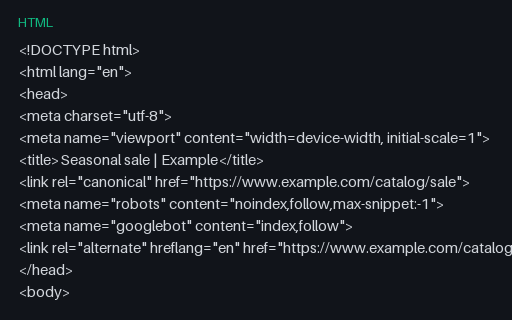
- htmlHTML where canonical and robots noindex conflictA page that names itself canonical while telling robots not to index it, and then contradicts that again with an agent-specific googlebot meta that permits indexing. For testing directive precedence when a page argues with itself.
Generated by generation/web_p7.py. Free for any use, no attribution required — license.