
Plain-Text Log — No Trailing Newline on the Last Line (log)
Four log lines where the last has no terminating newline — the normal state of any file still open for append. A tailer that only emits on seeing a newline holds that fourth line forever, which is why the newest error is the one missing from the dashboard.
2026-03-17T09:14:32.850Z INFO  checkout-api first line
2026-03-17T09:14:33.410Z INFO  checkout-api second line
2026-03-17T09:14:34.002Z WARN  checkout-api third line
2026-03-17T09:14:34.921Z ERROR checkout-api final line with no trailing newline
Specifications
- Lines
- 4
- Ends With Newline
- false
- Newline Count
- 3
- Cause
- file still open for append
- Risk
- tailer waits for a terminator that never arrives
Testing contract
Expected to pass- Scenario
- Tail the file to end of file and count the lines emitted.
- Expected result
- Four lines are emitted including the unterminated final ERROR line, rather than three with the newest line withheld until more data arrives.
What is a .log file?
LOG files are plain-text records of events emitted by software, typically one entry per line with a timestamp, severity, and message. There is no single standard, so formats range from unstructured text to structured JSON lines. They are central to debugging, monitoring, and auditing.
How to use this file
Use an example LOG file to test log parsers, timestamp and severity extraction, line-oriented streaming, and ingestion into monitoring or analysis pipelines.
How to use this file for testing
“Plain-Text Log — No Trailing Newline on the Last Line (log)” is a deterministic Novus Examples fixture for Observability, Log parsing, Error handling. Structured and plain-text telemetry with known timestamps, levels, request identifiers, and error states for testing log ingestion, correlation, dashboards, and alert pipelines.
Documented properties for this file: LOG · 245 bytes. Compare results against paired or grouped companions on this page when present (clean↔damaged, searchable↔scanned, or format twins) so scores stay reproducible across runs.
Download the file once, keep the path stable in CI or local scripts, and treat the spec table as the contract: dimensions, seeds, field lists, and roles are intentional. Corrupt or invalid samples are labelled as such — expect parsers to fail loudly rather than silently accept them.
Telemetry fixtures use fixed trace IDs, span IDs, and timestamps so ingestion is reproducible run to run. Point your collector, parser, or query layer at the file and assert the documented span tree, metric families, or severity mix; service and host names are invented.
Code examples
grep -i error app-no-trailing-newline.log | head
awk '{print $1, $2, $NF}' app-no-trailing-newline.log | head
Related files
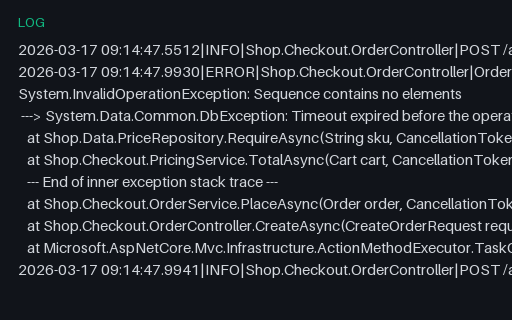
- log.NET Exception with an Inner Exception Chain (log)A .NET exception whose inner exception is introduced by the ---> marker and closed by End of inner exception stack trace, wrapped in pipe-delimited log lines. Error groupers that key on the outermost message alone merge two genuinely different faults here.
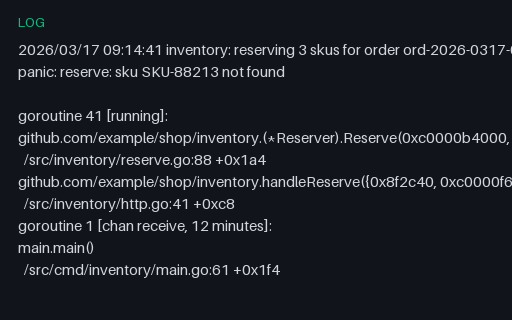
- logGo Panic with Full Goroutine Dump (log)A Go panic followed by the runtime's full goroutine dump — four goroutines with their wait states, two-line frames and a created by attribution, separated by blank lines. Blank-line separation defeats multi-line rules that treat an empty line as the end of an event.
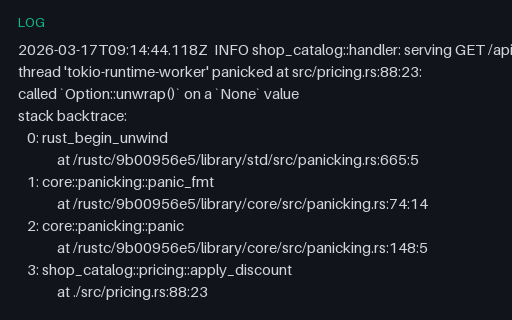
- logRust Panic with Numbered Backtrace (log)A Rust panic surrounded by ordinary tracing output: the panic location with line and column, a six-frame numbered backtrace where every frame spans two lines, and the RUST_BACKTRACE note. Frame numbering and the deep indent are what a generic stack parser gets wrong here.
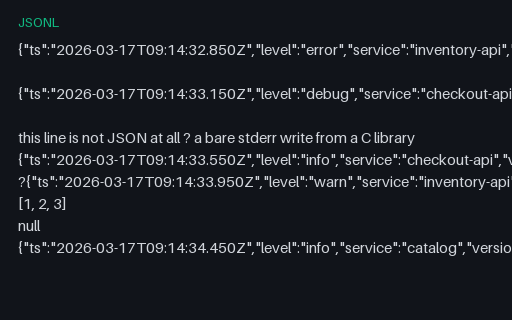
- jsonlStructured Log — Blank, Non-JSON and BOM-Prefixed Lines (jsonl)A JSON Lines file with the debris a real container stream carries: blank and whitespace-only lines, one bare stderr write from a C library, a mid-file byte-order mark and two lines that are valid JSON but not objects. Five real records are in there.
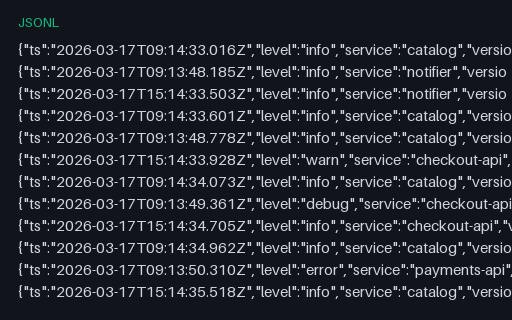
- jsonlStructured Log — Clock Skew Across Three Hosts (jsonl)Three hosts writing to one stream with disagreeing clocks: one 45 seconds behind and one six hours ahead because NTP is unreachable. Interleaved by host, so a naive tail shows events from the future and a retention window silently drops the past.
- jsonlStructured Log — Multi-Line Stack Traces Inside JSON (jsonl)Java, Python and Go stack traces carried inside JSON string fields with their newlines escaped — the shape a structured logger produces, and the one that defeats multi-line joining rules written for plain text. Includes a Caused by chain and a goroutine dump.
Generated by generation/observability.py. Free for any use, no attribution required — license.