
PlantUML Sequence Diagram
A PlantUML sequence diagram of an order interaction (customer, store, warehouse) as diagrams-as-code — for testing PlantUML parsing and diagram rendering pipelines.
@startuml
actor Customer
participant Store
participant Warehouse

Customer -> Store : Place order
Store -> Warehouse : Request pick
Warehouse --> Store : Confirm stock
Store --> Customer : Order confirmed
Store -> Warehouse : Ship
Warehouse --> Customer : Delivered
@enduml
Specifications
- Format
- PlantUML
- Diagram
- sequence
- Participants
- 3
What is a .puml file?
A PUML file contains a PlantUML diagram written as text — sequence, class, use-case, activity, and other UML diagrams described in a compact syntax that PlantUML renders to an image. It is a popular diagrams-as-code format.
How to use this file
Use an example PlantUML file to test diagram rendering and parsing, and PlantUML-to-image conversion in documentation pipelines.
How to use this file for testing
“PlantUML Sequence Diagram” is a deterministic Novus Examples fixture for Conversion testing, Editor testing. The same content exported across many formats and linked as a group, so you can convert one and diff against the expected twin.
Documented properties for this file: PlantUML. Compare results against paired or grouped companions on this page when present (clean↔damaged, searchable↔scanned, or format twins) so scores stay reproducible across runs.
Download the file once, keep the path stable in CI or local scripts, and treat the spec table as the contract: dimensions, seeds, field lists, and roles are intentional. Corrupt or invalid samples are labelled as such — expect parsers to fail loudly rather than silently accept them.
Data fixtures document their exact quirks — delimiters, encodings, null handling, schema, and row counts — in the spec table. Point your parser or importer at the file and assert it handles the documented edge cases; clean and deliberately-messy siblings make before/after diffs straightforward.
Related files
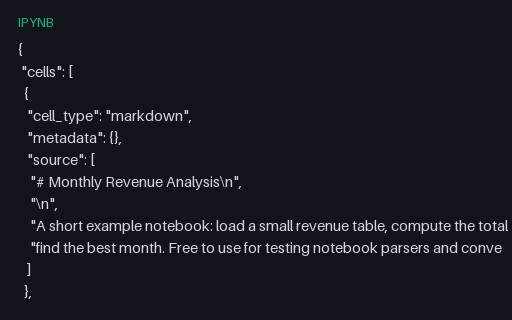
- ipynbJupyter Notebook (IPYNB)A valid Jupyter notebook (nbformat 4.5) with markdown cells, code cells, and real outputs (stdout stream and an execute result) — for testing notebook parsers, nbconvert, and JSON tooling.
- jwtSample JWT (HS256)A sample JSON Web Token (JWT) signed with HS256 using a published example secret — verifiable but powerless — for testing JWT decoders and validators. Sample only, never for production. Paired with its decoded claims.
- svgAnimated Spinner (SVG)An animated loading spinner using SMIL (animateTransform) — a self-contained animated SVG for testing whether a renderer or converter handles SVG animation, and how it rasterises an animated frame.

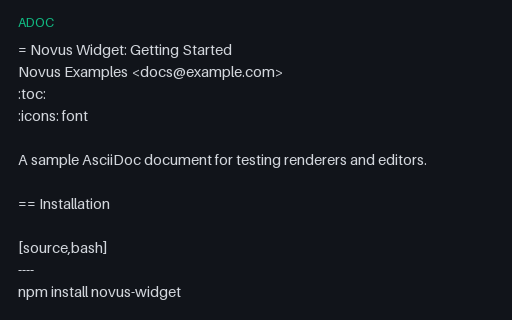
- adocAsciiDoc Guide (ADOC source)An AsciiDoc getting-started guide with source blocks, an admonition, and a table — for testing AsciiDoc renderers (Asciidoctor), editors, and conversion to HTML/PDF.
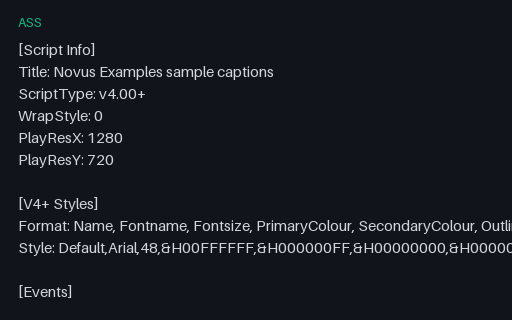
- assASS Subtitles (Advanced SSA)An Advanced SubStation Alpha (.ass) subtitle with a styles section and three timed Dialogue events — the styled format libass renders — carrying the same captions as the SRT/VTT twins.
- svgBar Chart (SVG)A bar chart drawn as vector SVG — axis, gridlines, labelled bars — the scalable counterpart to the raster chart images, for testing SVG chart rendering and vector conversion.
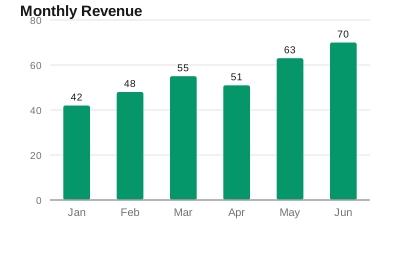
Generated by generation/data_dev_artifacts.py. Free for any use, no attribution required — license.