
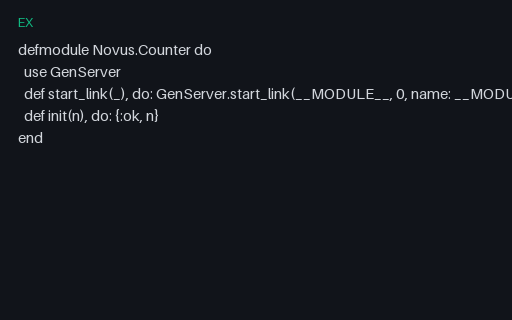
ex
154 BElixir GenServer Stub
Elixir GenServer stub SAMPLE for Beam tooling.
- File
- EX · Elixir
- Use case
- Syntax highlightingCode parsing+1
Find files, editable templates and browser test targets by what you need to make or test. Explore complete business kits for connected records, templates and expected results.
Page 62 of 221; 24 results per page.
Elixir GenServer stub SAMPLE for Beam tooling.
Elixir module hello, for Beam/Elixir syntax and formatter smoke tests.
Elixir pipe-operator snippet for AST and formatter fixtures.
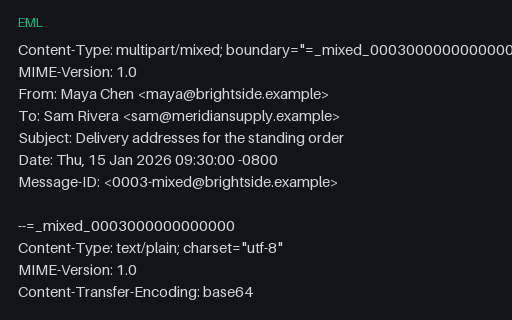
A multipart/mixed email with a base64-encoded CSV file attachment, for testing attachment detection, decoding, and extraction from an EML message.
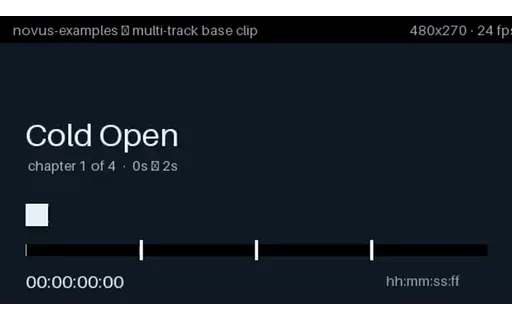
Cover art embedded in an MP4 as a still JPEG carrying the `attached_pic` disposition. Note what that means structurally: the artwork is a *second video stream*, not a metadata field. That is the trap. A pipeline that maps 'the video stream' with `-map 0:v` picks up both and produces a file with a stray one-frame track; one that counts video streams to decide whether a file is a video reports two. Both are common, and neither shows up until a file with artwork arrives.
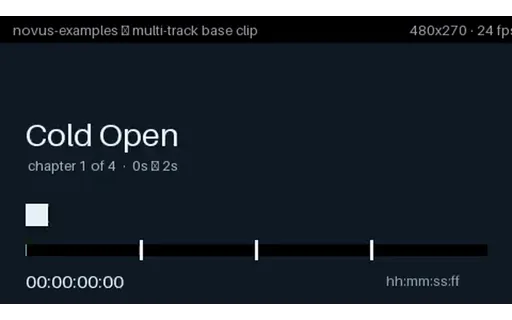
A Matroska attachment: a whole file carried inside the container alongside the media, with its own filename and MIME type. In the wild this is how fonts travel with styled ASS subtitles, so that a rendering machine lacking the typeface still gets the right result. Extract it with `ffmpeg -dump_attachment:t:0 out.txt -i …`. Unlike the MP4 cover art in this group, an attachment is not a media stream: it demuxes as `codec_type=attachment` and has no frames, which is why remuxing to any container without an attachment concept discards it silently. The filename here is deliberately not `cover.jpg`. Matroska's cover-art convention is simply an attachment named `cover.*`, and FFmpeg and most players special-case that name and promote it to an `attached_pic` video stream. So the same bytes attached under two different filenames produce two different stream lists: a genuinely surprising result if you are counting streams to decide what a file contains.
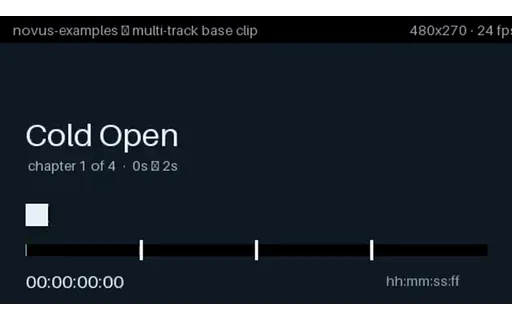
A file with a known, fixed creation time: the field media libraries sort by, importers use to build folders, and forensic tools read first. Fixed rather than generated at build time, so re-running the generator produces byte-identical output and the published value never goes stale. Two behaviours worth testing against it. MP4 stores the `mvhd` timestamp in seconds since 1904 with no timezone, so anything that displays a local time is applying an assumption; and the stripped file in this group has no creation time at all, which is what a privacy-scrubbed file should look like.
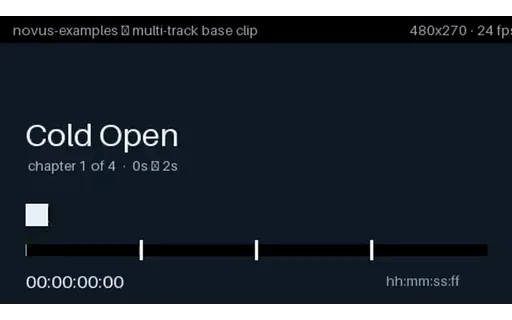
Eight container-level metadata fields written into the same eight-second clip, so a metadata reader can be checked against a file whose expected values are published rather than guessed. Every value is obviously sample data. Matroska stores tags as arbitrary name/value SimpleTags scoped to a target level, so it has no fixed vocabulary and nothing is dropped. The same eight fields as the MP4 in this group: compare the two to see exactly which values survive a cross-container remux and which are quietly lost.
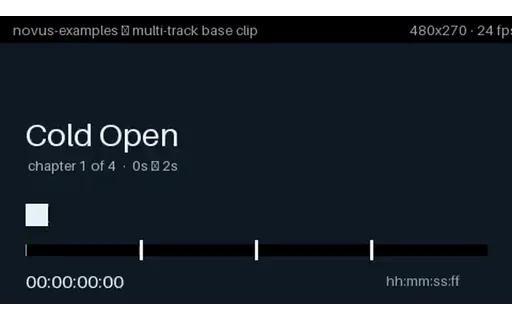
Eight container-level metadata fields written into the same eight-second clip, so a metadata reader can be checked against a file whose expected values are published rather than guessed. Every value is obviously sample data. MP4 stores these in an iTunes-style `moov/udta/meta/ilst` atom, with fixed four-character keys. Fields outside that vocabulary (`description` here) are written as freeform `----` atoms that many readers skip, so a tag can be present in the file and invisible to the tool you are testing.
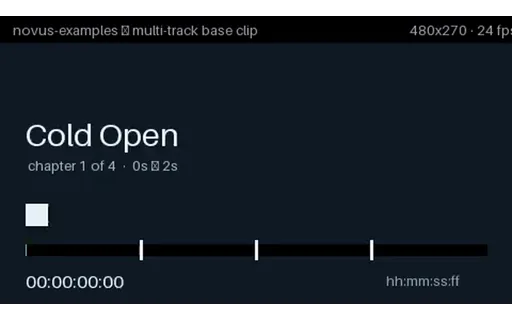
A start timecode of 01:00:00:00: the broadcast convention of beginning programme material at hour one, so that bars, slates and pre-roll can live before it without going negative. FFmpeg writes it as a QuickTime `tmcd` track. The burned-in timecode in the picture deliberately starts at 00:00:00:00 instead. That one-hour disagreement is the whole point: an editor or QC tool that reads the timecode track shows 01:00:00:00 at the first frame, one that reads elapsed time shows zero, and a file where they agree cannot tell you which your tool is doing. Non-drop-frame, since 24 fps has no drop-frame variant.
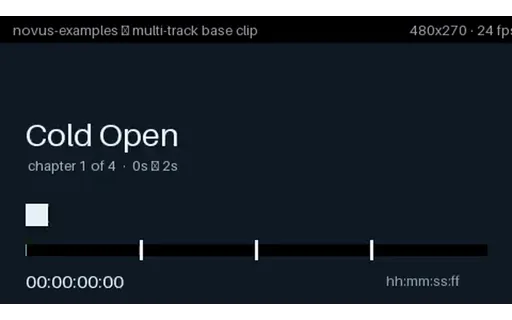
The same clip with every scrap of metadata removed: no tags, no creation time, not even the encoder string FFmpeg normally writes. The control for this group and the baseline for a privacy or scrubbing tool: if your stripper leaves anything this file does not have, it is not stripping enough. Getting to genuinely zero takes `-map_metadata -1` **and** `-fflags +bitexact` placed after the input, as an output option. `-map_metadata -1` alone still leaves the `encoder=Lavf…` tag behind, and putting the bitexact flag before `-i` applies it to the demuxer where it does nothing to the output, which is the usual reason a file someone believes they stripped still names the software that made it. What cannot be removed: `major_brand`, `minor_version` and `compatible_brands`. Probing tools list those alongside the tags, but they are fields of the `ftyp` box that define what the file is, not metadata about it.
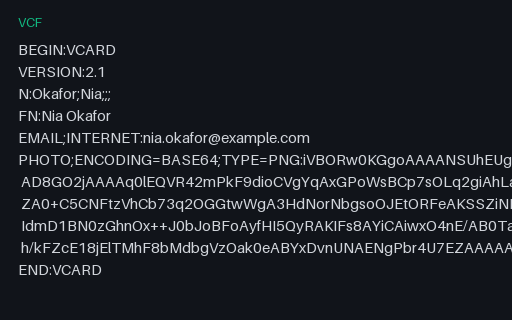
A fictional contact carrying the same tiny portrait in the version-specific photo syntax used by vCard 2.1, 3.0 and 4.0. This member uses vCard 2.1 syntax.
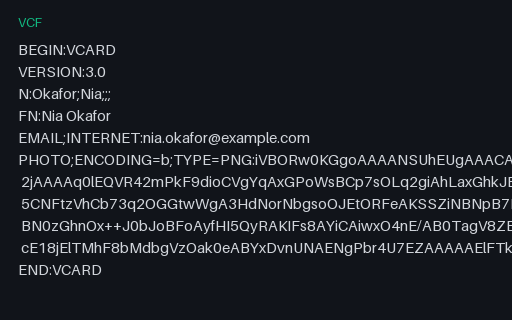
A fictional contact carrying the same tiny portrait in the version-specific photo syntax used by vCard 2.1, 3.0 and 4.0. This member uses vCard 3.0 syntax.
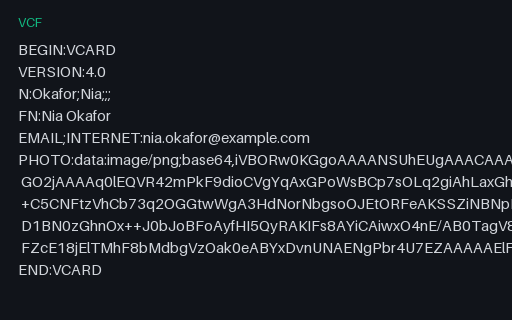
A fictional contact carrying the same tiny portrait in the version-specific photo syntax used by vCard 2.1, 3.0 and 4.0. This member uses vCard 4.0 syntax.
ID list and model metadata for the Wave F embedding set.
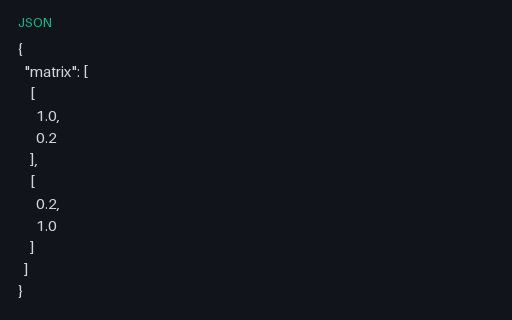
Tiny 2×2 cosine similarity matrix for embedding eval unit tests.
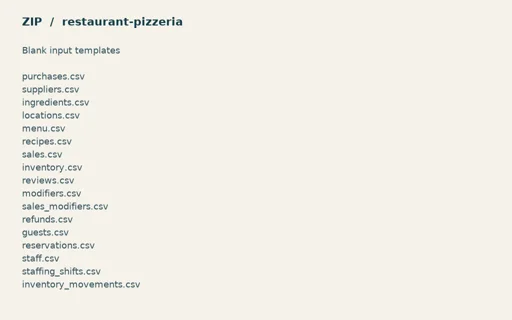
Blank input table templates for Ember Lane Pizza. 18 header-only CSV templates and one setup guide. No filled sample records or executable content.
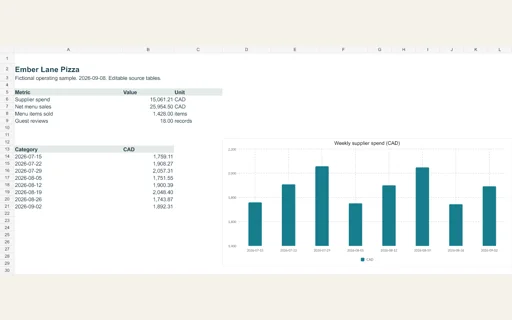
Editable operating workbook for Ember Lane Pizza. Native sheets preserve 375 source records, 4 calculated headline metrics and one editable chart. Supplier spend=15,061.21 CAD; Net menu sales=25,954.50 CAD; Menu items sold=1,428.00 items; Guest reviews=18.00 records. The first worksheet holds 96 compatible purchase rows.
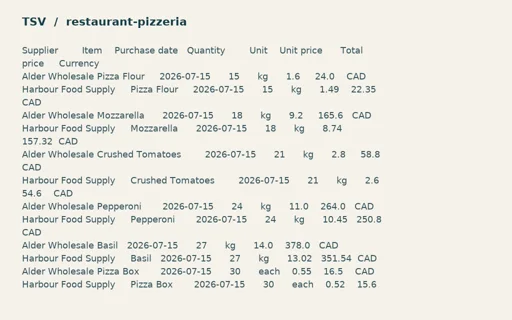
Equivalent purchase import TSV for Ember Lane Pizza. 96 data rows, 8 columns and 96 expected accepted rows.
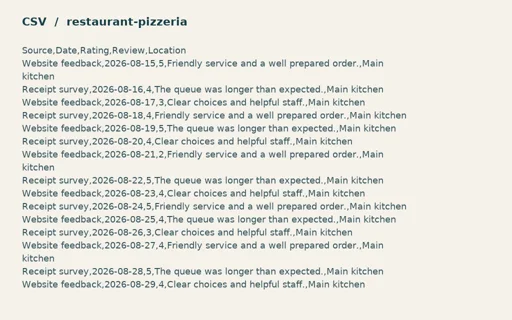
Guest review import CSV for Ember Lane Pizza. 18 data rows, 5 columns and 18 expected accepted rows.
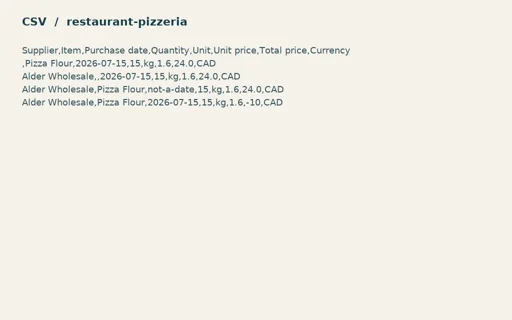
Intentionally invalid purchase import for Ember Lane Pizza. 4 data rows, 8 columns and 0 expected accepted rows.
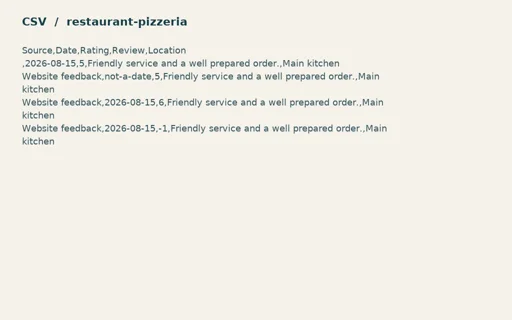
Intentionally invalid review import for Ember Lane Pizza. 4 data rows, 5 columns and 0 expected accepted rows.
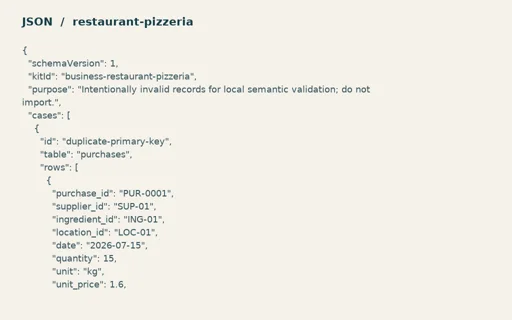
Intentionally invalid semantic test records for Ember Lane Pizza. Three independent cases report duplicate-primary-key, schema-type and foreign-key errors. JSON syntax remains valid.
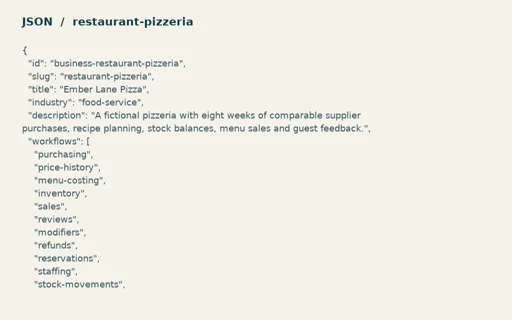
Linked operating model for Ember Lane Pizza. 375 records across 18 linked tables; no duplicate primary keys or missing references. Supplier spend=15,061.21 CAD; Net menu sales=25,954.50 CAD; Menu items sold=1,428.00 items; Guest reviews=18.00 records.
We use Google Analytics and show ads via Adsterra. Non-essential cookies and ad scripts run only after you allow the matching categories. See our cookie policy.