
md
1.6 KBJuniper Workspace Cloud: Workflow and import guide
Workflow and import guide for Juniper Workspace Cloud. Documents 6 source tables, exact expected totals and supported versus manual workflows.
- File
- MD · Business Kits
- Use case
- Data import
Find files, editable templates and browser test targets by what you need to make or test. Explore complete business kits for connected records, templates and expected results.
Page 113 of 221; 24 results per page.
Workflow and import guide for Juniper Workspace Cloud. Documents 6 source tables, exact expected totals and supported versus manual workflows.
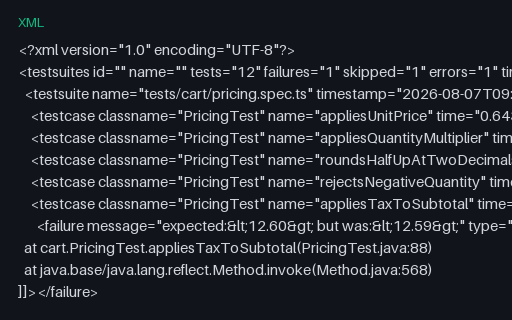
The same 12-case Novus Checkout run written the way @playwright/test 1.47 junit reporter writes it. Playwright puts the run totals on the <testsuites> root, names each suite after its spec file, and uses the bare describe title as classname. All eight dialect files in this group report 12 tests, 1 failure, 1 error and 1 skip, so a JUnit parser can be held to identical totals across every producer.
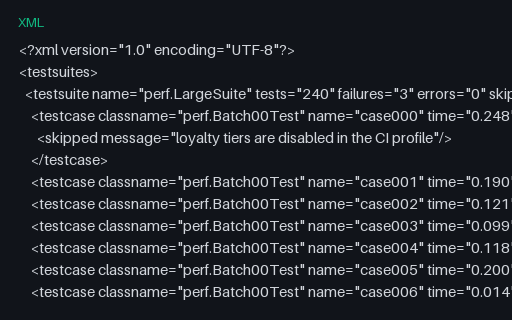
240 cases across six classes, three of them failing. Big enough to time a parser and to check that a report UI paginates or virtualises rather than rendering every row, but still small enough to read.
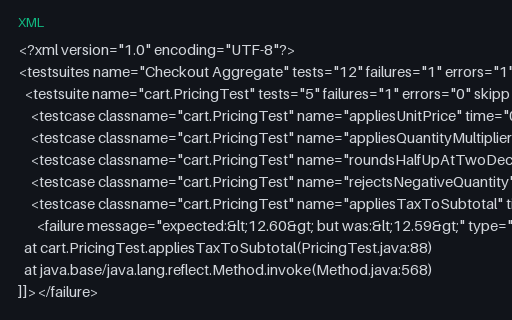
Three suites under a <testsuites> root whose own attributes already hold the aggregate totals. A parser that sums the children and also trusts the root double-counts every case, which is the classic cause of a dashboard reporting 24 tests for a 12-test run.
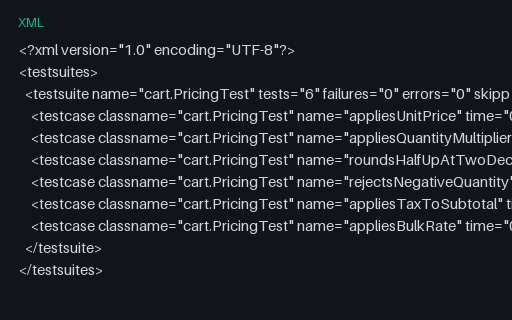
A clean green run: six passing cases, zero failures, errors and skips. The baseline a CI gate should treat as success, and the control case for any dashboard that colours a build from the failure count.
The single-suite form Gradle and Ant write: the root element is <testsuite> with no <testsuites> wrapper at all. Parsers hardcoded to descend from <testsuites> read this file as empty rather than failing, so it silently reports a run of zero tests.
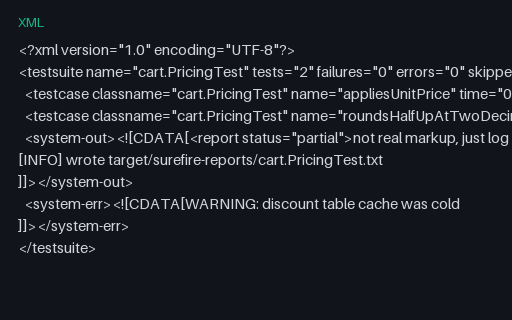
Captured stdout and stderr wrapped in CDATA, where the stdout text itself looks like XML markup. A parser must treat the CDATA content as opaque characters; one that re-parses it finds a <report> element that does not exist.
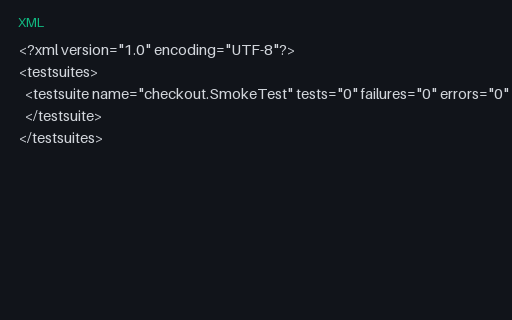
A structurally valid report containing a suite with no <testcase> children at all: what a runner writes when a filter matched nothing. Aggregators that divide by the test count to compute a pass rate hit a zero denominator here.
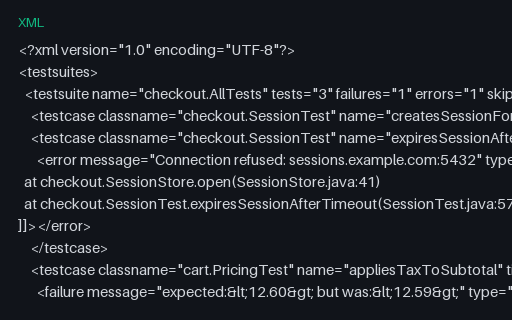
One <failure> (an assertion that did not hold) and one <error> (an exception the test never expected), side by side. Parsers that collapse the two lose the distinction between a broken assertion and a broken environment.
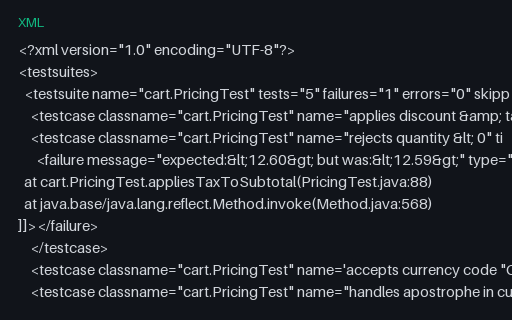
Test names containing &, <, >, quotes and an apostrophe, escaped as XML requires. Round-tripping this report through a converter is the fastest way to find double-escaping bugs that turn & into &amp; one hop at a time.
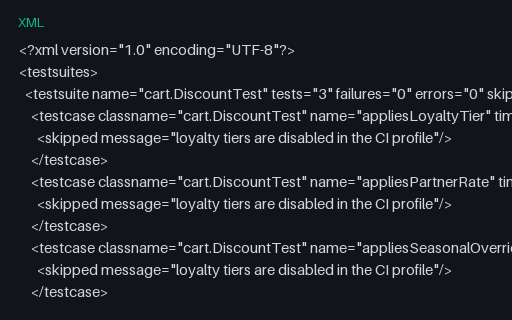
A suite in which every case was skipped, so tests equals skipped and nothing actually ran. A gate that reads only the failure count calls this green; one that checks executed>0 catches it.
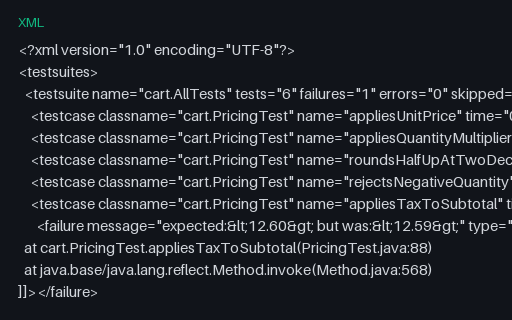
Cases annotated with the source file and line they were declared on, as pytest and several JS runners emit. This is what a code-review annotation bot needs to place a failure comment on the right line of the right file.
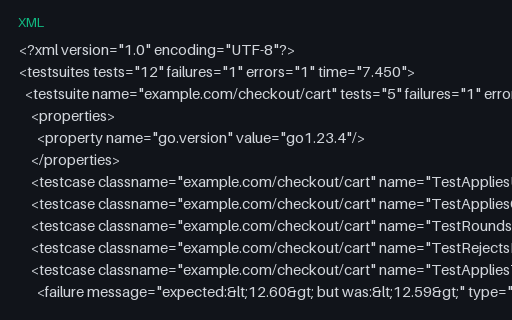
The same 12-case Novus Checkout run written the way go-junit-report 2.1 writes it. go-junit-report names each suite after a Go package and carries the toolchain version in a go.version property. All eight dialect files in this group report 12 tests, 1 failure, 1 error and 1 skip, so a JUnit parser can be held to identical totals across every producer.
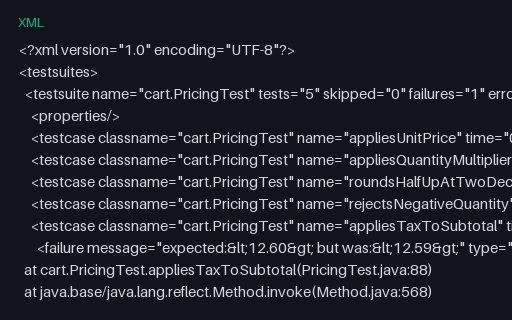
The same 12-case Novus Checkout run written the way Gradle 8.9 Test task writes it. Gradle writes hostname and timestamp on every suite and an empty self-closing <properties/> element that some parsers mishandle. All eight dialect files in this group report 12 tests, 1 failure, 1 error and 1 skip, so a JUnit parser can be held to identical totals across every producer.
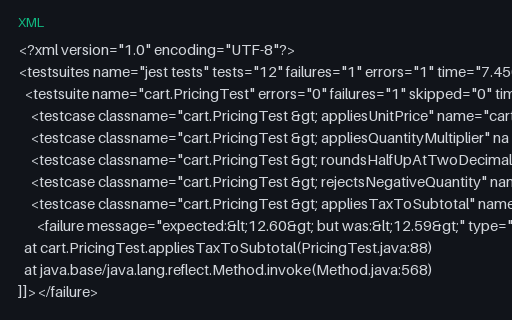
The same 12-case Novus Checkout run written the way jest-junit 16 writes it. jest-junit repeats the whole "describe > it" title in both classname and name, which breaks dashboards that assume classname is a package. All eight dialect files in this group report 12 tests, 1 failure, 1 error and 1 skip, so a JUnit parser can be held to identical totals across every producer.
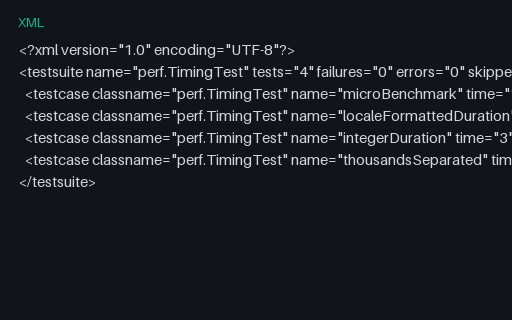
Durations written four different ways in one file: scientific notation, a comma decimal separator from a German-locale JVM, a bare integer, and a comma that could be either a decimal point or a thousands separator. A parser using a locale-sensitive number reader gets a different answer depending on where it runs.
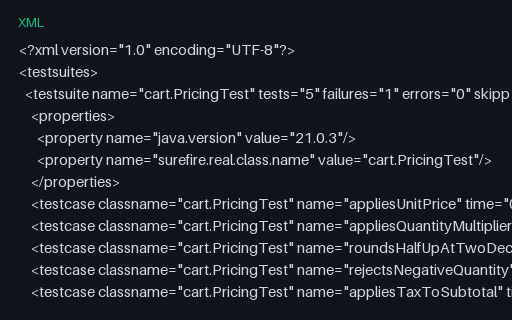
The same 12-case Novus Checkout run written the way maven-surefire 3.2 writes it. Maven Surefire merges its per-class files under a <testsuites> root and adds a <properties> block plus system-out/system-err on every suite. All eight dialect files in this group report 12 tests, 1 failure, 1 error and 1 skip, so a JUnit parser can be held to identical totals across every producer.
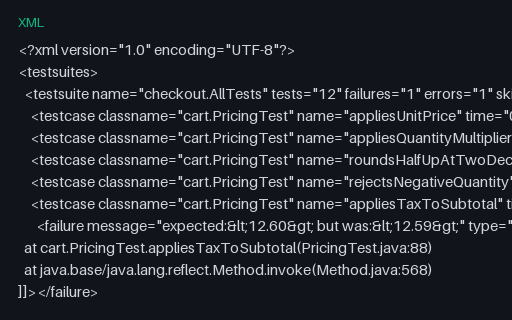
The full canonical run flattened into a single suite: nine passes, one failure, one error and one skip. This is the same twelve cases the eight dialect files carry, so totals can be compared straight across.
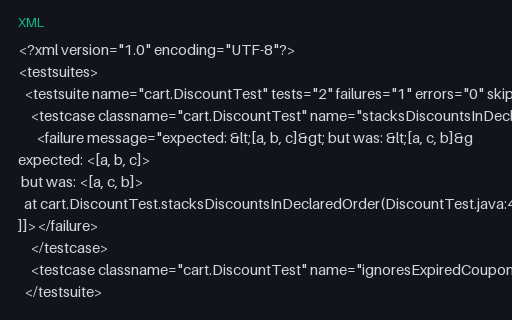
A failure whose message contains an expected/actual diff with angle brackets and newlines, the shape assertion libraries actually produce. Good for checking that a dashboard escapes the message for HTML and keeps its line breaks.
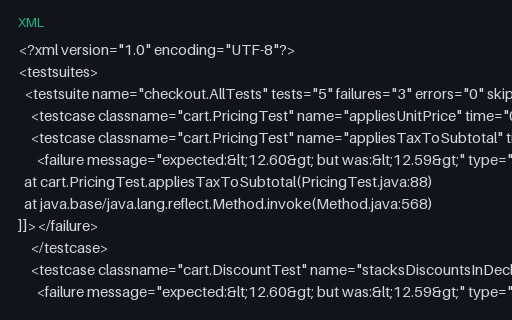
Three failures spread across three different classes in one suite. Use it to check that a reporter lists every failure rather than stopping at the first, and that it groups them by classname rather than by suite.
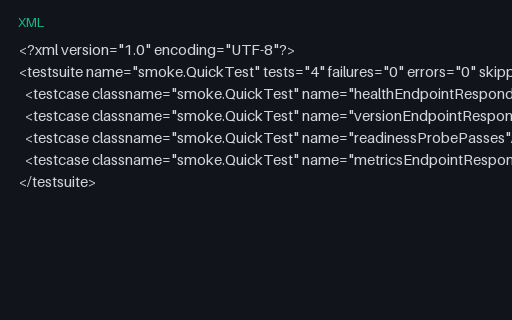
A report from a runner that never records durations: neither the suite nor any case carries a time attribute. Dashboards that parse time unconditionally throw here, and ones that default it to zero quietly report a suite that took no time at all.
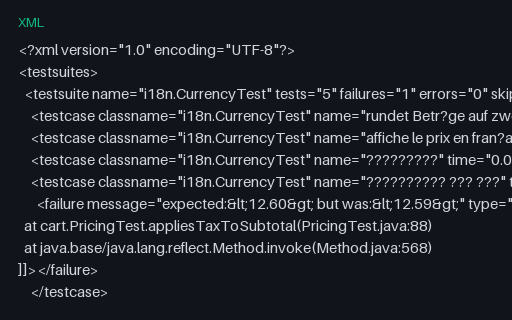
Test names in German, French, Japanese, Greek and Russian, stored as UTF-8 with no BOM and an explicit encoding declaration. A reporter that assumes the platform default encoding produces mojibake here rather than an error.
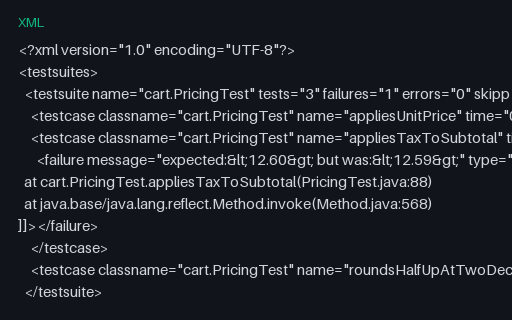
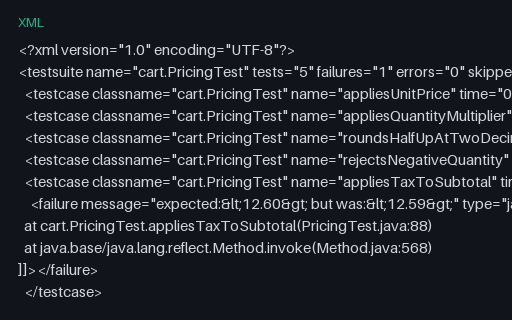
Three cases, one of them failing with an assertion message and a CDATA stack trace. The smallest report that must turn a build red, and the one to test a failure-summary renderer against.
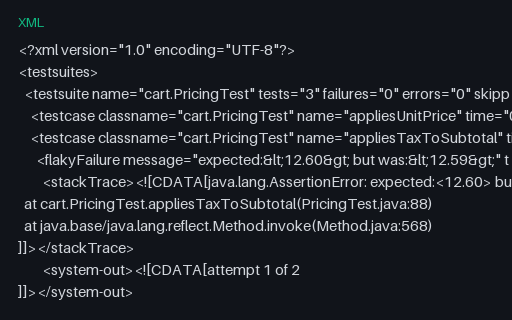
A case that failed on its first attempt and passed on the retry, recorded with Surefire's <flakyFailure> child. The suite counters say zero failures, so a parser that ignores the extension element reports a clean run and loses the flake entirely.
We use Google Analytics and show ads via Adsterra. Non-essential cookies and ad scripts run only after you allow the matching categories. See our cookie policy.