
Multi-Track — No Default Flag Anywhere (MKV)
Three subtitle tracks and not one of them flagged default. Matroska permits this and players disagree completely about what to do: some pick the first track, some pick by system language, some show nothing at all and leave the viewer to find the menu. There is no right answer to assert here — the value is that the disagreement is reproducible. If your player picks a track, this file tells you which rule it is using.
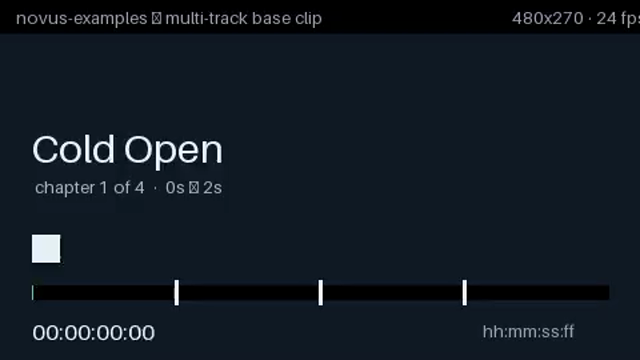
Rendered preview of the mkv file (27.9 KB). Download above for the original.
Specifications
- Subtitle Tracks
- 3
- Default Flags Set
- 0
- Languages
- eng, spa, jpn
- Duration
- 8s
- Subtitle Codec
- SubRip (S_TEXT/UTF8)
Testing contract
Expected to recover- Scenario
- Open the file and decide which subtitle track to pre-select.
- Expected result
- 3 subtitle tracks - eng, spa, jpn - and zero default flags set. There is no correct answer in the file, so the player's own fallback rule is what is being tested: first track, user locale, or nothing at all. Whatever it picks must be deterministic, which is what makes this checkable.
What is a .mkv file?
MKV (Matroska) is an open, codec-agnostic multimedia container that holds unlimited video, audio, subtitle, chapter, and attachment tracks in one file. Its structure is EBML, a binary tree of length-prefixed elements, and its attachments typically carry the fonts an ASS subtitle track needs. Because it constrains nothing about the streams inside, the extension says nothing about whether a player can decode them. Steve Lhomme started the project in 2002; WebM is the restricted profile of it that browsers accept.
How to use this file
Use an example MKV to test EBML parsing and multi-track demuxing, subtitle and chapter extraction, and remux pipelines, checking that per-track language and default flags survive, that font attachments are preserved, and that a remux to MP4 reports the tracks MP4 cannot carry instead of dropping them silently.
How to use this file for testing
“Multi-Track — No Default Flag Anywhere (MKV)” is a deterministic Novus Examples fixture for Media accessibility, Media metadata, Subtitle testing, Video QA. Containers carrying several subtitle and audio tracks at once, with real language tags and the default, forced, hearing-impaired and visual-impaired flags actually set, for testing track pickers, accessibility menus, and the flag handling that only shows up when more than one track exists.
Documented properties for this file: 8s. Compare results against paired or grouped companions on this page when present (clean↔damaged, searchable↔scanned, or format twins) so scores stay reproducible across runs.
Download the file once, keep the path stable in CI or local scripts, and treat the spec table as the contract: dimensions, seeds, field lists, and roles are intentional. Corrupt or invalid samples are labelled as such, expect parsers to fail loudly rather than silently accept them.
Media fixtures are short and synthetic by design. Prefer waveform or transcript ground truth in the same group when measuring ASR, trim, upscale, or sync tools; do not assume broadcast-quality masters.
Code examples
<video controls preload="metadata" width="640" src="mkv-no-default-track.mkv"></video>Related files
- webmMulti-Track Subtitles — Embedded WebVTT (WebM)WebVTT muxed inside a WebM container, which the Matroska specification allows and almost nothing consumes. No browser surfaces an embedded WebVTT track through the HTML TextTrack API — the web platform expects a separate <track> element pointing at a sidecar file — so this is the fixture for the gap between what a container is permitted to hold and what a player will actually give you. One caveat about this file specifically. Every other fixture in this phase carries byte-identical H.264 video, but the WebM muxer accepts only VP8, VP9 or AV1 video and WebVTT subtitles — that restriction is the container's definition, not a limitation of the tooling — so the picture here is re-encoded to VP9 from the same source frames. Same content, different bytes.
- mkvMulti-Track Subtitles — Forced Narrative (MKV)Two English subtitle tracks in one file: the full dialogue track, and a forced-narrative track that carries only the two moments where on-screen text needs translating. The second track sets the `forced` disposition, which tells a player to display it even when the viewer has subtitles switched off. The forced track is deliberately two cues, not eight. A forced track that repeats the full dialogue is the most common way this feature is got wrong in the wild, and a fixture that reproduced that mistake could not be used to detect it. Useful for checking that a player reads the flag rather than the track order, and that a transcoder preserves it — many drop the disposition silently and the file still looks fine until a viewer turns subtitles off.
- mp4Multi-Track Subtitles — No Subtitle Track (MP4)The control for this group: the same picture with no subtitle track at all. Every other file here differs from this one only by what was muxed in. Worth more than it looks. A track enumerator that returns an empty list, one that returns a single null entry and one that throws are three different behaviours, and none of them can be told apart using a file that has subtitles.
- mkvMulti-Track Subtitles — SDH and Standard (MKV)Standard subtitles and SDH (Subtitles for the Deaf and Hard of Hearing) as two separate English tracks, distinguished only by the `hearing_impaired` disposition. The SDH track adds the non-speech information a deaf viewer would otherwise lose — the tone that is playing, the marker that is moving — in square brackets above each line. Because both tracks are tagged `eng`, any picker that keys on language alone shows two identical-looking entries. That is exactly the bug this file exists to surface: the flag is the only thing that separates them, and it is the thing most often dropped in a remux.
- mkvMulti-Track Subtitles — Styled ASS Track (MKV)An ASS subtitle track that carries its own styling — two named styles, alternating cue by cue, one bottom-centred and one top-centred in italic teal. ASS is the only widely-used soft subtitle format that survives a remux with its positioning and colour intact. The useful test is what happens on the way out. Convert this to SubRip or to WebVTT and the styling is silently discarded — the cues remain, so the conversion reports success while half the information is gone. Converting to MP4 is worse still: mov_text keeps neither the styles nor the positions.
- mkvMulti-Track Subtitles — Three Languages (MKV)One MKV carrying three soft subtitle tracks — English, Spanish and Japanese — each with a real ISO 639-2 language tag and a human track title, and English flagged as the default. Every cue names its own second and its own chapter, and the picture burns in a matching timecode, so you can confirm the right track is displaying without trusting the player's own menu labels. Single-track sample files never exercise the code that actually breaks: track enumeration, language-tag mapping and default selection. This is the smallest file that does.
Generated by generation/video_accessibility.py. Free for any use, no attribution required, license.