
Compression Input — text-motion at CRF 44
The text-motion plate at CRF 44 — severe artefacts. Encoded from the original frames rather than transcoded from the reference, so it carries exactly one generation of loss and the comparison is clean. On this plate the damage shows as ringing around glyph edges, where legibility gives a pass/fail signal that needs no metric.
Browser-playable test video · 2 seconds
Specifications
- Resolution
- 640x360
- Fps
- 24
- Codec
- H.264 (libx264)
- Crf
- 19
- Preset
- slow
- Artefact Severity
- severe
- Role
- artefact-removal input
- Reference
- vid-compress-text-motion-gt
- Base Plate
- text-motion
Testing contract
Expected to pass- Scenario
- Remove compression artefacts from the clip and score the result against the ground-truth reference.
- Expected result
- This is the text-motion plate encoded far enough down the quantiser ladder that artefacts are severe. It is 8,298 bytes against the reference's 38,619, and the four rungs of this ladder decrease monotonically in size - the only variable across them is the encoder setting, since each was encoded from the original frames rather than transcoded from the reference, so every rung carries exactly one generation of loss.
What is a .mp4 file?
MP4 (MPEG-4 Part 14) is the dominant container for digital video, holding video, audio, subtitle, and metadata tracks in a tree of typed boxes. `ftyp` declares the brand, `moov` carries the sample tables that make seeking possible, and `mdat` holds the media; when an encoder writes `moov` last, playback cannot begin until the file has fully downloaded, which a faststart remux fixes. It derives from Apple's QuickTime format, generalized by ISO into the ISOBMFF base that MOV, 3GP, and HEIF share.
How to use this file
Use an example MP4 to test box parsing and track detection, seeking, range-request streaming, and transcode or thumbnail pipelines: verifying that a file with a trailing `moov` box is still handled, and that codec support is checked per track rather than inferred from the extension.
How to use this file for testing
“Compression Input — text-motion at CRF 44” is a deterministic Novus Examples fixture for Compression artefacts, Video codecs, Video QA. The same footage at a ladder of quantiser settings from near-lossless down to visibly broken, each paired with its high-quality source, for testing artefact-removal models and for calibrating quality metrics against known encoder settings.
Documented properties for this file: artefact-removal input · 24 fps. Compare results against paired or grouped companions on this page when present (clean↔damaged, searchable↔scanned, or format twins) so scores stay reproducible across runs.
Download the file once, keep the path stable in CI or local scripts, and treat the spec table as the contract: dimensions, seeds, field lists, and roles are intentional. Corrupt or invalid samples are labelled as such, expect parsers to fail loudly rather than silently accept them.
Media fixtures are short and synthetic by design. Prefer waveform or transcript ground truth in the same group when measuring ASR, trim, upscale, or sync tools; do not assume broadcast-quality masters.
Code examples
<video controls preload="metadata" width="640" src="text-motion-crf44.mp4"></video>Related files
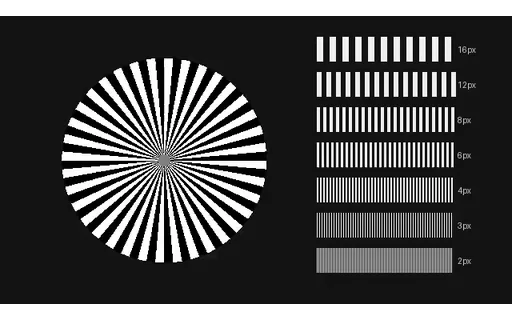
- mp4Compression Input — detail-chart at CRF 28The detail-chart plate at CRF 28 — mild artefacts. Encoded from the original frames rather than transcoded from the reference, so it carries exactly one generation of loss and the comparison is clean. On this plate the fine wedges collapse first, showing exactly which spatial frequencies the quantiser discarded.
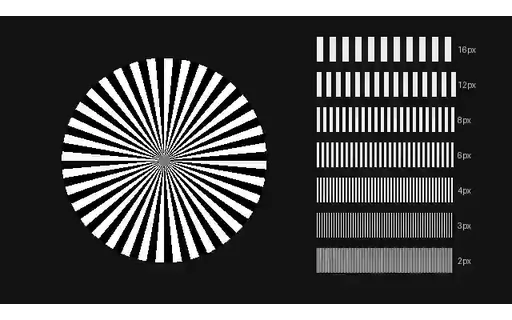
- mp4Compression Input — detail-chart at CRF 36The detail-chart plate at CRF 36 — clearly visible artefacts. Encoded from the original frames rather than transcoded from the reference, so it carries exactly one generation of loss and the comparison is clean. On this plate the fine wedges collapse first, showing exactly which spatial frequencies the quantiser discarded.
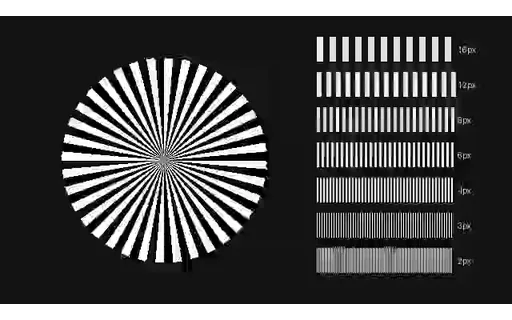
- mp4Compression Input — detail-chart at CRF 44The detail-chart plate at CRF 44 — severe artefacts. Encoded from the original frames rather than transcoded from the reference, so it carries exactly one generation of loss and the comparison is clean. On this plate the fine wedges collapse first, showing exactly which spatial frequencies the quantiser discarded.
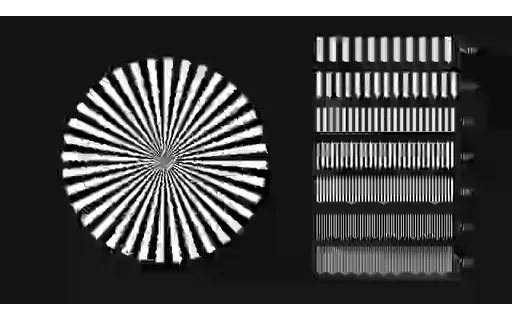
- mp4Compression Input — detail-chart at CRF 51The detail-chart plate at CRF 51 — extreme — the codec's limit artefacts. Encoded from the original frames rather than transcoded from the reference, so it carries exactly one generation of loss and the comparison is clean. On this plate the fine wedges collapse first, showing exactly which spatial frequencies the quantiser discarded.
- mp4Compression Input — gradient-sky at CRF 28The gradient-sky plate at CRF 28 — mild artefacts. Encoded from the original frames rather than transcoded from the reference, so it carries exactly one generation of loss and the comparison is clean. On this plate the damage shows as banding across the smooth gradient, which is the artefact viewers notice first and metrics score most poorly.

- mp4Compression Input — gradient-sky at CRF 36The gradient-sky plate at CRF 36 — clearly visible artefacts. Encoded from the original frames rather than transcoded from the reference, so it carries exactly one generation of loss and the comparison is clean. On this plate the damage shows as banding across the smooth gradient, which is the artefact viewers notice first and metrics score most poorly.
Generated by generation/video_ai_suites.py. Free for any use, no attribution required, license.