
Chapters — Matroska Chapter XML
The XML dialect `mkvmerge` and `mkvpropedit` read to write chapters into a Matroska file without re-muxing it. Timestamps are nanosecond-precision `HH:MM:SS.nnnnnnnnn`, and each ChapterAtom carries a UID that must be stable across edits — the field most hand-written generators omit, which is why re-running them renumbers every chapter.
<?xml version="1.0" encoding="UTF-8"?>
<Chapters>
  <EditionEntry>
    <EditionUID>1</EditionUID>
    <EditionFlagDefault>1</EditionFlagDefault>
    <ChapterAtom>
      <ChapterUID>101</ChapterUID>
      <ChapterTimeStart>00:00:00.000000000</ChapterTimeStart>
      <ChapterTimeEnd>00:00:02.000000000</ChapterTimeEnd>
      <ChapterDisplay>
        <ChapterString>Cold Open</ChapterString>
        <ChapterLanguage>eng</ChapterLanguage>
      </ChapterDisplay>
    </ChapterAtom>
    <ChapterAtom>
      <ChapterUID>102</ChapterUID>
      <ChapterTimeStart>00:00:02.000000000</ChapterTimeStart>
      <ChapterTimeEnd>00:00:04.000000000</ChapterTimeEnd>
      <ChapterDisplay>
        <ChapterString>Titles</ChapterString>
        <ChapterLanguage>eng</ChapterLanguage>
      </ChapterDisplay>
    </ChapterAtom>
    <ChapterAtom>
      <ChapterUID>103</ChapterUID>
      <ChapterTimeStart>00:00:04.000000000</ChapterTimeStart>
      <ChapterTimeEnd>00:00:06.000000000</ChapterTimeEnd>
      <ChapterDisplay>
        <ChapterString>Main Segment</ChapterString>
        <ChapterLanguage>eng</ChapterLanguage>
      </ChapterDisplay>
    </ChapterAtom>
    <ChapterAtom>
      <ChapterUID>104</ChapterUID>
      <ChapterTimeStart>00:00:06.000000000</ChapterTimeStart>
      <ChapterTimeEnd>00:00:08.000000000</ChapterTimeEnd>
      <ChapterDisplay>
        <ChapterString>Credits</ChapterString>
        <ChapterLanguage>eng</ChapterLanguage>
      </ChapterDisplay>
    </ChapterAtom>
  </EditionEntry>
</Chapters>
Specifications
- Format
- Matroska Chapters XML
- Chapters
- 4
- Timestamp Precision
- nanoseconds
- Tool
- mkvpropedit --chapters
- Chapter Names
- Cold Open / Titles / Main Segment / Credits
Testing contract
Expected to pass- Scenario
- Parse the file as Matroska Chapters XML and apply it with `mkvpropedit --chapters`.
- Expected result
- 4 chapters - Cold Open, Titles, Main Segment, Credits - with timestamps at nanosecond precision. Nanoseconds are the assertion: this is the highest-precision representation in the group, so converting it to the FFMETADATA form (1/1000 timebase) or to WebVTT (milliseconds) loses resolution, and the conversion must round explicitly rather than truncate.
What is a .xml file?
XML (Extensible Markup Language) is a verbose, self-describing markup language using nested tags, attributes, and namespaces to represent structured, hierarchical data. It supports schemas, entities, and validation and underlies many document and data formats. It remains common in enterprise, publishing, and interchange contexts.
How to use this file
Use an example XML file to test parsers, namespace and schema validation, XPath queries, and protection against entity-expansion and external-entity attacks.
How to use this file for testing
“Chapters — Matroska Chapter XML” is a deterministic Novus Examples fixture for Media metadata, Video QA, Conversion testing. Video files with embedded chapters, full container tags, attached cover art and a SMPTE start timecode, each paired with a deliberately stripped twin, so you can tell a metadata reader that found nothing from one that was never given anything.
Documented properties for this file: Matroska Chapters XML. Compare results against paired or grouped companions on this page when present (clean↔damaged, searchable↔scanned, or format twins) so scores stay reproducible across runs.
Download the file once, keep the path stable in CI or local scripts, and treat the spec table as the contract: dimensions, seeds, field lists, and roles are intentional. Corrupt or invalid samples are labelled as such, expect parsers to fail loudly rather than silently accept them.
Media fixtures are short and synthetic by design. Prefer waveform or transcript ground truth in the same group when measuring ASR, trim, upscale, or sync tools; do not assume broadcast-quality masters.
Code examples
import xml.etree.ElementTree as ET

tree = ET.parse("chapters-matroska.xml")
root = tree.getroot()
print(root.tag, [c.tag for c in root][:5])
Related files
- mp4Embedded Metadata — Cover Art (MP4)Cover art embedded in an MP4 as a still JPEG carrying the `attached_pic` disposition. Note what that means structurally: the artwork is a *second video stream*, not a metadata field. That is the trap. A pipeline that maps 'the video stream' with `-map 0:v` picks up both and produces a file with a stray one-frame track; one that counts video streams to decide whether a file is a video reports two. Both are common, and neither shows up until a file with artwork arrives.
- mkvEmbedded Metadata — File Attachment (MKV)A Matroska attachment: a whole file carried inside the container alongside the media, with its own filename and MIME type. In the wild this is how fonts travel with styled ASS subtitles, so that a rendering machine lacking the typeface still gets the right result. Extract it with `ffmpeg -dump_attachment:t:0 out.txt -i …`. Unlike the MP4 cover art in this group, an attachment is not a media stream — it demuxes as `codec_type=attachment` and has no frames, which is why remuxing to any container without an attachment concept discards it silently. The filename here is deliberately not `cover.jpg`. Matroska's cover-art convention is simply an attachment named `cover.*`, and FFmpeg and most players special-case that name and promote it to an `attached_pic` video stream. So the same bytes attached under two different filenames produce two different stream lists — a genuinely surprising result if you are counting streams to decide what a file contains.
- mp4Embedded Metadata — Fixed Creation Time (MP4)A file with a known, fixed creation time — the field media libraries sort by, importers use to build folders, and forensic tools read first. Fixed rather than generated at build time, so re-running the generator produces byte-identical output and the published value never goes stale. Two behaviours worth testing against it. MP4 stores the `mvhd` timestamp in seconds since 1904 with no timezone, so anything that displays a local time is applying an assumption; and the stripped file in this group has no creation time at all, which is what a privacy-scrubbed file should look like.
- mkvEmbedded Metadata — Full Container Tags (MKV)Eight container-level metadata fields written into the same eight-second clip, so a metadata reader can be checked against a file whose expected values are published rather than guessed. Every value is obviously sample data. Matroska stores tags as arbitrary name/value SimpleTags scoped to a target level, so it has no fixed vocabulary and nothing is dropped. The same eight fields as the MP4 in this group: compare the two to see exactly which values survive a cross-container remux and which are quietly lost.
- mp4Embedded Metadata — Full Container Tags (MP4)Eight container-level metadata fields written into the same eight-second clip, so a metadata reader can be checked against a file whose expected values are published rather than guessed. Every value is obviously sample data. MP4 stores these in an iTunes-style `moov/udta/meta/ilst` atom, with fixed four-character keys. Fields outside that vocabulary — `description` here — are written as freeform `----` atoms that many readers skip, so a tag can be present in the file and invisible to the tool you are testing.
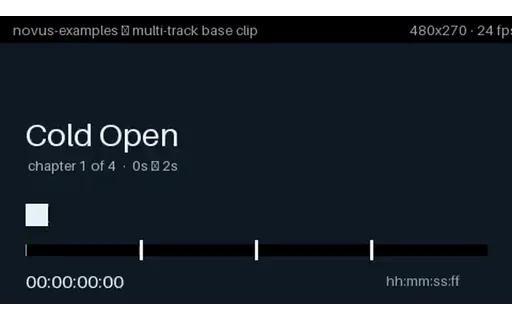
- mp4Embedded Metadata — SMPTE Start Timecode (MP4)A start timecode of 01:00:00:00 — the broadcast convention of beginning programme material at hour one, so that bars, slates and pre-roll can live before it without going negative. FFmpeg writes it as a QuickTime `tmcd` track. The burned-in timecode in the picture deliberately starts at 00:00:00:00 instead. That one-hour disagreement is the whole point: an editor or QC tool that reads the timecode track shows 01:00:00:00 at the first frame, one that reads elapsed time shows zero, and a file where they agree cannot tell you which your tool is doing. Non-drop-frame, since 24 fps has no drop-frame variant.
Generated by generation/video_accessibility.py. Free for any use, no attribution required, license.