
ASS — Karaoke Timing and Override Tags
Advanced SubStation Alpha using the features that distinguish it from SubRip: per-syllable \k karaoke timings in centiseconds, a full V4+ style definition with primary and secondary colours, and an \an override that repositions a line. Converting this to SRT necessarily loses all of it, which makes it a good test of whether a converter warns about that or drops it silently.
[Script Info]
; Karaoke timing — \k tags give per-syllable durations in centiseconds.
ScriptType: v4.00+
PlayResX: 640
PlayResY: 360
WrapStyle: 0

[V4+ Styles]
Format: Name, Fontname, Fontsize, PrimaryColour, SecondaryColour, OutlineColour, BackColour, Bold, Italic, Underline, StrikeOut, ScaleX, ScaleY, Spacing, Angle, BorderStyle, Outline, Shadow, Alignment, MarginL, MarginR, MarginV, Encoding
Style: Karaoke,Arial,28,&H00FFFFFF,&H000088EF,&H00000000,&H80000000,0,0,0,0,100,100,0,0,1,2,1,2,20,20,30,1

[Events]
Format: Layer, Start, End, Style, Name, MarginL, MarginR, MarginV, Effect, Text
Dialogue: 0,0:00:01.00,0:00:04.00,Karaoke,,0,0,0,,{\k50}No{\k40}vus {\k60}Ex{\k50}am{\k70}ples
Dialogue: 0,0:00:04.50,0:00:08.00,Karaoke,,0,0,0,,{\k30}Per{\k30}syl{\k40}la{\k60}ble {\k80}tim{\k60}ing
Dialogue: 0,0:00:08.50,0:00:12.00,Karaoke,,0,0,0,,{\an8}Top-positioned line via an override tag
Specifications
- Script Type
- v4.00+
- Events
- 3
- Tags
- \k karaoke, \an alignment
- Resolution
- 640x360
- Styles
- 1
Testing contract
Expected to pass- Scenario
- Parse the file as Advanced SubStation Alpha and resolve its karaoke timing tags.
- Expected result
- A v4.00+ script with 3 events, 1 style and a declared resolution of 640x360, using `\k` karaoke and `\an` alignment tags. The `\k` values are per-syllable durations in centiseconds, so converting this to SubRip or WebVTT necessarily discards the intra-cue timing - the loss is the point.
What is a .ass file?
ASS (Advanced SubStation Alpha, .ass) is a feature-rich subtitle format that extends SSA with precise styling, positioning, fonts, colours, and animation override tags. It is the standard for fansubs and anime, and is rendered by libass in players like VLC and mpv.
How to use this file
Use an example .ass file to test subtitle parsers and renderers (libass), style and timing extraction, and conversion to or from SRT, VTT, and TTML.
How to use this file for testing
“ASS — Karaoke Timing and Override Tags” is a deterministic Novus Examples fixture for Subtitle parsing, Conversion testing, Video QA. The same captions written out across SubRip, WebVTT, ASS/SSA, SBV, TTML and a synced LRC lyric file, with known timings, for exercising subtitle parsers, format converters and burn-in tools against every serialisation.
Documented properties for this file: ASS · 893 bytes. Compare results against paired or grouped companions on this page when present (clean↔damaged, searchable↔scanned, or format twins) so scores stay reproducible across runs.
Download the file once, keep the path stable in CI or local scripts, and treat the spec table as the contract: dimensions, seeds, field lists, and roles are intentional. Corrupt or invalid samples are labelled as such, expect parsers to fail loudly rather than silently accept them.
Media fixtures are short and synthetic by design. Prefer waveform or transcript ground truth in the same group when measuring ASR, trim, upscale, or sync tools; do not assume broadcast-quality masters.
Parse the cues and check timings against the documented count; the same captions ship across subtitle formats so you can diff a converter against a known target.
Code examples
<video controls src="clip.mp4">
  <track kind="captions" srclang="en" label="English" src="karaoke.ass" default>
</video>
Related files
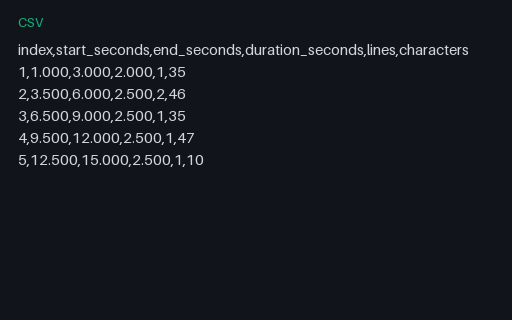
- csvCSV — Cue Timing ReportPer-cue timings and text metrics for the shared cue list, as a caption QC tool would export them: start, end, duration, line count and character count. Useful as the expected output when testing a caption analyser, and as a quick way to check reading-rate calculations against known values.
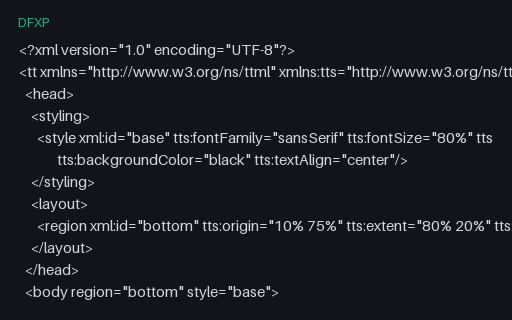
- dfxpDFXP — TTML Under Its Other ExtensionTimed text as DFXP — byte-for-byte a TTML document, just under the extension Netflix, Adobe and older captioning tool-chains still use. Same tt root, same head/body/div/p structure, same styling and region attributes. It exists to check that a caption parser dispatches on document content rather than on the file extension: a parser that accepts .ttml but rejects an identical .dfxp is exactly the bug this catches.
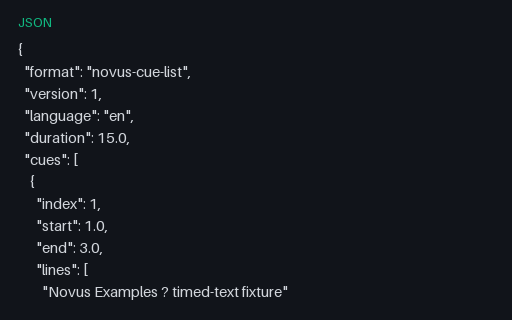
- jsonJSON — Caption Cue ListThe same five cues as a plain JSON array with float second timings — the shape most caption pipelines use internally between parsing one format and writing another. Handy as the expected intermediate when testing a converter, since it removes timestamp-formatting differences from the comparison.
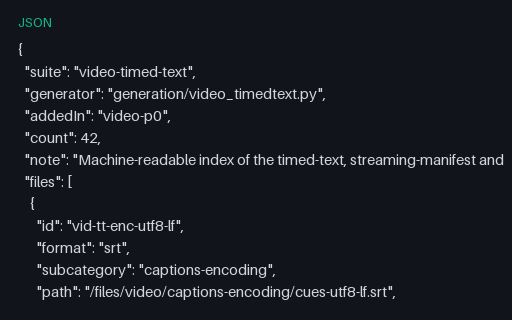
- jsonJSON — Timed-Text Suite IndexA machine-readable index of all 67 timed-text, streaming-manifest and ad-signalling fixtures in this wave, with id, format, path and byte size for each. Useful as a work-list when running a parser across the whole suite, and as a manifest to diff against after regenerating.
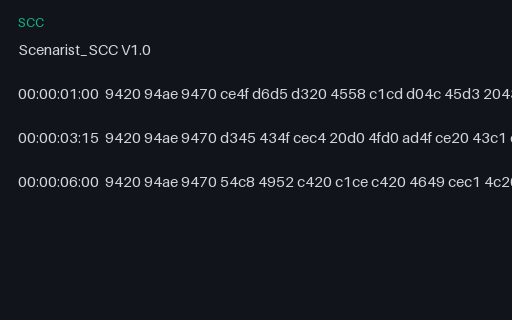
- sccSCC — Broadcast CEA-608 CaptionsBroadcast closed captions as Scenarist SCC: SMPTE timecodes followed by hexadecimal CEA-608 byte pairs, with odd parity set on every byte as the standard requires. Uses pop-on mode — RCL to load, ENM to clear non-displayed memory, a preamble address code for row 15, the character pairs, then EOC to display. This is the fixture that exposes decoders which treat captions as text: the parity bits, the two-byte control codes and the frame-accurate timecodes all have to be handled.
- webmAlpha Channel — Opaque VP9 TwinThe same codec and container with NO alpha plane, as the control for the alpha clip in this group. Useful for checking that alpha detection reads the pixel format rather than assuming every WebM is transparent — and for confirming a compositing bug is in the alpha handling rather than in the player.

Generated by generation/video_timedtext.py. Free for any use, no attribution required, license.