
Base Plate — Detail — Siemens Star and Frequency Wedges
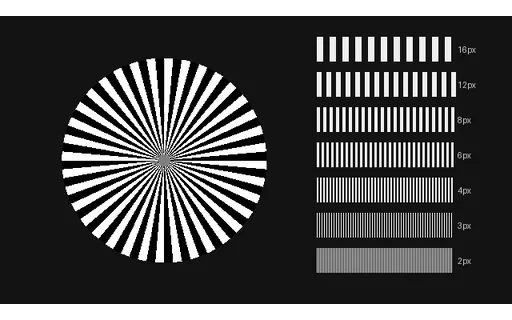
A 36-spoke Siemens star under a slow zoom, plus bar-pair wedges from 16 pixels down to 2. Detail runs right down to the Nyquist limit, which is exactly where super-resolution and denoise either recover structure or invent it. One of eight shared base plates: every AI-video suite in this library degrades one of these rather than inventing its own footage, so results across suites are comparable. Encoded at CRF 14 — well above the house CRF 30 — because a reference compressed as hard as the material under test puts the measurement floor above the effect being measured.
Browser-playable test video · 2 seconds
Specifications
- Resolution
- 640x360
- Fps
- 24
- Duration
- 2s
- Frames
- 48
- Codec
- H.264 (libx264)
- Crf
- 14
- Pixel Format
- yuv420p
- Audio
- none
- Role
- base plate
- Synthesis
- deterministic — pure function of frame index and a fixed seed
Testing contract
Reference control- Scenario
- Decode the plate and confirm its geometry, then re-run whichever AI-video suite in this library uses it as a source and compare results across suites.
- Expected result
- 48 frames of 640x360 at 24 fps (2s), H.264 at CRF 14, pixel format yuv420p, and no audio track. Synthesis is a pure function of frame index and a fixed seed, so a regenerated plate is byte-identical. The CRF 14 encode is deliberate: a reference compressed as hard as the material under test would put the measurement floor above the effect being measured.
What is a .mp4 file?
MP4 (MPEG-4 Part 14) is the dominant container for digital video, holding video, audio, subtitle, and metadata tracks in a tree of typed boxes. `ftyp` declares the brand, `moov` carries the sample tables that make seeking possible, and `mdat` holds the media; when an encoder writes `moov` last, playback cannot begin until the file has fully downloaded, which a faststart remux fixes. It derives from Apple's QuickTime format, generalized by ISO into the ISOBMFF base that MOV, 3GP, and HEIF share.
How to use this file
Use an example MP4 to test box parsing and track detection, seeking, range-request streaming, and transcode or thumbnail pipelines: verifying that a file with a trailing `moov` box is still handled, and that codec support is checked per track rather than inferred from the extension.
How to use this file for testing
“Base Plate — Detail — Siemens Star and Frequency Wedges” is a deterministic Novus Examples fixture for Video upscaling, Video denoise, Video QA. Low-resolution clips produced from a documented high-quality source by a recorded filter, so super-resolution output can be measured against the original rather than judged by eye.
Documented properties for this file: base plate · 2s · 24 fps. Compare results against paired or grouped companions on this page when present (clean↔damaged, searchable↔scanned, or format twins) so scores stay reproducible across runs.
Download the file once, keep the path stable in CI or local scripts, and treat the spec table as the contract: dimensions, seeds, field lists, and roles are intentional. Corrupt or invalid samples are labelled as such, expect parsers to fail loudly rather than silently accept them.
Media fixtures are short and synthetic by design. Prefer waveform or transcript ground truth in the same group when measuring ASR, trim, upscale, or sync tools; do not assume broadcast-quality masters.
Code examples
<video controls preload="metadata" width="640" src="detail-chart.mp4"></video>Related files
- mp4Denoise Ground Truth — detail-chartThe clean reference for the detail-chart denoise set — no noise added, encoded at CRF 14. Every noisy clip in this group was produced from these exact pixels, so PSNR, SSIM and LPIPS against this file are meaningful rather than approximate.
- mp4Denoise Ground Truth — gradient-skyThe clean reference for the gradient-sky denoise set — no noise added, encoded at CRF 14. Every noisy clip in this group was produced from these exact pixels, so PSNR, SSIM and LPIPS against this file are meaningful rather than approximate.

- mp4Denoise Ground Truth — pan-cityThe clean reference for the pan-city denoise set — no noise added, encoded at CRF 14. Every noisy clip in this group was produced from these exact pixels, so PSNR, SSIM and LPIPS against this file are meaningful rather than approximate.

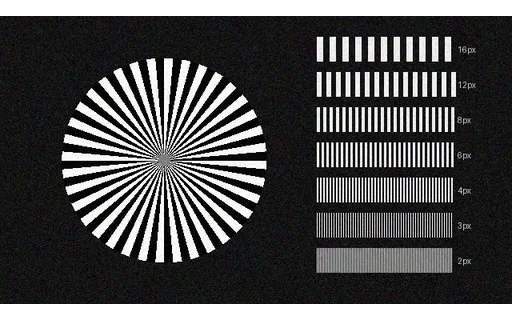
- mp4Denoise Input — detail-chart, Gaussian σ=15Gaussian σ=15 applied to the detail-chart base plate with seed 9017. Moderate Gaussian noise, roughly a mid-ISO handheld shot. The level most denoise benchmarks use. Paired with the clean ground truth in this group, so denoiser output can be scored numerically. Encoded at CRF 19, where the light noise could otherwise be confused with compression artefacts.
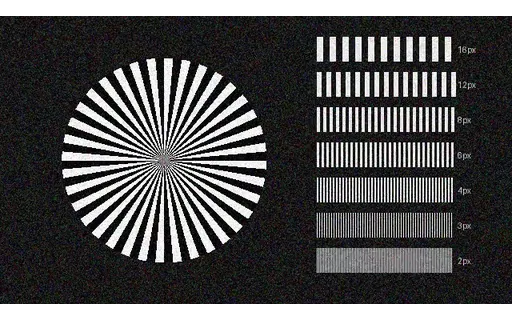
- mp4Denoise Input — detail-chart, Gaussian σ=30Gaussian σ=30 applied to the detail-chart base plate with seed 9034. Heavy Gaussian noise where fine detail and noise overlap in amplitude, so recovery requires temporal information rather than spatial smoothing alone. Paired with the clean ground truth in this group, so denoiser output can be scored numerically. Encoded at CRF 24 rather than 19: random noise is incompressible, and at this amplitude the codec's own artefacts sit far below the noise floor, so a coarser quantiser saves several megabytes without affecting any measurement.
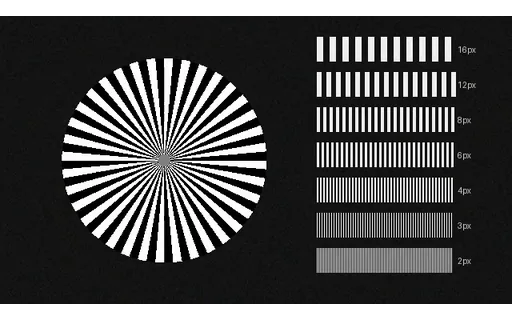
- mp4Denoise Input — detail-chart, Gaussian σ=5Gaussian σ=5 applied to the detail-chart base plate with seed 9000. Light sensor noise — the level a modern camera produces at base ISO. Subtle enough that an over-aggressive denoiser does more damage than the noise did. Paired with the clean ground truth in this group, so denoiser output can be scored numerically. Encoded at CRF 19, where the light noise could otherwise be confused with compression artefacts.
Generated by generation/video_baseplates.py. Free for any use, no attribution required, license.