
SAMPLE Leaf Certificate — Revoked
A leaf that is valid in every structural respect and revoked in the matching CRL and OCSP response shipped alongside it. It is the fixture that proves a client actually performs revocation checking rather than stopping at path building.
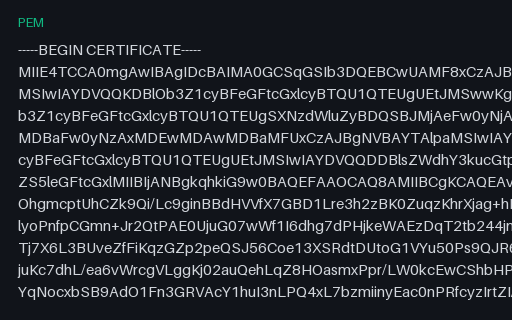
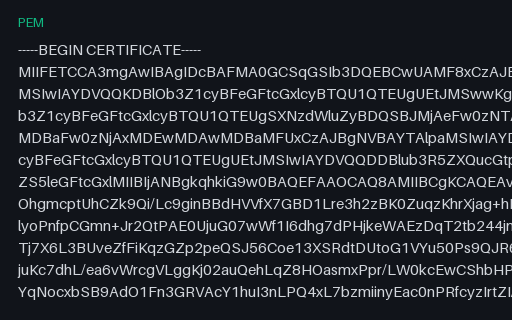
-----BEGIN CERTIFICATE-----
MIIFEzCCA3ugAwIBAgIDcBAMMA0GCSqGSIb3DQEBCwUAMF8xCzAJBgNVBAYTAlpa
MSIwIAYDVQQKDBlOb3Z1cyBFeGFtcGxlcyBTQU1QTEUgUEtJMSwwKgYDVQQDDCNO
b3Z1cyBFeGFtcGxlcyBTQU1QTEUgSXNzdWluZyBDQSBJMjAeFw0yNjAxMDEwMDAw
MDBaFw0yNzAxMDEwMDAwMDBaMFYxCzAJBgNVBAYTAlpaMSIwIAYDVQQKDBlOb3Z1
cyBFeGFtcGxlcyBTQU1QTEUgUEtJMSMwIQYDVQQDDBpyZXZva2VkLnBraS5zYW1w
bGUuZXhhbXBsZTCCASIwDQYJKoZIhvcNAQEBBQADggEPADCCAQoCggEBALxUPhSr
6ToYJnKbVIQmZPUIvy3PYIpwQXR1VX1+xgQ9S63t4dswStGbqsyoa142oPoTHMkV
aJcqD536Qhpp/ia9kLTwBNFI7htO8Fn9SOnYYO3Tx45HlgBMw6k9rW9uOI52ClT1
c04+1+i9wVL3mXxYiqsxmadqXkEieegqHtd10kXbQ1LaBtVWLudD7PUCUeqCr/W9
Lo7inO3YS/3mur1q3IFS4ICo9NmrkHoS6mfBzmrJsT6a/y1tJHBMAkoWxz3NqpIG
e2KjaHMW0gfQHTtRZ9xkVQHGNYbiN5yz0OMS+285oop8hGnNJz0X3MsyK7WSP9yx
2ja1u5UmzFl/vbcCAwEAAaOCAV8wggFbMAwGA1UdEwEB/wQCMAAwHQYDVR0OBBYE
FEdR0m4GbyDrby5cC30XofkfFKrvMA4GA1UdDwEB/wQEAwIFoDAlBgNVHREEHjAc
ghpyZXZva2VkLnBraS5zYW1wbGUuZXhhbXBsZTAdBgNVHSUEFjAUBggrBgEFBQcD
AQYIKwYBBQUHAwIwHwYDVR0jBBgwFoAUD8kkTA/cebaqtrM3GaVPA5Df0PowQAYD
VR0fBDkwNzA1oDOgMYYvaHR0cDovL2NybC5wa2kuc2FtcGxlLmV4YW1wbGUvaXNz
dWluZy1jYS1pMi5jcmwwcwYIKwYBBQUHAQEEZzBlMCoGCCsGAQUFBzABhh5odHRw
Oi8vb2NzcC5wa2kuc2FtcGxlLmV4YW1wbGUwNwYIKwYBBQUHMAKGK2h0dHA6Ly9w
a2kuc2FtcGxlLmV4YW1wbGUvaXNzdWluZy1jYS1pMi5jcnQwDQYJKoZIhvcNAQEL
BQADggGBAAFFDi51ygIcCWkMIs3KgWoJhxi4KooOYPxX9XC3IMnkjxqMWpPud/jM
ES9NhfrCOjbdWQmoNZU3YdDfpEbYH0IVPV695XYfcW+Q60AHvIg84eTHsjQuxd0F
klDbBdA8/CKZ/APwc4gVgnuTvG3VUCKCJuLm5yhNKSCvgizuaMdwfKBD8mI08yqL
NaDLNzxqshMyVSRxjhT9yxSVsrYXCsu4dbtNzCKMijEcPjujgJc8hYoo9kmg8WgR
YscWopFy1VyLmAOE4KlQRwpEEHOaHmwa56Ov+X9v1ImaDwu/7m3LRzgAb7V+861a
6lEszIFnWbXa98fLzZNbl7GLXRfEd9/pjoDUi6f87OA7/4BHcZOcgbi11PQPjxRu
wUfu9SLlTgpgWX18pJRiHU7Y3yj+NCkDzNIl/d729NB1IxPL+ebdrimWwV4HTvpJ
3LNvZowPsbJWCFmmD6Yx4nYOfcD+D3l1JW+AYHeW9THusMcbF8s/9/DWOkwYh1uf
ZGtrgmi+TA==
-----END CERTIFICATE-----
Specifications
- Serial
- 0x70100c
- Revoked
- true
- Reason
- keyCompromise
- Revocation Date
- 2026-03-01
- Listed In
- the p7 CRL and OCSP response
- Issuer
- Novus Examples SAMPLE Issuing CA I2
- Sample Only
- true
- Seed
- 70117
Testing contract
Expected to fail- Scenario
- Build a path for this certificate, then consult the p7 CRL or the pinned OCSP response for its serial.
- Expected result
- Path building succeeds, and the revocation check then fails with reason keyCompromise for serial 0x70100c.
What is a .pem file?
PEM (Privacy-Enhanced Mail) is a text container that Base64-encodes DER binary data between BEGIN/END header lines, used to hold X.509 certificates, certificate requests, and keys. A single .pem file may contain a certificate, a chain, or a private key, which makes it the most common format for TLS material.
How to use this file
Use an example .pem certificate to test X.509 and TLS parsers, PEM decoders, certificate-chain validators, and PEM-to-DER converters. This is published sample material — never a real production key.
How to use this file for testing
“SAMPLE Leaf Certificate — Revoked” is a deterministic Novus Examples fixture for Certificate & key testing, Error handling. Self-signed X.509 certificates (PEM, CRT, DER), a CSR, RSA and Ed25519 keys, an SSH public key, a PKCS#12 bundle, and an htpasswd file — all published sample-only material, for testing certificate parsers, TLS tooling, keystore importers, and PEM/DER decoders.
Documented properties for this file: seed 70117. Compare results against paired or grouped companions on this page when present (clean↔damaged, searchable↔scanned, or format twins) so scores stay reproducible across runs.
Download the file once, keep the path stable in CI or local scripts, and treat the spec table as the contract: dimensions, seeds, field lists, and roles are intentional. Corrupt or invalid samples are labelled as such — expect parsers to fail loudly rather than silently accept them.
This is published, SAMPLE-only security material — never a real secret. Point certificate, key, or token parsers at it, test PEM/DER decoding and PKCS handling, and confirm your tooling reads the documented fields; any sample password is printed on this page.
This is a published, sample-only certificate/key. Parse it, verify the chain or signature, and test PEM↔DER conversion — never deploy it anywhere real.
Related files
- pemSAMPLE Certificate Revocation List — EmptyA correctly signed CRL with an absent revokedCertificates field — what a CA publishes when it has revoked nothing. Parsers that assume the list is always present tend to fault here rather than report zero entries.
- pemSAMPLE Certificate Revocation List — StaleA validly signed CRL whose nextUpdate passed in 2020. Whether a client hard-fails, soft-fails, or silently trusts stale revocation data is a real policy decision, and this is the fixture that reveals which one it made.
- csrSAMPLE CSR — Intentionally Corrupt Base64An intentionally corrupt PKCS#10 request: the PEM armour is intact but four illegal characters have been substituted into the Base64 body, so decoding fails part-way. It exists to check that a CSR intake path reports a parse error instead of a stack trace or a partially populated record.
- pemSAMPLE Leaf Certificate — ExpiredA correctly signed leaf whose notAfter fell in the past (2020). The only thing wrong with it is the clock, which makes it the clean way to assert that an expiry error is reported as expiry and not as a signature failure.
- pemSAMPLE Leaf Certificate — No SAN ExtensionA pre-RFC 6125-style certificate carrying only a Common Name and no subjectAltName extension. Every current browser and most TLS libraries reject it outright, which makes it a precise legacy-compatibility probe.
- pemSAMPLE Leaf Certificate — Not Yet ValidThe mirror of the expired leaf: identical in every respect except that notBefore is 2035, so it is rejected from the other side of the validity window. Pairs with it to prove a verifier distinguishes the two clock errors.
Generated by generation/security_p7.py. Free for any use, no attribution required — license.