
Nginx Access Log
An nginx combined-format access log with several requests, including a 403 and a 404 — for testing log parsers.
127.0.0.1 - - [01/Jan/2026:09:00:01 +0000] "GET /index.html HTTP/1.1" 200 1024 "-" "Mozilla/5.0"
127.0.0.1 - - [01/Jan/2026:09:00:02 +0000] "GET /style.css HTTP/1.1" 200 512 "http://localhost/" "Mozilla/5.0"
203.0.113.7 - - [01/Jan/2026:09:00:03 +0000] "POST /api/submit HTTP/1.1" 403 89 "-" "curl/8.0"
203.0.113.7 - - [01/Jan/2026:09:00:04 +0000] "GET /missing HTTP/1.1" 404 153 "-" "Mozilla/5.0"
Specifications
- Format
- nginx combined
- Records
- 4
- Statuses
- 200, 403, 404
- Encoding
- UTF-8
What is a .log file?
LOG files are plain-text records of events emitted by software, typically one entry per line with a timestamp, severity, and message. There is no single standard, so formats range from unstructured text to structured JSON lines. They are central to debugging, monitoring, and auditing.
How to use this file
Use an example LOG file to test log parsers, timestamp and severity extraction, line-oriented streaming, and ingestion into monitoring or analysis pipelines.
How to use this file for testing
“Nginx Access Log” is a deterministic Novus Examples fixture for Log parsing. Access logs and JSON-lines application logs — for testing log parsers, tailers, and ingestion pipelines.
Documented properties for this file: 4 records · UTF-8 · nginx combined. Compare results against paired or grouped companions on this page when present (clean↔damaged, searchable↔scanned, or format twins) so scores stay reproducible across runs.
Download the file once, keep the path stable in CI or local scripts, and treat the spec table as the contract: dimensions, seeds, field lists, and roles are intentional. Corrupt or invalid samples are labelled as such — expect parsers to fail loudly rather than silently accept them.
Data fixtures document their exact quirks — delimiters, encodings, null handling, schema, and row counts — in the spec table. Point your parser or importer at the file and assert it handles the documented edge cases; clean and deliberately-messy siblings make before/after diffs straightforward.
Code examples
grep -i error nginx-access.log | head
awk '{print $1, $2, $NF}' nginx-access.log | head
Related files
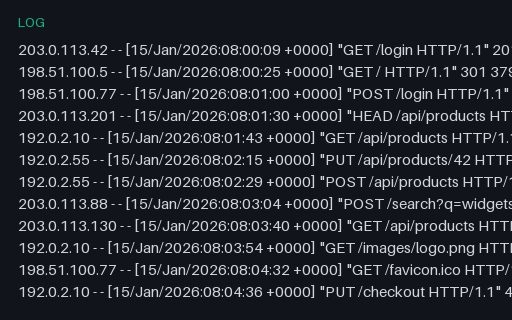
- logApache Access Log — Combined Format (log)An Apache access log in the Combined Log Format — the Common fields plus referer and user-agent. A realistic web-server log for testing access-log parsers, analytics, and grok patterns.
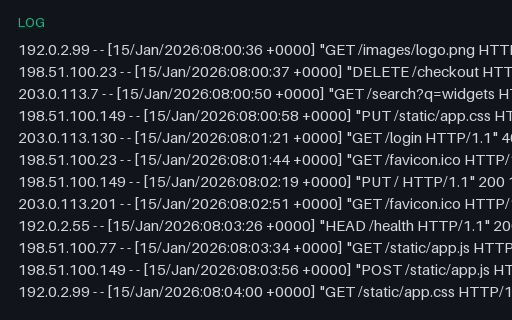
- logApache Access Log — Common Format (log)An Apache access log in the Common Log Format (CLF) — client, timestamp, request line, status, and byte count. Deterministic, with reserved documentation IPs. Paired with a Combined-format twin for testing log parsers.
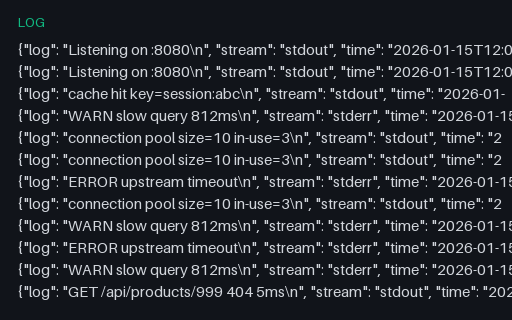
- logDocker Container Log — json-file driver (log)A Docker json-file container log — one JSON object per line with the log text, stream (stdout/stderr), and an RFC 3339 timestamp, exactly as Docker's default logging driver writes it. A fixture for container-log shippers and parsers.
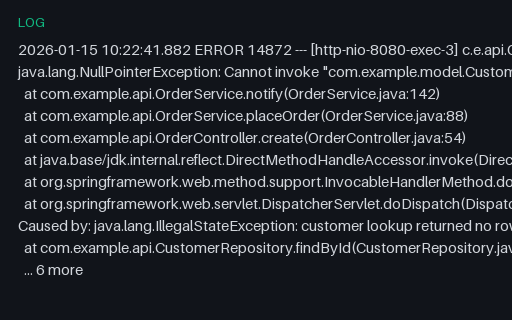
- logJava Stack Trace (log)A realistic Java stack trace — a Spring-style NullPointerException with a nested 'Caused by' chain and '... N more' elision. A fixture for testing stack-trace parsers, error groupers, and log viewers.
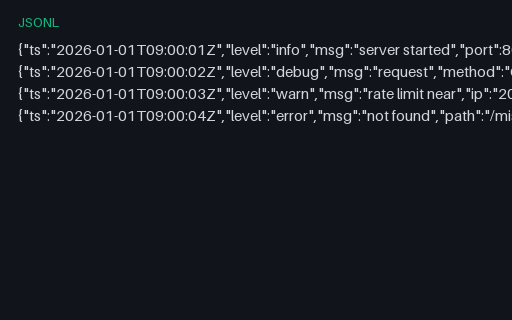
- jsonlJSON-Lines Application LogA structured application log with one JSON object per line at info/debug/warn/error levels — for testing log ingestion.
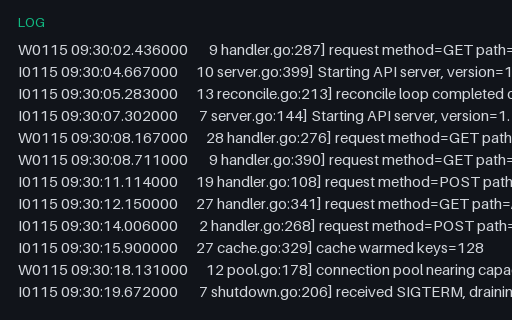
- logKubernetes Component Log — klog (log)A Kubernetes-component log in the klog/glog format — a severity letter, timestamp, thread id, and source location prefix followed by the message. A fixture for testing klog parsers and severity extraction.
Generated by generation/data_formats.py. Free for any use, no attribution required — license.