
YAML — Intentionally Invalid (Lint Fixture)
Intentionally invalid YAML indentation for parser error fixtures. Labelled intentionally invalid in title and description.
list:
  - one
 - bad-indent
Specifications
- Language
- yaml
- Role
- intentionally invalid
- Valid
- false
Testing contract
Expected to fail- Scenario
- Load the file with a YAML 1.1/1.2 parser.
- Expected result
- Loading fails with a bad-indentation error on line 3: the sequence entry `- bad-indent` is indented one column less than `- one`, so it cannot belong to the same block sequence.
What is a .yml file?
YML is an alternate file extension for YAML, a human-readable data-serialization format based on indentation, key-value mappings, and lists. The content and parsing rules are identical to .yaml; only the extension differs. It is widely used for CI and application configuration files.
How to use this file
Use an example YML file to test that config loaders treat .yml and .yaml identically, and to exercise indentation, comment, and multi-document parsing.
How to use this file for testing
“YAML — Intentionally Invalid (Lint Fixture)” is a deterministic Novus Examples fixture for Error handling, Code parsing, Editor testing. Deliberately corrupt and invalid files, clearly labelled, for testing how your tool fails.
Documented properties for this file: intentionally invalid · yaml · intentionally invalid. Compare results against paired or grouped companions on this page when present (clean↔damaged, searchable↔scanned, or format twins) so scores stay reproducible across runs.
Download the file once, keep the path stable in CI or local scripts, and treat the spec table as the contract: dimensions, seeds, field lists, and roles are intentional. Corrupt or invalid samples are labelled as such, expect parsers to fail loudly rather than silently accept them.
This is a short, known-correct source file. Run it through your syntax highlighter, linter, formatter, tree-sitter grammar, or parser, and open it in the in-browser editor to tweak and re-download. Each snippet exercises comments, string escapes, literals, and language keywords.
Code examples
import yaml  # pip install pyyaml

with open("intentionally-invalid-lint.yml") as f:
    data = yaml.safe_load(f)
print(data)
Related files
- cljClojure — Intentionally InvalidIntentionally invalid Clojure (unbalanced forms) for clj-kondo-style tests.
- f90Fortran — Intentionally InvalidIntentionally invalid Fortran for compiler error fixtures.
- goGo — Intentionally InvalidIntentionally invalid Go syntax for gofmt/parser failure tests.
- hsHaskell — Intentionally InvalidIntentionally invalid Haskell (unterminated string) for parser failure tests.
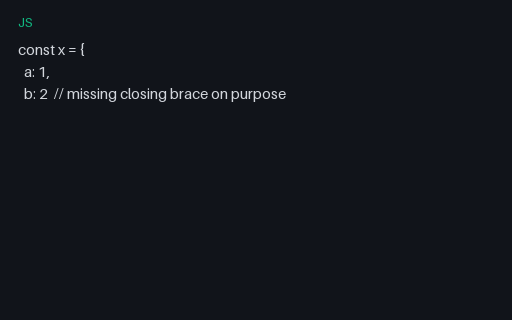
- jsJavaScript — Intentionally Invalid SyntaxIntentionally corrupt JavaScript object literal — labelled invalid for error handling. Labelled intentionally invalid in title and description.
- jsonJSON — Intentionally Invalid (Lint Fixture)Intentionally invalid JSON (unquoted key + trailing) for strict parser failure tests. Labelled intentionally invalid in title and description.

Generated by generation/code_wave_c.py. Free for any use, no attribution required, license.