
JSON — Intentionally Invalid (Lint Fixture)
Intentionally invalid JSON (unquoted key + trailing) for strict parser failure tests. Labelled intentionally invalid in title and description.
{ "ok": true, trailing: }
Specifications
- Language
- json
- Role
- intentionally invalid
- Valid
- false
Testing contract
Expected to fail- Scenario
- Parse the file with a strict JSON parser (RFC 8259).
- Expected result
- Parsing fails at byte offset 14 with an unquoted property name: the member `trailing` has no quotes and no value. A parser that accepts it is running in JSON5 or relaxed mode, not strict JSON.
What is a .json file?
JSON (JavaScript Object Notation) is a lightweight, text-based data-interchange format representing objects, arrays, strings, numbers, booleans, and null. It is language-independent, human-readable, and the dominant format for web APIs and configuration. It requires a single well-formed root value.
How to use this file
Use an example JSON file to test parsers and serializers, schema validation, Unicode and number-precision handling, and API request or response processing.
How to use this file for testing
“JSON — Intentionally Invalid (Lint Fixture)” is a deterministic Novus Examples fixture for Error handling, Code parsing, Editor testing. Deliberately corrupt and invalid files, clearly labelled, for testing how your tool fails.
Documented properties for this file: intentionally invalid · json · intentionally invalid. Compare results against paired or grouped companions on this page when present (clean↔damaged, searchable↔scanned, or format twins) so scores stay reproducible across runs.
Download the file once, keep the path stable in CI or local scripts, and treat the spec table as the contract: dimensions, seeds, field lists, and roles are intentional. Corrupt or invalid samples are labelled as such, expect parsers to fail loudly rather than silently accept them.
This is a short, known-correct source file. Run it through your syntax highlighter, linter, formatter, tree-sitter grammar, or parser, and open it in the in-browser editor to tweak and re-download. Each snippet exercises comments, string escapes, literals, and language keywords.
Code examples
import json

with open("intentionally-invalid-lint.json") as f:
    data = json.load(f)
print(type(data), len(data))
Related files
- cljClojure — Intentionally InvalidIntentionally invalid Clojure (unbalanced forms) for clj-kondo-style tests.
- f90Fortran — Intentionally InvalidIntentionally invalid Fortran for compiler error fixtures.
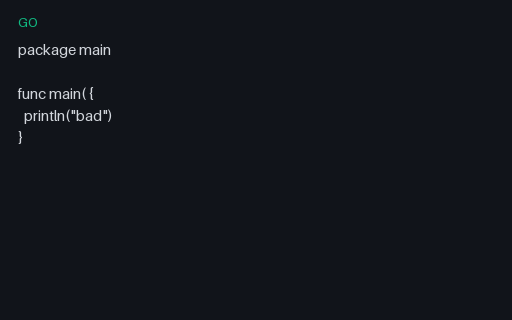
- goGo — Intentionally InvalidIntentionally invalid Go syntax for gofmt/parser failure tests.
- hsHaskell — Intentionally InvalidIntentionally invalid Haskell (unterminated string) for parser failure tests.
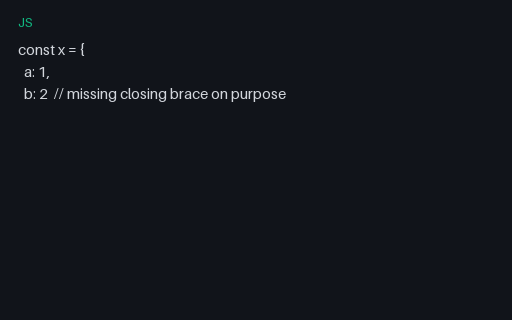
- jsJavaScript — Intentionally Invalid SyntaxIntentionally corrupt JavaScript object literal — labelled invalid for error handling. Labelled intentionally invalid in title and description.
- jlJulia — Intentionally InvalidIntentionally invalid Julia (unclosed function) for linter error-path tests.
Generated by generation/code_wave_c.py. Free for any use, no attribution required, license.