
Loudness and Peak-Clip Testing With Documented Tone Ladders
Verify LUFS meters and clip detectors against amplitude ladders and clean↔hard-clipped WAV twins with exact specs.
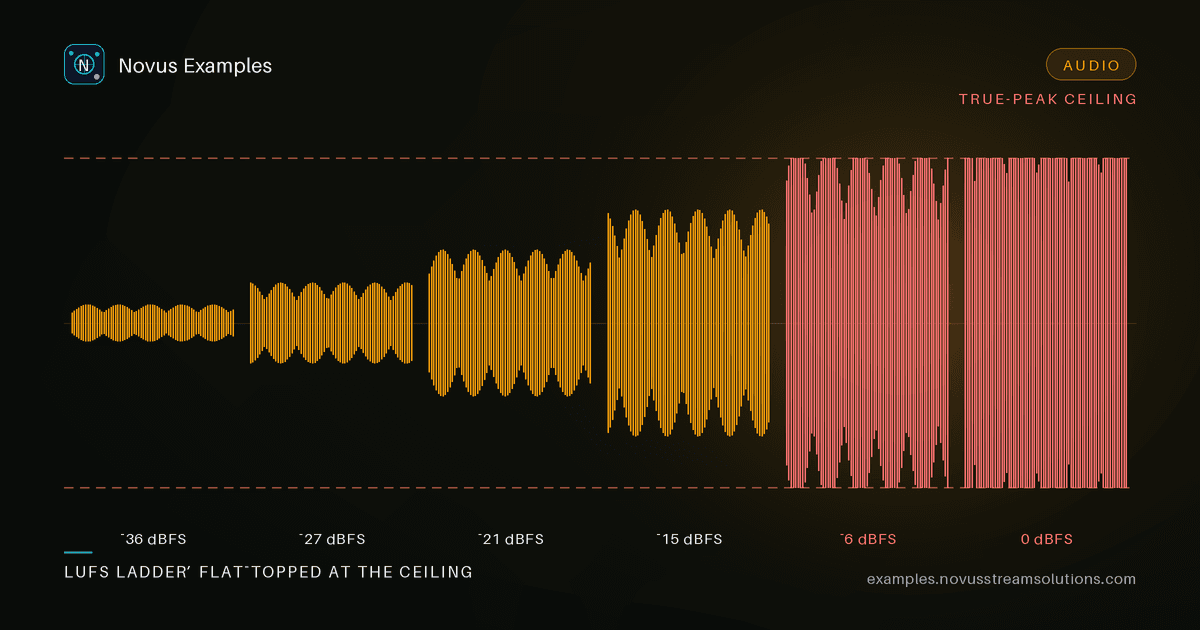
Loudness meters and true-peak limiters are only trustworthy when the input level is a known quantity. A podcast dump with “it sounded quiet” is not a test. Use short synthetic tones where amplitude, sample rate, and clip role are written into the file specs.
Filter loudness-testing fixtures and walk the Wave E amplitude ladder (silent → near full-scale). For each rung:
- Measure integrated loudness / peak.
- Assert monotonic increase with documented linear amplitude.
- Confirm digital silence measures as −∞ / below your gate.
Because only level changes, a meter regression is obvious.
Peak-clip pairs ship as twins: a clean tone and the same tone amplified then clipped to ±1. Assert:
- The clean twin never trips a true-peak “clipped” flag at your configured ceiling.
- The clipped twin does, and still has the documented frequency so you are not measuring a different signal by mistake.
The distinction these fixtures exist to expose: sample peak is the largest absolute sample value in the file; true peak is the largest value the waveform reaches between samples, after reconstruction. A signal can sit at exactly 0 dBFS sample peak and still overshoot to +1.5 dBTP when a D/A converter or a lossy encoder reconstructs the curve through those points.
That is why a limiter set to "ceiling 0 dBFS" still produces audible distortion after an MP3 or AAC encode. To test for it properly:
- Measure with a 4× oversampling true-peak meter, as ITU-R BS.1770 specifies. A meter reading raw sample values will report the clipped twin at exactly 0.0 and call it clean.
- Expect the clipped twin to read above 0 dBTP, not at it. A flat-topped waveform has sharp corners, and corners are exactly what inter-sample reconstruction overshoots.
- Assert the clean twin stays below your ceiling with margin, typically −1 dBTP, rather than merely "not over".
If your meter reports the same number for the clean and clipped twins, it is measuring sample peak regardless of what the documentation claims.
Integrated loudness under BS.1770 uses gating: an absolute gate at −70 LUFS, then a relative gate 10 LU below the ungated mean. Short fixtures interact with this in a way that surprises people:
- A file shorter than the 400 ms measurement block returns no valid integrated reading at all. Assert your harness reports "not measurable" rather than 0 or −∞, both of which read as a real level downstream.
- Digital silence must land below the absolute gate. Confirm it reports −∞ (or your sentinel) and never a finite value near −70, which would mean the gate is not applied.
- Momentary (400 ms) and short-term (3 s) values are separate measurements. Do not compare a momentary reading against an integrated threshold; on a ladder of short tones they can differ by several LU legitimately.
Stereo/mono twins and the sample-rate set (8 kHz / 16 kHz / 44.1 kHz) catch downmix and resampler bugs that masquerade as loudness bugs. Watch for the classic off-by-3 dB: summing two identical mono channels to stereo without the appropriate gain compensation shifts every reading, and the ladder makes that constant offset obvious because every rung moves by the same amount. Keep mid-gap silence trim cases separate: they test split/trim, not meters.
These are pure tones and DTMF sequences with JSON ground truth: not licensed speech. That is enough to prove loader, meter, and harness correctness before you spend time on production audio.
Continue this workflow
Was this article helpful?
Found an error? Send a correction.