
sitemap.xml
An XML sitemap (sitemaps.org 0.9) with loc, lastmod, changefreq, and priority for several URLs — for testing sitemap parsers and crawl-scheduling tools.
<?xml version="1.0" encoding="UTF-8"?>
<urlset xmlns="http://www.sitemaps.org/schemas/sitemap/0.9">
  <url>
    <loc>https://example.com/</loc>
    <lastmod>2026-01-01</lastmod>
    <changefreq>daily</changefreq>
    <priority>1.0</priority>
  </url>
  <url>
    <loc>https://example.com/about</loc>
    <lastmod>2026-01-01</lastmod>
    <changefreq>monthly</changefreq>
    <priority>0.6</priority>
  </url>
  <url>
    <loc>https://example.com/blog</loc>
    <lastmod>2026-01-01</lastmod>
    <changefreq>weekly</changefreq>
    <priority>0.8</priority>
  </url>
  <url>
    <loc>https://example.com/contact</loc>
    <lastmod>2026-01-01</lastmod>
    <changefreq>yearly</changefreq>
    <priority>0.4</priority>
  </url>
</urlset>
Specifications
- Format
- sitemap.xml
- Encoding
- UTF-8
- Data
- fictional example.com
What is a .xml file?
XML (Extensible Markup Language) is a verbose, self-describing markup language using nested tags, attributes, and namespaces to represent structured, hierarchical data. It supports schemas, entities, and validation and underlies many document and data formats. It remains common in enterprise, publishing, and interchange contexts.
How to use this file
Use an example XML file to test parsers, namespace and schema validation, XPath queries, and protection against entity-expansion and external-entity attacks.
How to use this file for testing
“sitemap.xml” is a deterministic Novus Examples fixture for Web assets, Editor testing. Favicons, web app manifests, service workers, robots and sitemap files, Open Graph images, and .well-known resources — for testing web tooling, crawlers, PWA installers, and asset pipelines.
Documented properties for this file: UTF-8 · sitemap.xml. Compare results against paired or grouped companions on this page when present (clean↔damaged, searchable↔scanned, or format twins) so scores stay reproducible across runs.
Download the file once, keep the path stable in CI or local scripts, and treat the spec table as the contract: dimensions, seeds, field lists, and roles are intentional. Corrupt or invalid samples are labelled as such — expect parsers to fail loudly rather than silently accept them.
Web-platform fixtures are standards-compliant samples against fictional example.com data. Test crawlers, PWA installers and manifest validators, favicon/icon pipelines, service-worker registration, or .well-known parsers against the documented structure.
Code examples
import xml.etree.ElementTree as ET

tree = ET.parse("sitemap.xml")
root = tree.getroot()
print(root.tag, [c.tag for c in root][:5])
Related files
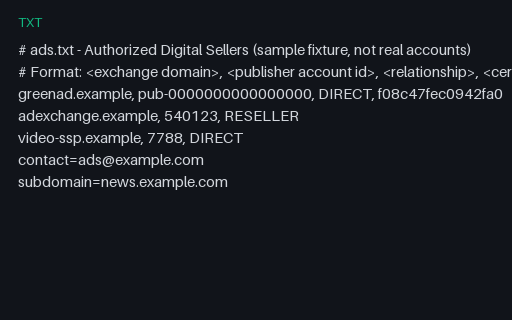
- txtads.txtAn IAB ads.txt listing authorised digital sellers with account IDs and relationships (sample data) — for testing ads.txt parsers and ad-fraud tooling.
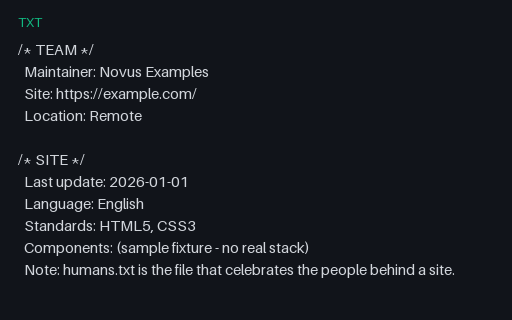
- txthumans.txtA humans.txt crediting the people and stack behind a site, in the conventional TEAM/SITE block format — for testing plain-text metadata parsers.
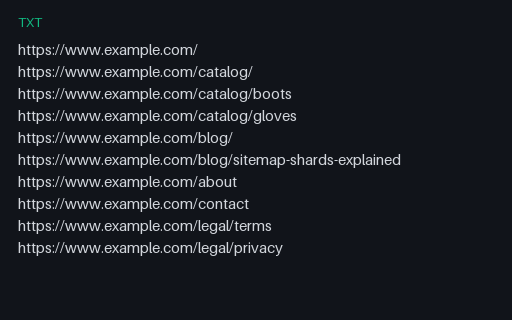
- txtPlain-text sitemap (one URL per line)The plain-text sitemap format the sitemaps.org protocol also accepts: one absolute URL per line, no markup, UTF-8 encoded. For testing that a crawler supports the text form as well as XML.
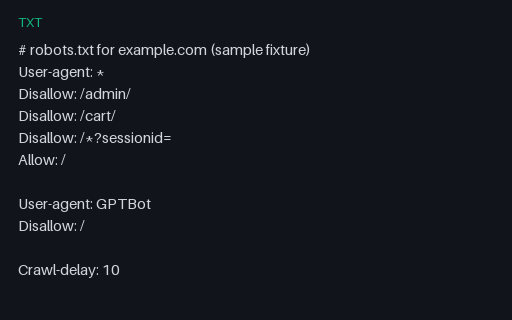
- txtrobots.txtA robots.txt with wildcard and per-agent rules, a crawl-delay, and a sitemap reference — for testing robots parsers and crawler policy handling.
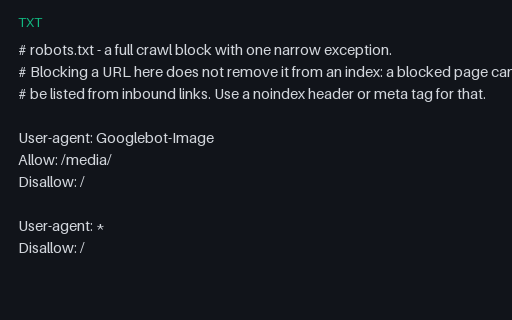
- txtrobots.txt - block everything except one pathA robots.txt that disallows the entire site for every crawler while allowing one media path for a single image agent. For testing full-block handling and the common misconception that a Disallow removes a URL from a search index.
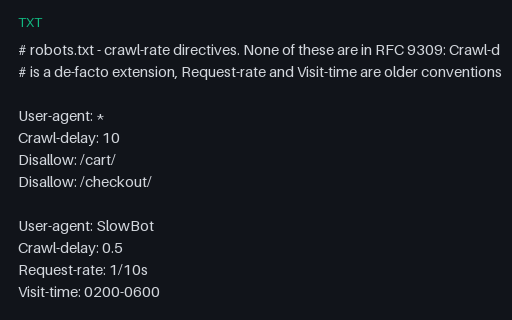
- txtrobots.txt - Crawl-delay, Request-rate and Visit-timeA robots.txt carrying three different crawl-rate hints - an integer Crawl-delay, a fractional one alongside Request-rate and Visit-time, and a very large one - none of which are part of RFC 9309. For testing that a crawler reads or ignores rate hints without dropping the Disallow rules that share the group.
Generated by generation/web_assets.py. Free for any use, no attribution required — license.