
Source map with deliberately invalid fields and mappings
A deliberately invalid source map: version 2 instead of 3, a sources array longer than sourcesContent, a mapping segment that names an index outside `names`, and a `$` that is not in the base64 VLQ alphabet. For testing that a decoder validates the envelope before trusting the mappings.
{
  "version": 2,
  "file": "bundle.min.js",
  "sourceRoot": "",
  "sources": [
    "src/greet.js",
    "src/index.js",
    "src/missing.js"
  ],
  "sourcesContent": [
    "export function greet(name) {\n  return `Hello, ${name}!`;\n}\n"
  ],
  "names": [
    "greet"
  ],
  "mappings": "MAAOA,WAAeC,GACpB,qBCAF,YAAYD;AA$A,;;"
}
Specifications
- Seed
- 70400
- Site
- example.com (fictional)
- Version
- 2
- Sources
- 3
- Sources Content
- 1
- Names
- 1
- Illegal Mapping Chars
- $
- Deliberately Invalid
- true
Testing contract
Expected to fail- Scenario
- Load a source map whose version, array lengths and VLQ alphabet are all wrong.
- Expected result
- The decoder rejects version 2, reports the sources/sourcesContent length mismatch and the out-of-range name index, and raises on the illegal `$` character instead of decoding it as zero.
What is a .json file?
JSON (JavaScript Object Notation) is a lightweight, text-based data-interchange format representing objects, arrays, strings, numbers, booleans, and null. It is language-independent, human-readable, and the dominant format for web APIs and configuration. It requires a single well-formed root value.
How to use this file
Use an example JSON file to test parsers and serializers, schema validation, Unicode and number-precision handling, and API request or response processing.
How to use this file for testing
“Source map with deliberately invalid fields and mappings” is a deterministic Novus Examples fixture for Web assets, JSON parsing, Error handling. Favicons, web app manifests, service workers, robots and sitemap files, Open Graph images, and .well-known resources — for testing web tooling, crawlers, PWA installers, and asset pipelines.
Documented properties for this file: seed 70400. Compare results against paired or grouped companions on this page when present (clean↔damaged, searchable↔scanned, or format twins) so scores stay reproducible across runs.
Download the file once, keep the path stable in CI or local scripts, and treat the spec table as the contract: dimensions, seeds, field lists, and roles are intentional. Corrupt or invalid samples are labelled as such — expect parsers to fail loudly rather than silently accept them.
Web-platform fixtures are standards-compliant samples against fictional example.com data. Test crawlers, PWA installers and manifest validators, favicon/icon pipelines, service-worker registration, or .well-known parsers against the documented structure.
Code examples
import json

with open("sourcemap-invalid.json") as f:
    data = json.load(f)
print(type(data), len(data))
Related files
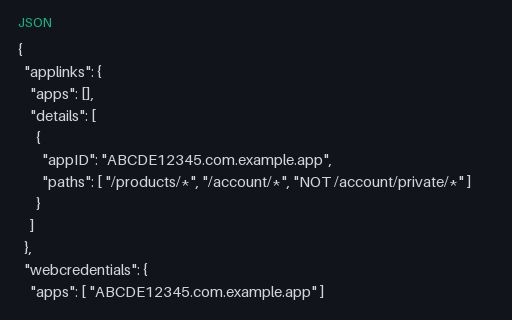
- jsonapple-app-site-associationAn Apple app-site-association file declaring Universal Links, web credentials, and app clips — normally served without an extension at /.well-known/, for testing AASA parsers (shown here as .json).
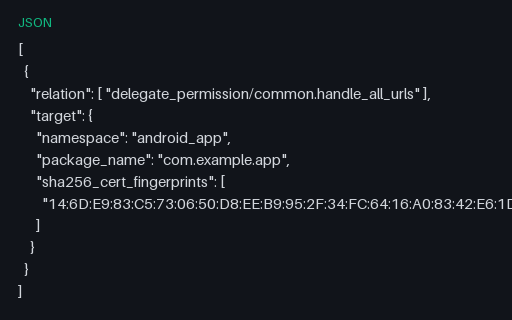
- jsonassetlinks.json (Android)An Android Digital Asset Links file granting app-link handling to a package via a certificate fingerprint (sample) — for testing assetlinks.json parsers and App Links verification.
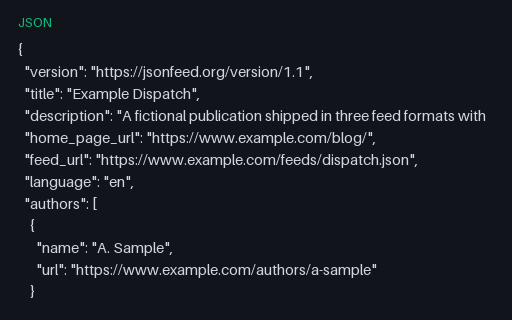
- jsonFeed twin - JSON Feed 1.1The third twin: the same four articles as JSON Feed 1.1, using the 1.1 `authors` array rather than the 1.0 singular form, with ids, URLs, summaries, HTML bodies and timestamps identical to the RSS and Atom files. The reference output for an XML-to-JSON feed converter.
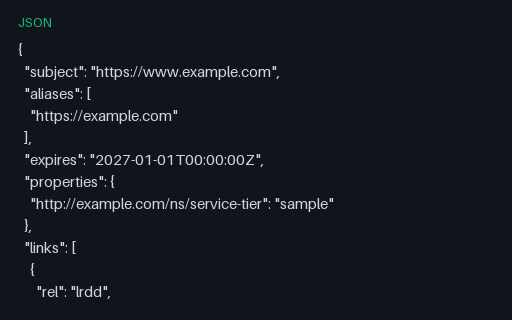
- jsonhost-meta.json (JRD, JSON form)The JSON Resource Descriptor twin of the XRD host-meta: identical subject, alias, expiry, property and three links, expressed with lower-case JSON member names. For testing XRD-to-JRD conversion against a known answer.
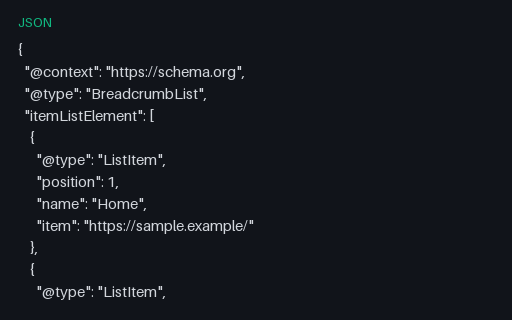
- jsonJSON-LD — Breadcrumb SAMPLEschema.org JSON-LD SAMPLE (breadcrumb) for SEO/structured-data validators.
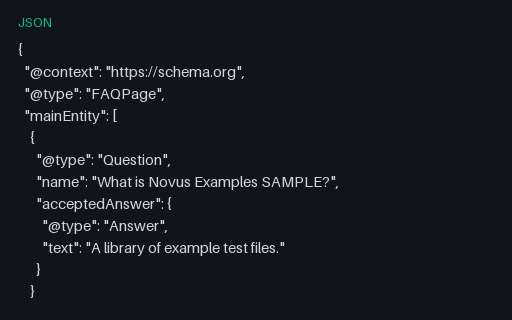
- jsonJSON-LD — Faq Page SAMPLEschema.org JSON-LD SAMPLE (faq-page) for SEO/structured-data validators.
Generated by generation/web_p7.py. Free for any use, no attribution required — license.