
Feed twin - JSON Feed 1.1
The third twin: the same four articles as JSON Feed 1.1, using the 1.1 `authors` array rather than the 1.0 singular form, with ids, URLs, summaries, HTML bodies and timestamps identical to the RSS and Atom files. The reference output for an XML-to-JSON feed converter.
{
  "version": "https://jsonfeed.org/version/1.1",
  "title": "Example Dispatch",
  "description": "A fictional publication shipped in three feed formats with identical content.",
  "home_page_url": "https://www.example.com/blog/",
  "feed_url": "https://www.example.com/feeds/dispatch.json",
  "language": "en",
  "authors": [
    {
      "name": "A. Sample",
      "url": "https://www.example.com/authors/a-sample"
    }
  ],
  "items": [
    {
      "id": "tag:example.com,2026:dispatch-004",
      "url": "https://www.example.com/blog/sitemap-shards-explained",
      "title": "Sitemap shards, explained",
      "summary": "Why a 50,000-URL ceiling exists and what a sitemap index actually buys you.",
      "content_html": "<p>A sitemap index is a list of lists. Sample article body.</p>",
      "date_published": "2026-01-01T12:00:00+00:00",
      "date_modified": "2026-01-01T12:00:00+00:00",
      "language": "en"
    },
    {
      "id": "tag:example.com,2026:dispatch-003",
      "url": "https://www.example.com/blog/crawl-budget-notes",
      "title": "Crawl budget notes",
      "summary": "Notes on crawl budget for a fictional catalogue of 500 items.",
      "content_html": "<p>Crawl budget is a scheduling story, not a quota. Sample article body.</p>",
      "date_published": "2026-01-01T09:30:00+00:00",
      "date_modified": "2026-01-01T09:30:00+00:00",
      "language": "en"
    },
    {
      "id": "tag:example.com,2026:dispatch-002",
      "url": "https://www.example.com/blog/reading-robots-txt",
      "title": "Reading robots.txt like a parser",
      "summary": "Group merging, longest-match precedence, and the fields nobody implements.",
      "content_html": "<p>Most robots.txt bugs are precedence bugs. Sample article body.</p>",
      "date_published": "2026-01-01T08:15:00+00:00",
      "date_modified": "2026-01-01T08:15:00+00:00",
      "language": "en"
    },
    {
      "id": "tag:example.com,2026:dispatch-001",
      "url": "https://www.example.com/blog/hello",
      "title": "Hello from the Example Dispatch",
      "summary": "The first entry of a fictional publication used as a feed fixture.",
"content_html": "<p>Nothing here is real. Sample article body.</p>",Specifications
- Seed
- 70400
- Site
- example.com (fictional)
- Format
- JSON Feed 1.1
- Items
- 4
- Date Format
- RFC 3339
- Authors Array
- true
- Feed Url
- true
Testing contract
Reference control- Scenario
- Convert the RSS or Atom twin to JSON Feed and diff against this file.
- Expected result
- The converter emits four items whose id, url, title, summary, content_html and date_published match this document field for field, and uses the plural `authors` member required by version 1.1.
What is a .json file?
JSON (JavaScript Object Notation) is a lightweight, text-based data-interchange format representing objects, arrays, strings, numbers, booleans, and null. It is language-independent, human-readable, and the dominant format for web APIs and configuration. It requires a single well-formed root value.
How to use this file
Use an example JSON file to test parsers and serializers, schema validation, Unicode and number-precision handling, and API request or response processing.
How to use this file for testing
“Feed twin - JSON Feed 1.1” is a deterministic Novus Examples fixture for Web assets, Feed parsing, JSON parsing, Conversion testing. Favicons, web app manifests, service workers, robots and sitemap files, Open Graph images, and .well-known resources — for testing web tooling, crawlers, PWA installers, and asset pipelines.
Documented properties for this file: seed 70400 · JSON Feed 1.1. Compare results against paired or grouped companions on this page when present (clean↔damaged, searchable↔scanned, or format twins) so scores stay reproducible across runs.
Download the file once, keep the path stable in CI or local scripts, and treat the spec table as the contract: dimensions, seeds, field lists, and roles are intentional. Corrupt or invalid samples are labelled as such — expect parsers to fail loudly rather than silently accept them.
Web-platform fixtures are standards-compliant samples against fictional example.com data. Test crawlers, PWA installers and manifest validators, favicon/icon pipelines, service-worker registration, or .well-known parsers against the documented structure.
Code examples
import json

with open("dispatch.json") as f:
    data = json.load(f)
print(type(data), len(data))
Related files
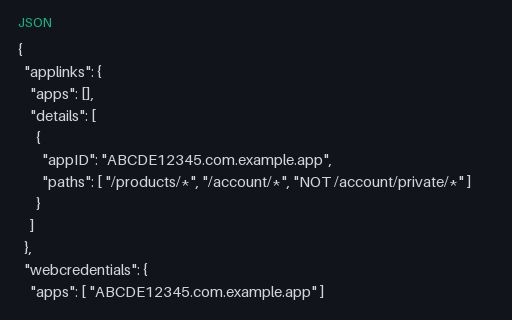
- jsonapple-app-site-associationAn Apple app-site-association file declaring Universal Links, web credentials, and app clips — normally served without an extension at /.well-known/, for testing AASA parsers (shown here as .json).
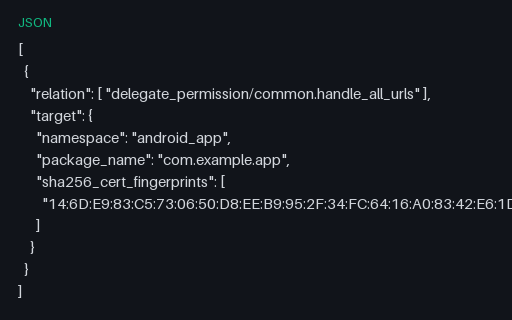
- jsonassetlinks.json (Android)An Android Digital Asset Links file granting app-link handling to a package via a certificate fingerprint (sample) — for testing assetlinks.json parsers and App Links verification.
- icoFavicon (multi-size ICO)A multi-resolution favicon.ico bundling 16, 32, 48, and 64 px images of the brand mark — for testing favicon parsers, ICO decoders, and multi-image icon handling.

- svgFavicon (scalable SVG)A scalable SVG favicon of the brand mark — the modern crisp-at-any-size icon format, for testing SVG favicon support and vector-to-raster favicon pipelines.

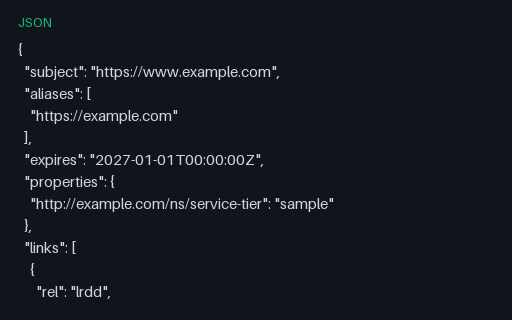
- jsonhost-meta.json (JRD, JSON form)The JSON Resource Descriptor twin of the XRD host-meta: identical subject, alias, expiry, property and three links, expressed with lower-case JSON member names. For testing XRD-to-JRD conversion against a known answer.
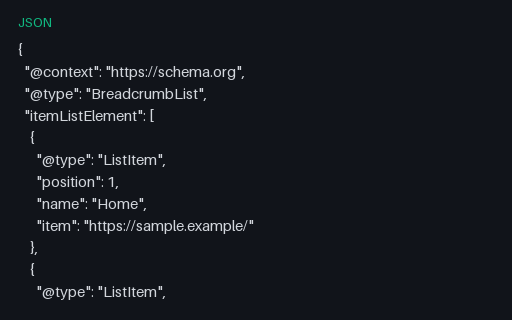
- jsonJSON-LD — Breadcrumb SAMPLEschema.org JSON-LD SAMPLE (breadcrumb) for SEO/structured-data validators.
Generated by generation/web_p7.py. Free for any use, no attribution required — license.