
HLS VOD — Master Playlist (Playable Package)
The entry point to a COMPLETE and genuinely playable HLS package: a 3-rung ladder (320x180 at 300 kbps, 480x270 at 700 kbps, 640x360 at 1400 kbps) with real CMAF segments alongside it in this group. Point hls.js or Safari at this URL and it plays — it is served inline with permissive CORS from /files/stream/, so it works cross-origin without re-hosting. Unlike the hand-authored HLS fixtures elsewhere in the catalog, which are parser tests that reference placeholder segment names on purpose, everything this playlist references actually exists.
#EXTM3U
#EXT-X-VERSION:7
#EXT-X-STREAM-INF:BANDWIDTH=157880,AVERAGE-BANDWIDTH=143292,RESOLUTION=320x180,CODECS="avc1.64000c"
stream-0.m3u8

#EXT-X-STREAM-INF:BANDWIDTH=498384,AVERAGE-BANDWIDTH=409636,RESOLUTION=480x270,CODECS="avc1.640015"
stream-1.m3u8

#EXT-X-STREAM-INF:BANDWIDTH=476056,AVERAGE-BANDWIDTH=364224,RESOLUTION=640x360,CODECS="avc1.64001e"
stream-2.m3u8
Specifications
- Protocol
- HLS
- Packaging
- CMAF / fMP4
- Segment Duration
- 1s
- Ladder
- 320x180 at 300 kbps, 480x270 at 700 kbps, 640x360 at 1400 kbps
- Generated By
- ffmpeg hls muxer
- Served Inline
- yes — /files/stream/
- Cors
- Access-Control-Allow-Origin: *
- Variants
- 3
Testing contract
Expected to pass- Scenario
- Load the master playlist and choose a variant by advertised bandwidth alone.
- Expected result
- 3 variants are advertised - stream-0.m3u8 at 320x180, stream-1.m3u8 at 480x270 and stream-2.m3u8 at 640x360. The catch is that the advertised BANDWIDTH values are not monotonic with resolution: stream-1 declares 498,384 while the larger stream-2 declares 476,056, because these are measured peaks from a short encode rather than the nominal 320x180 at 300 kbps, 480x270 at 700 kbps, 640x360 at 1400 kbps. A player selecting purely on BANDWIDTH therefore picks 480x270 over 640x360, which is correct behaviour on a manifest like this and worth asserting deliberately.
What is a .m3u8 file?
M3U8 (.m3u8) is a UTF-8 M3U playlist, most importantly the backbone of HTTP Live Streaming (HLS). An HLS media playlist lists timed media segments with #EXTINF tags and directives like #EXT-X-TARGETDURATION, and a master playlist points to alternate bitrate renditions.
How to use this file
Use an example .m3u8 file to test HLS parsers and players, segment and directive extraction, and adaptive-streaming tooling, or as a plain UTF-8 M3U playlist.
How to use this file for testing
“HLS VOD — Master Playlist (Playable Package)” is a deterministic Novus Examples fixture for Streaming manifests, Video codecs, Video QA. HLS playlists and DASH MPDs covering multi-bitrate ladders, byte-range addressing, and segment templates. Served inline with permissive CORS under /files/stream/, so a player can load them from any origin without re-hosting.
Documented properties for this file: M3U8 · 370 bytes. Compare results against paired or grouped companions on this page when present (clean↔damaged, searchable↔scanned, or format twins) so scores stay reproducible across runs.
Download the file once, keep the path stable in CI or local scripts, and treat the spec table as the contract: dimensions, seeds, field lists, and roles are intentional. Corrupt or invalid samples are labelled as such, expect parsers to fail loudly rather than silently accept them.
Media fixtures are short and synthetic by design. Prefer waveform or transcript ground truth in the same group when measuring ASR, trim, upscale, or sync tools; do not assume broadcast-quality masters.
Code examples
# manifests resolve their own segments, so pass the URL, not a local copy
ffprobe -v error -show_entries stream=codec_name,width,height master.m3u8
ffplay master.m3u8
Related files
- m4sDASH VOD — Init Segment (init-stream0.m4s)A DASH initialisation segment carrying codec configuration for one representation. Named by the manifest's $RepresentationID$ template, so this file also exercises whether a client resolves template variables correctly rather than pattern-matching filenames.
- m4sDASH VOD — Init Segment (init-stream1.m4s)A DASH initialisation segment carrying codec configuration for one representation. Named by the manifest's $RepresentationID$ template, so this file also exercises whether a client resolves template variables correctly rather than pattern-matching filenames.
- m4sDASH VOD — Init Segment (init-stream2.m4s)A DASH initialisation segment carrying codec configuration for one representation. Named by the manifest's $RepresentationID$ template, so this file also exercises whether a client resolves template variables correctly rather than pattern-matching filenames.
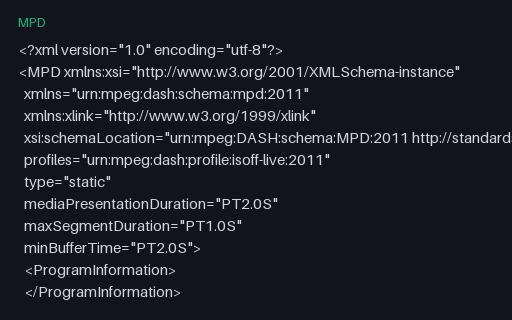
- mpdDASH VOD — Manifest (Playable Package)A complete, playable MPEG-DASH manifest for the same 320x180 at 300 kbps, 480x270 at 700 kbps, 640x360 at 1400 kbps ladder as the HLS package, produced from the same encoder run — so the two can be compared directly as packaging rather than as content. Every segment it references exists in this group. Served inline as application/dash+xml with permissive CORS, so dash.js can load it cross-origin.
- m4sDASH VOD — Media Segment (chunk-stream0-00001.m4s)A one-second DASH media segment, addressed by the manifest's $Number$ template. The same underlying CMAF structure as the HLS segments in the sibling package — which is the whole point of CMAF, and something a fixture set should let you verify rather than take on trust.
- m4sDASH VOD — Media Segment (chunk-stream0-00002.m4s)A one-second DASH media segment, addressed by the manifest's $Number$ template. The same underlying CMAF structure as the HLS segments in the sibling package — which is the whole point of CMAF, and something a fixture set should let you verify rather than take on trust.
Generated by generation/video_streaming_wave.py. Free for any use, no attribution required, license.