
DASH — Dynamic (Live) Manifest With a Time-Shift Buffer
A live DASH manifest: type is dynamic, there is no total duration, and the client must compute which segment is currently available from availabilityStartTime, the wall clock, and the segment duration. Declares a one-minute time-shift buffer and an eight-second presentation delay. The timestamps are fixed so the fixture stays deterministic — a real client will compute a segment number far in the future, which is itself a useful edge case to handle gracefully.
<?xml version="1.0" encoding="utf-8"?>
<MPD xmlns="urn:mpeg:dash:schema:mpd:2011" profiles="urn:mpeg:dash:profile:isoff-live:2011"
     type="dynamic" availabilityStartTime="2026-01-01T00:00:00Z"
     publishTime="2026-01-01T00:10:00Z" minimumUpdatePeriod="PT4.0S"
     timeShiftBufferDepth="PT1M" suggestedPresentationDelay="PT8.0S" minBufferTime="PT4.0S">
  <Period id="live" start="PT0S">
    <AdaptationSet mimeType="video/mp4" segmentAlignment="true">
      <SegmentTemplate timescale="1000" duration="4000" startNumber="1"
                       initialization="init-$RepresentationID$.mp4"
                       media="seg-$RepresentationID$-$Number$.m4s"/>
      <Representation id="360p" codecs="avc1.4d401e" width="640" height="360" bandwidth="700000"/>
    </AdaptationSet>
  </Period>
</MPD>
Specifications
- Protocol
- MPEG-DASH
- Type
- dynamic (live)
- Availability Start Time
- 2026-01-01T00:00:00Z
- Minimum Update Period
- PT4.0S
- Time Shift Buffer Depth
- PT1M
- Suggested Presentation Delay
- PT8.0S
- Duration
- unbounded — no mediaPresentationDuration
Testing contract
Expected to pass- Scenario
- Parse the manifest as a live DASH client and compute the currently available segment window.
- Expected result
- A dynamic (live) manifest with `availabilityStartTime` 2026-01-01T00:00:00Z, `minimumUpdatePeriod` PT4.0S, `timeShiftBufferDepth` PT1M and `suggestedPresentationDelay` PT8.0S. There is deliberately no `mediaPresentationDuration` - the stream is unbounded - so a client that reads duration and gets nothing must treat it as live rather than as zero-length.
What is a .mpd file?
MPD (Media Presentation Description, .mpd) is the XML manifest at the heart of MPEG-DASH adaptive streaming. It describes periods, adaptation sets, representations, and segment templates, telling a player which bitrate ladders exist and how to construct segment URLs. It is the DASH counterpart to an HLS .m3u8 playlist.
How to use this file
Use an example .mpd to test DASH players, manifest parsers, and ABR ladder logic. Files under /files/stream/ are served inline with permissive CORS, so a player can fetch this manifest and its segments from any origin without re-hosting them.
How to use this file for testing
“DASH — Dynamic (Live) Manifest With a Time-Shift Buffer” is a deterministic Novus Examples fixture for Streaming manifests, Conversion testing, Video QA. HLS playlists and DASH MPDs covering multi-bitrate ladders, byte-range addressing, and segment templates. Served inline with permissive CORS under /files/stream/, so a player can load them from any origin without re-hosting.
Documented properties for this file: unbounded — no mediaPresentationDuration · dynamic (live). Compare results against paired or grouped companions on this page when present (clean↔damaged, searchable↔scanned, or format twins) so scores stay reproducible across runs.
Download the file once, keep the path stable in CI or local scripts, and treat the spec table as the contract: dimensions, seeds, field lists, and roles are intentional. Corrupt or invalid samples are labelled as such, expect parsers to fail loudly rather than silently accept them.
Media fixtures are short and synthetic by design. Prefer waveform or transcript ground truth in the same group when measuring ASR, trim, upscale, or sync tools; do not assume broadcast-quality masters.
Code examples
# manifests resolve their own segments, so pass the URL, not a local copy
ffprobe -v error -show_entries stream=codec_name,width,height live.mpd
ffplay live.mpd
Related files
- webmAlpha Channel — Opaque VP9 TwinThe same codec and container with NO alpha plane, as the control for the alpha clip in this group. Useful for checking that alpha detection reads the pixel format rather than assuming every WebM is transparent — and for confirming a compositing bug is in the alpha handling rather than in the player.

- webmAlpha Channel — VP9 in WebMVideo with a real per-pixel alpha channel: VP9 yuva420p in WebM, the one alpha path browsers decode natively. Composite it over a page background and the transparency is genuine, not a chroma key. Roughly 90% of each frame is fully transparent. Two traps this file exists to expose. First, auto-alt-ref must be disabled at encode time or libvpx silently drops the alpha plane, producing a valid file with no transparency and no error. Second, WebM stores VP9 alpha in BlockAdditional and signals it with AlphaMode=1, so FFmpeg's NATIVE vp9 decoder reports pix_fmt yuv420p and decodes fully opaque — you must force `-c:v libvpx-vp9` to see the alpha at all. Probing this file with default settings and concluding it has no alpha is the expected mistake.

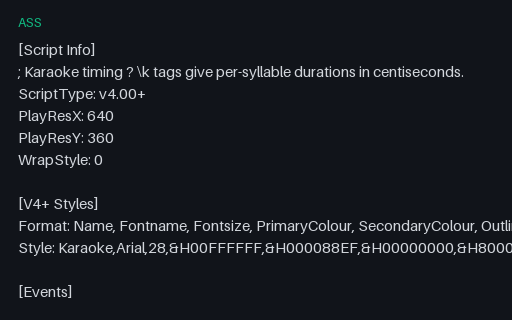
- assASS — Karaoke Timing and Override TagsAdvanced SubStation Alpha using the features that distinguish it from SubRip: per-syllable \k karaoke timings in centiseconds, a full V4+ style definition with primary and secondary colours, and an \an override that repositions a line. Converting this to SRT necessarily loses all of it, which makes it a good test of whether a converter warns about that or drops it silently.
- mp4Bitstream — All-Intra (Every Frame a Keyframe)Every frame is an I-frame, so any frame is an independent cut point. Much larger, and the shape editing and frame-accurate seeking want. Same picture and same codec as every other clip in this group — only the GOP and frame-type structure differ, so the effect on size and seekability is directly attributable.

- mp4Bitstream — Heavy B-Frames (8 Consecutive)Eight consecutive B-frames with a B-pyramid, so decode order and display order diverge sharply and DTS runs well behind PTS. The case that breaks naive timestamp handling and any code that assumes frames arrive in display order. Same picture and same codec as every other clip in this group — only the GOP and frame-type structure differ, so the effect on size and seekability is directly attributable.

- mp4Bitstream — Long GOP (24 Frames, One Per Second)One keyframe per second — the delivery default, and the setting that determines HLS/DASH segment boundaries, since a segment must start on a keyframe. Same picture and same codec as every other clip in this group — only the GOP and frame-type structure differ, so the effect on size and seekability is directly attributable.

Generated by generation/video_timedtext.py. Free for any use, no attribution required, license.