
VTT — Intentionally Corrupt: Malformed Cue Timestamp
An intentionally corrupt WebVTT file with timestamps that are not zero-padded — 00:00:3.000 and 00:1:03.000 where the grammar requires two digits. The third cue is well-formed. A strict parser drops the two bad cues; a lenient one accepts them; a regex-based one may match partially and produce a time that is wrong rather than rejected, which is the worst outcome of the three.
WEBVTT

1
00:00:01.000 --> 00:00:3.000
The end timestamp has one-digit seconds

2
00:1:03.000 --> 00:01:06.000
The start timestamp has one-digit minutes

3
00:00:07.000 --> 00:00:09.000
This cue is well-formed
Specifications
- Corruption
- seconds and minutes not zero-padded to two digits
- Affected Cues
- 2
- Valid Cues
- 1
- Spec
- WebVTT requires two-digit minutes and seconds
Testing contract
Expected to fail- Scenario
- Parse the file with a strict WebVTT parser and count how many cues survive.
- Expected result
- Two cues carry timestamps that are not zero-padded - `00:00:3.000` and `00:1:03.000`, where the grammar requires two-digit minutes and seconds - and the third is well formed. A strict parser returns 1 cue and drops 2. The outcome to watch for is the third possibility: a regex-based parser that matches partially and returns a time that is wrong rather than rejected.
What is a .vtt file?
WebVTT (VTT) is the W3C subtitle and caption format used by the HTML5 <track> element for timed text on the web. It extends the SubRip model with cue settings, positioning, styling, and metadata, and requires a WEBVTT header. It is the standard format for browser-based captions.
How to use this file
Use an example VTT to test HTML5 <track> caption rendering, cue-setting and positioning parsers, and converters between WebVTT and SRT.
How to use this file for testing
“VTT — Intentionally Corrupt: Malformed Cue Timestamp” is a deterministic Novus Examples fixture for Streaming manifests, Video QA. HLS playlists and DASH MPDs covering multi-bitrate ladders, byte-range addressing, and segment templates. Served inline with permissive CORS under /files/stream/, so a player can load them from any origin without re-hosting.
Documented properties for this file: VTT · 210 bytes. Compare results against paired or grouped companions on this page when present (clean↔damaged, searchable↔scanned, or format twins) so scores stay reproducible across runs.
Download the file once, keep the path stable in CI or local scripts, and treat the spec table as the contract: dimensions, seeds, field lists, and roles are intentional. Corrupt or invalid samples are labelled as such, expect parsers to fail loudly rather than silently accept them.
Media fixtures are short and synthetic by design. Prefer waveform or transcript ground truth in the same group when measuring ASR, trim, upscale, or sync tools; do not assume broadcast-quality masters.
Code examples
<video controls src="clip.mp4">
  <track kind="captions" srclang="en" label="English" src="bad-timestamp.vtt" default>
</video>
Related files
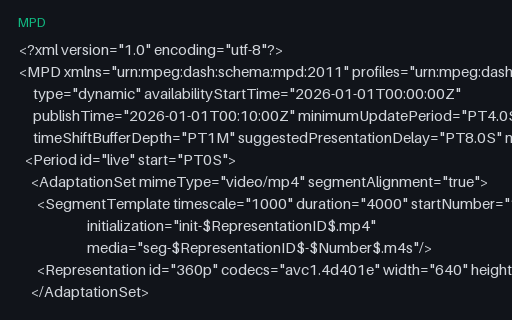
- mpdDASH — Dynamic (Live) Manifest With a Time-Shift BufferA live DASH manifest: type is dynamic, there is no total duration, and the client must compute which segment is currently available from availabilityStartTime, the wall clock, and the segment duration. Declares a one-minute time-shift buffer and an eight-second presentation delay. The timestamps are fixed so the fixture stays deterministic — a real client will compute a segment number far in the future, which is itself a useful edge case to handle gracefully.
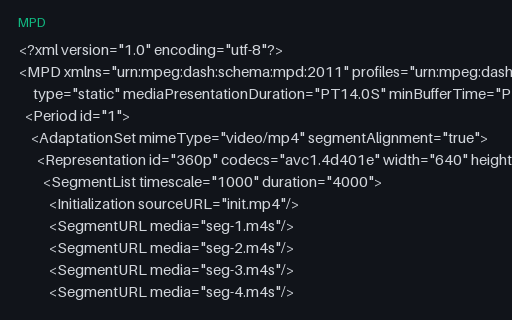
- mpdDASH — Explicit SegmentList AddressingThe same content addressed with an explicit SegmentList — every segment URL enumerated rather than derived from a template. Verbose, but it is what older packagers emit and it permits non-uniform segment naming. A DASH client must support both this and SegmentTemplate; the paired template manifest in this group is the direct contrast.
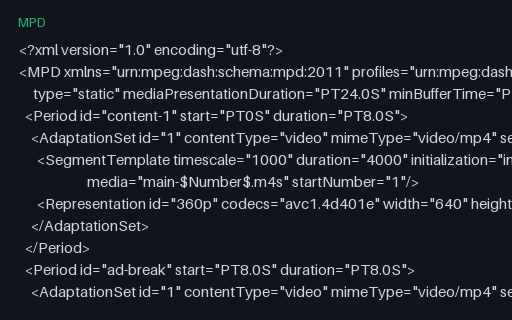
- mpdDASH — Multi-Period Manifest With a Mid-Roll BreakThree DASH periods — content, an ad break, then content again — each with its own initialisation segment. Period boundaries are where players most often break: the decoder must be reset, the buffer cannot span the discontinuity, and rendition selection restarts. Pairs with the VMAP and SCTE-35 fixtures, which describe the same break from the ad-signalling side.
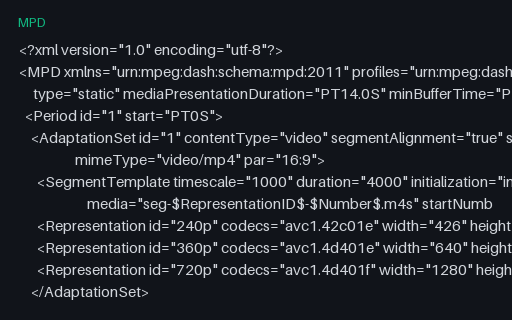
- mpdDASH — Static MPD With a Segment TemplateA DASH manifest with separate video and audio adaptation sets, three video representations, and $RepresentationID$/$Number$ segment-template addressing — the standard VOD packaging shape. Served inline as application/dash+xml with permissive CORS, so dash.js can load it cross-origin. A manifest-parsing fixture: it describes segment URLs rather than shipping the segments.
- m4sDASH VOD — Init Segment (init-stream0.m4s)A DASH initialisation segment carrying codec configuration for one representation. Named by the manifest's $RepresentationID$ template, so this file also exercises whether a client resolves template variables correctly rather than pattern-matching filenames.
- m4sDASH VOD — Init Segment (init-stream1.m4s)A DASH initialisation segment carrying codec configuration for one representation. Named by the manifest's $RepresentationID$ template, so this file also exercises whether a client resolves template variables correctly rather than pattern-matching filenames.
Generated by generation/video_timedtext.py. Free for any use, no attribution required, license.