
Flaky Run — Timing Race, Flake-Rate Table (CSV)
The answer key for the timing race family: the flake rate a detector should derive from the five build reports next to it. Exactly one of the six tests is unstable, at a rate of 2/5; the other five are stable at 0.00.
test,builds,passed,failed,errored,skipped,flake_rate,verdict
checkout.SessionTest.createsSessionForNewCart,5,5,0,0,0,0.00,stable
checkout.SessionTest.expiresSessionAfterTimeout,5,3,2,0,0,0.40,flaky
checkout.SessionTest.restoresCartOnResume,5,5,0,0,0,0.00,stable
checkout.SessionTest.rotatesSessionToken,5,5,0,0,0,0.00,stable
checkout.SessionTest.rejectsExpiredToken,5,5,0,0,0,0.00,stable
checkout.SessionTest.persistsCartAcrossRestart,5,5,0,0,0,0.00,stable
Specifications
- Seed
- 61200
- Rows
- 6
- Columns
- 8
- Delimiter
- ,
- Header
- true
- Builds Covered
- 5
- Flaky Test
- checkout.SessionTest.expiresSessionAfterTimeout
- Flaky Rate
- 0.4
- Stable Tests
- 5
- Line Endings
- LF
Testing contract
Reference control- Scenario
- Score a flake detector against the five build reports in this family.
- Expected result
- The detector flags checkout.SessionTest.expiresSessionAfterTimeout and only that test, at the rate in this table; flagging any of the other five is a false positive.
What is a .csv file?
CSV (Comma-Separated Values) is a plain-text tabular format where rows are lines and fields are separated by commas, with quoting rules for values that contain delimiters, quotes, or newlines. It has no formal type system and depends on encoding and dialect conventions. It is the most portable format for tabular data exchange.
How to use this file
Use an example CSV to test parsers against quoting and embedded-delimiter edge cases, header handling, encoding detection, and import pipelines into databases or spreadsheets.
How to use this file for testing
“Flaky Run — Timing Race, Flake-Rate Table (CSV)” is a deterministic Novus Examples fixture for CSV parsing, Conversion testing, Error handling. Clean and deliberately messy CSVs — quoted commas, embedded newlines, ragged rows, odd delimiters, and encodings.
Documented properties for this file: seed 61200 · 6 rows · 8 columns · LF. Compare results against paired or grouped companions on this page when present (clean↔damaged, searchable↔scanned, or format twins) so scores stay reproducible across runs.
Download the file once, keep the path stable in CI or local scripts, and treat the spec table as the contract: dimensions, seeds, field lists, and roles are intentional. Corrupt or invalid samples are labelled as such — expect parsers to fail loudly rather than silently accept them.
Test and coverage reports document their totals (suites, cases, passes, failures, skips, covered lines) in the spec table. Point your CI dashboard, coverage gate, or report converter at the file and assert those counts survive; format twins carry identical numbers so a conversion can be scored exactly.
Feed the file to your parser and assert it handles the documented quirks — quoted delimiters, embedded newlines, ragged rows, or invalid syntax; the valid↔invalid distinction is labelled in the title.
Code examples
import pandas as pd

df = pd.read_csv("timing-race-flake-rate.csv")
print(df.head())
print(df.dtypes)
Related files
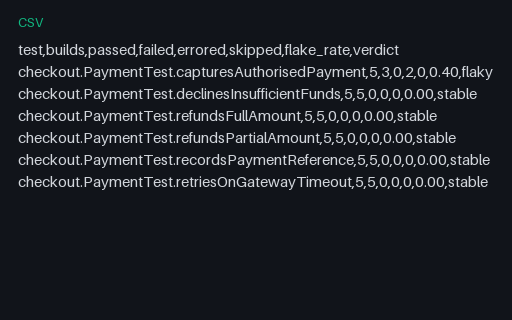
- csvFlaky Run — Network Dependency, Flake-Rate Table (CSV)The answer key for the network dependency family: the flake rate a detector should derive from the five build reports next to it. Exactly one of the six tests is unstable, at a rate of 2/5; the other five are stable at 0.00.
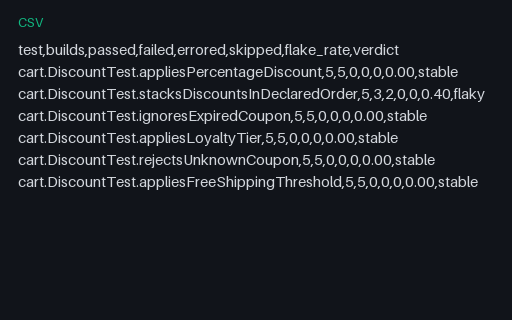
- csvFlaky Run — Order Dependent, Flake-Rate Table (CSV)The answer key for the order dependent family: the flake rate a detector should derive from the five build reports next to it. Exactly one of the six tests is unstable, at a rate of 2/5; the other five are stable at 0.00.
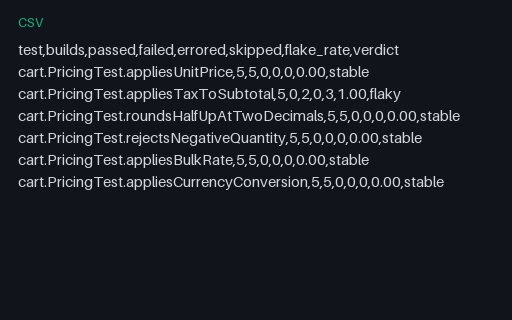
- csvFlaky Run — Quarantined After Two Failures, Flake-Rate Table (CSV)The answer key for the quarantined after two failures family: the flake rate a detector should derive from the five build reports next to it. Exactly one of the six tests is unstable, at a rate of 5/5; the other five are stable at 0.00.
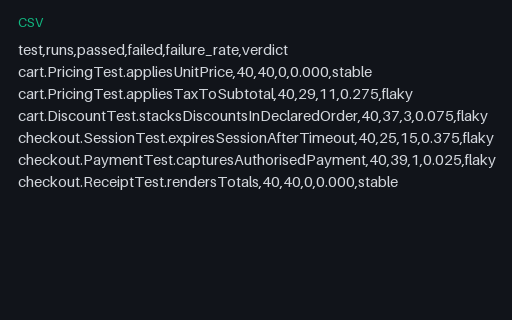
- csvFlaky Detection — Per-Test Failure-Rate Summary (CSV)The aggregate answer key for the 40-build history in this group: runs, passes, failures and failure rate per test, with each test labelled stable or flaky. Use it to score a detector rather than eyeballing 240 JSONL records.
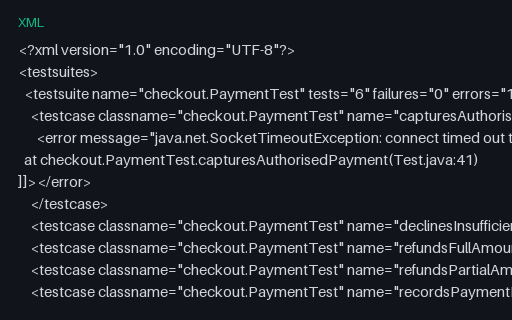
- xmlFlaky Run — Network Dependency, Build #301 (errored)Build #301 of five consecutive runs of checkout.PaymentTest, in which capturesAuthorisedPayment is errored while the other five cases pass every time. The underlying cause is a real call to the fictional payments host instead of the stub. Read the whole family in build order to reproduce what a flake detector sees.
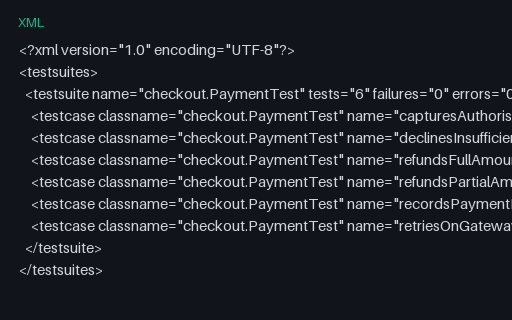
- xmlFlaky Run — Network Dependency, Build #302 (passing)Build #302 of five consecutive runs of checkout.PaymentTest, in which capturesAuthorisedPayment is passing while the other five cases pass every time. The underlying cause is a real call to the fictional payments host instead of the stub. Read the whole family in build order to reproduce what a flake detector sees.
Generated by generation/testing.py. Free for any use, no attribution required — license.