
JUnit XML — Truncated Mid-Element (intentionally corrupt)
An intentionally corrupt JUnit report: the file ends in the middle of a testcase attribute value, exactly as it would if the CI worker were killed while the reporter was still writing. Three elements are left unclosed and the document is not well-formed XML. A parser must fail loudly rather than report the two complete cases as the whole run.
<?xml version="1.0" encoding="UTF-8"?>
<testsuites>
  <testsuite name="checkout.AllTests" tests="12" failures="1" errors="1" skipped="1" time="7.450" timestamp="2026-08-07T09:14:22" hostname="ci-runner-04">
    <testcase classname="cart.PricingTest" name="appliesUnitPrice" time="0.643"/>
    <testcase classname="cart.PricingTest" name="appliesQuantityMultiplier" time="0.659"/>
    <testcase classname="cart.PricingTest" name="roundsHalfUpAtTwoDec
Specifications
- Seed
- 61200
- Intentionally Corrupt
- true
- Damage
- file ends inside an attribute value
- Unclosed Elements
- testcase, testsuite, testsuites
- Well Formed
- false
- Complete Testcases
- 2
- Declared Tests
- 12
- Line Endings
- LF
Testing contract
Expected to fail- Scenario
- Ingest a test report that was truncated while the runner was still writing it.
- Expected result
- XML parsing fails with an unexpected-end-of-document error and the build is marked as having no usable report — not as a passing two-test run.
What is a .xml file?
XML (Extensible Markup Language) is a verbose, self-describing markup language using nested tags, attributes, and namespaces to represent structured, hierarchical data. It supports schemas, entities, and validation and underlies many document and data formats. It remains common in enterprise, publishing, and interchange contexts.
How to use this file
Use an example XML file to test parsers, namespace and schema validation, XPath queries, and protection against entity-expansion and external-entity attacks.
How to use this file for testing
“JUnit XML — Truncated Mid-Element (intentionally corrupt)” is a deterministic Novus Examples fixture for Error handling, Conversion testing, Log parsing. Deliberately corrupt and invalid files, clearly labelled, for testing how your tool fails.
Documented properties for this file: seed 61200 · damage: file ends inside an attribute value · LF · intentionally corrupt. Compare results against paired or grouped companions on this page when present (clean↔damaged, searchable↔scanned, or format twins) so scores stay reproducible across runs.
Download the file once, keep the path stable in CI or local scripts, and treat the spec table as the contract: dimensions, seeds, field lists, and roles are intentional. Corrupt or invalid samples are labelled as such — expect parsers to fail loudly rather than silently accept them.
Test and coverage reports document their totals (suites, cases, passes, failures, skips, covered lines) in the spec table. Point your CI dashboard, coverage gate, or report converter at the file and assert those counts survive; format twins carry identical numbers so a conversion can be scored exactly.
Code examples
import xml.etree.ElementTree as ET

tree = ET.parse("truncated-junit-results.xml")
root = tree.getroot()
print(root.tag, [c.tag for c in root][:5])
Related files
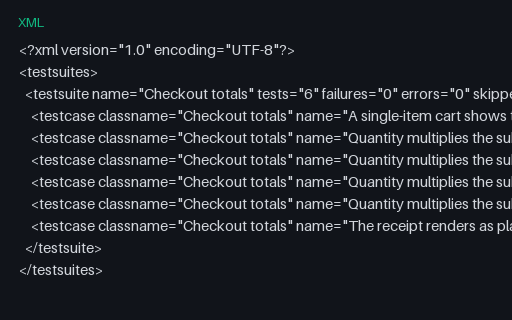
- xmlCucumber JUnit XML — Checkout RunThe same six pickles reported as JUnit XML, which is what a BDD suite hands to a generic CI dashboard. One <testcase> per pickle means the three expanded outline rows appear as three tests with identical names — enough to break any store keyed on name alone.
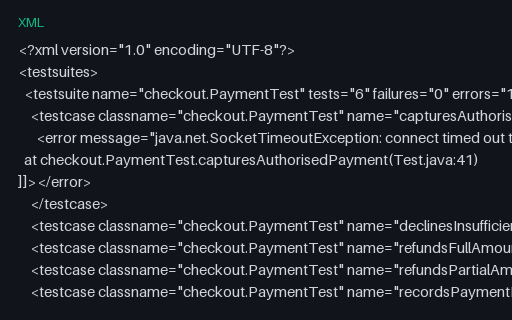
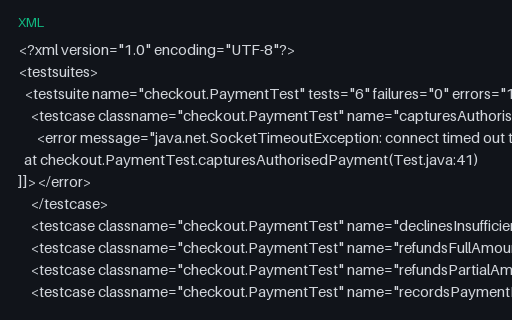
- xmlFlaky Run — Network Dependency, Build #301 (errored)Build #301 of five consecutive runs of checkout.PaymentTest, in which capturesAuthorisedPayment is errored while the other five cases pass every time. The underlying cause is a real call to the fictional payments host instead of the stub. Read the whole family in build order to reproduce what a flake detector sees.
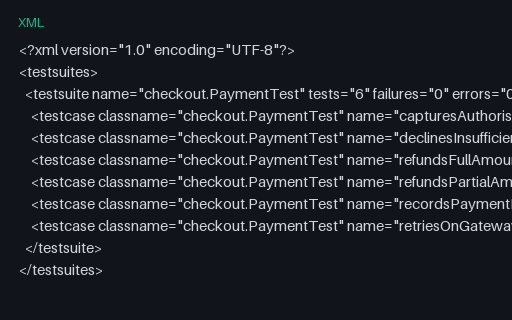
- xmlFlaky Run — Network Dependency, Build #302 (passing)Build #302 of five consecutive runs of checkout.PaymentTest, in which capturesAuthorisedPayment is passing while the other five cases pass every time. The underlying cause is a real call to the fictional payments host instead of the stub. Read the whole family in build order to reproduce what a flake detector sees.
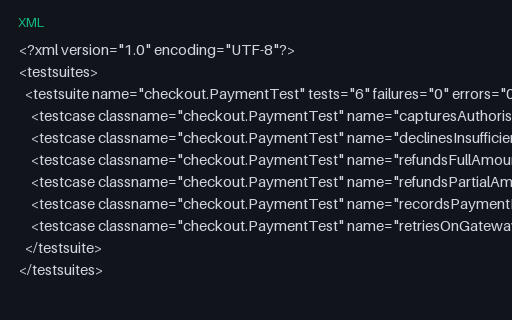
- xmlFlaky Run — Network Dependency, Build #303 (passing)Build #303 of five consecutive runs of checkout.PaymentTest, in which capturesAuthorisedPayment is passing while the other five cases pass every time. The underlying cause is a real call to the fictional payments host instead of the stub. Read the whole family in build order to reproduce what a flake detector sees.
- xmlFlaky Run — Network Dependency, Build #304 (passing)Build #304 of five consecutive runs of checkout.PaymentTest, in which capturesAuthorisedPayment is passing while the other five cases pass every time. The underlying cause is a real call to the fictional payments host instead of the stub. Read the whole family in build order to reproduce what a flake detector sees.
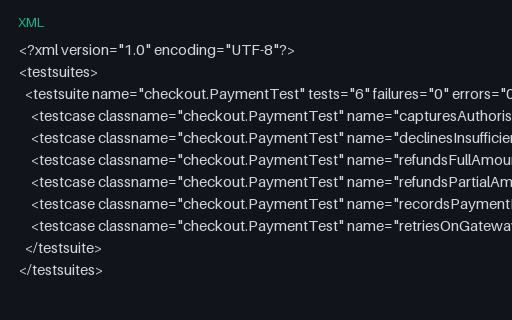
- xmlFlaky Run — Network Dependency, Build #305 (errored)Build #305 of five consecutive runs of checkout.PaymentTest, in which capturesAuthorisedPayment is errored while the other five cases pass every time. The underlying cause is a real call to the fictional payments host instead of the stub. Read the whole family in build order to reproduce what a flake detector sees.
Generated by generation/testing.py. Free for any use, no attribution required — license.