
Ethanol — SMILES String (.smi)
Ethanol as a single tab-delimited SMILES record, the most compressed member of this family: three heavy atoms with every hydrogen implicit and no geometry whatsoever. Round-tripping molfile to SMILES and back is the classic lossy conversion, and this pair is the reference for it.
CCO ethanol
Specifications
- Format
- SMILES
- Records
- 1
- Smiles
- CCO
- Delimiter
- tab
- Heavy Atoms
- 3
- Hydrogens
- implicit
- Coordinates
- none
Testing contract
Expected to pass- Scenario
- Parse the SMILES string, add explicit hydrogens, and compare the resulting formula with the paired molfile.
- Expected result
- The molecular formula comes out as C2H6O with nine atoms after hydrogens are added, matching the molfile's atom count while carrying none of its coordinates.
What is a .smi file?
A .smi file holds SMILES strings — a line notation that encodes a molecular graph as text. Atoms are written as element symbols, aromatic atoms in lower case, bonds as `-`, `=`, `#`, branches in parentheses, and rings as matching digit labels, with stereochemistry expressed by `/`, `\\`, and `@` markers. Files typically carry one SMILES per line with an optional whitespace-separated identifier, and a canonical SMILES is a unique string for a given structure.
How to use this file
Use an example .smi file to test SMILES parsers, canonicalisers, and structure-search tooling, verifying ring-closure and aromaticity handling, stereochemistry round-tripping, and that an invalid string is rejected rather than partially parsed.
How to use this file for testing
“Ethanol — SMILES String (.smi)” is a deterministic Novus Examples fixture for Scientific data, Editor testing, Conversion testing. Citation catalogs (BibTeX, RIS), chemistry structures (MDL Molfile, PDB), and gridded binary data (NetCDF, FITS) — for testing reference managers, molecule viewers, and scientific-data loaders.
Documented properties for this file: 1 records · SMILES. Compare results against paired or grouped companions on this page when present (clean↔damaged, searchable↔scanned, or format twins) so scores stay reproducible across runs.
Download the file once, keep the path stable in CI or local scripts, and treat the spec table as the contract: dimensions, seeds, field lists, and roles are intentional. Corrupt or invalid samples are labelled as such — expect parsers to fail loudly rather than silently accept them.
Scientific fixtures are small, valid, and fully synthetic — no real organism, patient, sample, or observation. Point your parser or loader at the file and check it reads the documented records, variables, or headers; binary formats ship a readable twin or metadata listing for comparison.
Related files
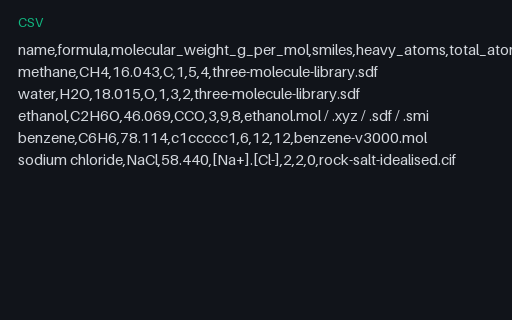
- csvChemistry Fixture Molecule Index (.csv)One row per molecule used across the chemistry fixtures, with formula, molecular weight, SMILES and the atom and bond counts each file should yield. It is the oracle a cheminformatics toolkit can be scored against without needing a second toolkit to generate the answers.
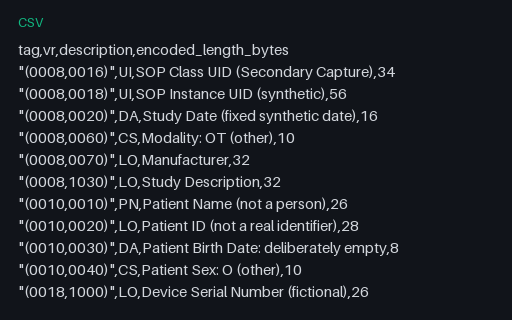
- csvDICOM-Shaped Dataset — Element Table Reference (.csv)Every element of the synthetic phantom dataset as tag, value representation, meaning and encoded length, in the ascending tag order the standard mandates. Diff a parser's element list against it to check both the ordering rule and the two different length encodings.
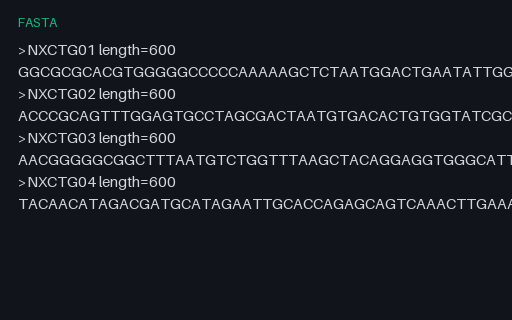
- fastaFASTA Contigs — One Line Per Record (.fasta)The same four contigs written one sequence per line rather than wrapped, which is how many pipelines emit FASTA and how many line-oriented parsers assume it always looks. Comparing against the wrapped twin proves a parser joins continuation lines instead of taking the first one.
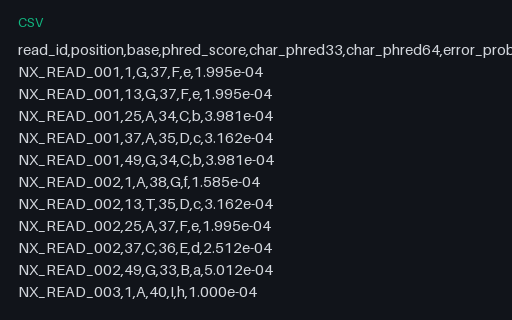
- csvFASTQ Quality Score Reference — Both Encodings Decoded (.csv)Every twelfth base of the six reads with its Phred score, the ASCII character it takes under both offsets, and the error probability that score implies. It converts a quality-encoding argument into a lookup you can diff.
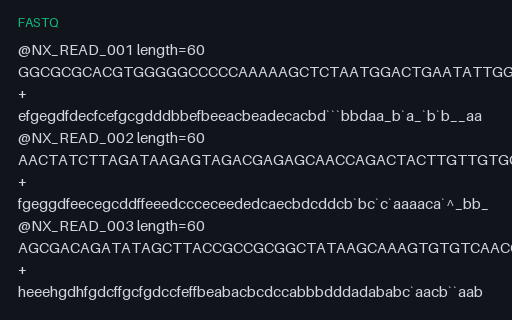
- fastqFASTQ Reads — Phred+64 Legacy Encoding (.fastq)The identical reads and identical quality scores written with the legacy Phred+64 offset used by older Illumina pipelines. Decode it with the modern offset and every base looks 31 points better than it is, which is a silent quality inflation rather than a parse failure.
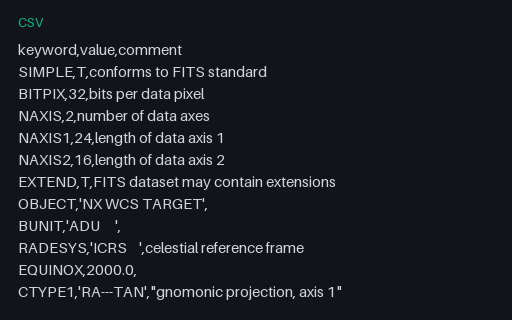
- csvFITS WCS Header Cards — CSV Reference (.csv)Every header card of the tangent-plane WCS file transcribed to keyword, value and comment columns. Diff a header parser's output against it to prove the parser split each 80-column card at the right places instead of guessing on whitespace.
Generated by generation/scientific.py. Free for any use, no attribution required — license.