
Helm Default values.yaml
The defaults half of a Helm values pair: nested maps, an empty map and an empty list, a list of env entries, and quoted booleans that must survive as strings. Pairs with the production overrides fixture for deep-merge testing.
# Default values for the `orders` chart. Merged with an overrides file at install time, so this
# pair is the canonical fixture for deep-merge semantics: maps merge key by key, lists replace
# wholesale, and an explicit `null` deletes an inherited key.
replicaCount: 2

image:
  repository: registry.example.invalid/example-org/orders
  tag: ""
  pullPolicy: IfNotPresent

service:
  type: ClusterIP
  port: 80

resources:
  requests:
    cpu: 100m
    memory: 128Mi
  limits:
    cpu: 500m
    memory: 512Mi

autoscaling:
  enabled: false
  minReplicas: 2
  maxReplicas: 10
  targetCPUUtilizationPercentage: 70

nodeSelector: {}
tolerations: []

env:
  - name: LOG_LEVEL
    value: info
  - name: FEATURE_CHECKOUT_V2
    value: "true"

cache:
  enabled: true
metrics:
  enabled: false

podAnnotations:
  example.invalid/scrape: "false"
Specifications
- Role
- defaults
- Top Level Keys
- 11
- Empty Map
- 1
- Empty List
- 1
- List Values
- 1
Testing contract
Reference control- Scenario
- Load a Helm defaults file without coercing quoted values or collapsing empty collections
- Expected result
- nodeSelector stays an empty map, tolerations an empty list, and FEATURE_CHECKOUT_V2 stays the string "true" rather than a boolean
What is a .yaml file?
YAML (YAML Ain't Markup Language) is a human-readable data-serialization format using indentation, key-value pairs, and lists, and is a superset of JSON. It supports comments, anchors, and multiple documents per file, favoring readability for configuration. Its indentation sensitivity makes it error-prone to hand-edit.
How to use this file
Use an example YAML file to test config parsers, indentation and anchor handling, multi-document streams, and safe-loading to avoid arbitrary object construction.
How to use this file for testing
“Helm Default values.yaml” is a deterministic Novus Examples fixture for Config testing, Config parsing, Editor testing. TOML, INI, YAML, .env, and dotfile configuration samples with nested sections and typed values — for testing config parsers, loaders, and environment tooling.
Documented properties for this file: defaults. Compare results against paired or grouped companions on this page when present (clean↔damaged, searchable↔scanned, or format twins) so scores stay reproducible across runs.
Download the file once, keep the path stable in CI or local scripts, and treat the spec table as the contract: dimensions, seeds, field lists, and roles are intentional. Corrupt or invalid samples are labelled as such — expect parsers to fail loudly rather than silently accept them.
Pipeline and infrastructure fixtures are inert configuration: steps reference fictional images and scripts, and nothing here executes. Run your linter, schema validator, migrator, or policy engine against them, and expect the deprecated-syntax and intentionally invalid variants to be rejected.
Point your config loader at the file and assert it reads the documented sections and typed values, including any deliberately-tricky nesting or comments.
Code examples
import yaml  # pip install pyyaml

with open("helm-values.yaml") as f:
    data = yaml.safe_load(f)
print(data)
Related files
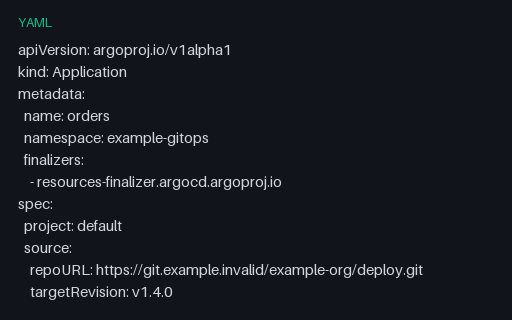
- yamlArgo CD Application with Sync PolicyAn Argo CD Application with automated sync, prune and self-heal, retry backoff, sync options, and an ignoreDifferences rule that exempts replica counts from drift detection. All Git and cluster endpoints are example.invalid.
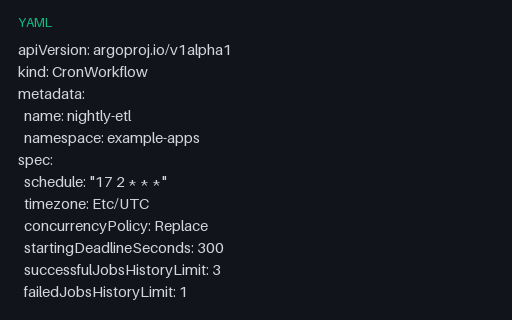
- yamlArgo CronWorkflow ScheduleAn Argo CronWorkflow wrapping an inline workflowSpec: a cron schedule with an explicit timezone, Replace concurrency, history limits, and a suspend flag. Nested-spec shape that flat schedule extractors miss.
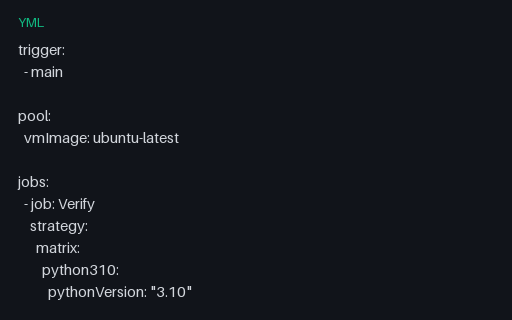
- ymlAzure Pipelines Matrix StrategyAzure's named-leg matrix form, where each leg is a mapping of variables rather than an axis product: three Python legs, a maxParallel cap, a job timeout, and a JUnit results publish step that runs on failure too.
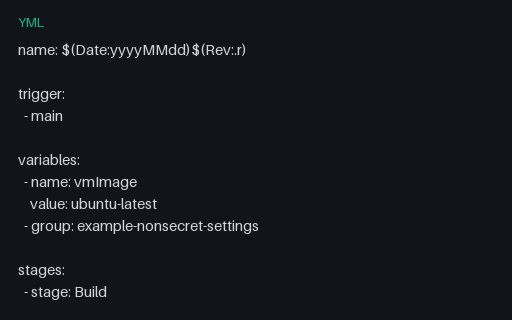
- ymlAzure Pipelines Stages and Deployment JobA three-stage Azure Pipelines definition with a build-number format expression, a variable group reference, stage conditions built from the expression functions, and a deployment job using the runOnce strategy against a named environment.
- ymlAzure Pipelines Steps and TriggersThe simplest Azure Pipelines shape: no stages or jobs, just a trigger with branch and path filters, a PR trigger, variables, and a flat step list mixing task and script steps. Baseline for the stage-based fixtures.
- ymlAzure Pipelines Template Expressions and ParametersCompile-time template expressions: an `${{ each }}` loop over an object parameter, an `${{ if }}` conditional insertion, an `extends` template, and a step template with arguments. These resolve before runtime, which template-aware linters must model.
Generated by generation/pipelines.py. Free for any use, no attribution required — license.