
OTLP Trace — ERROR Status and Exception Event (json)
A failed checkout: an upstream payment timeout sets ERROR status on four spans up the chain and attaches an exception event whose exception.stacktrace attribute holds a real multi-line Python traceback with embedded newlines. The fixture for error grouping, status propagation and multi-line attribute rendering.
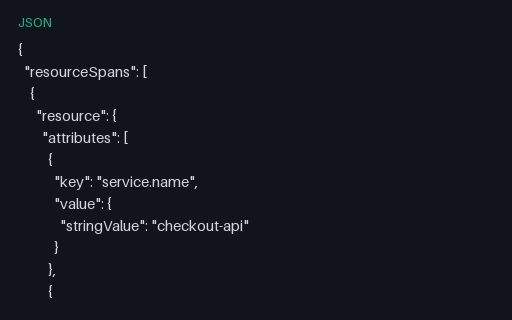
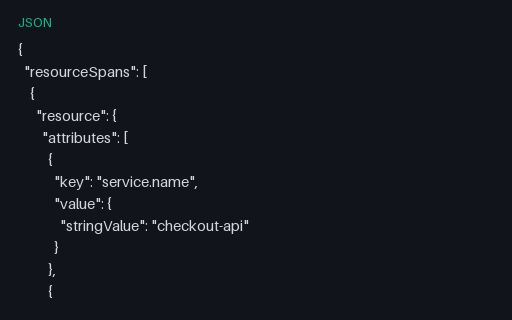
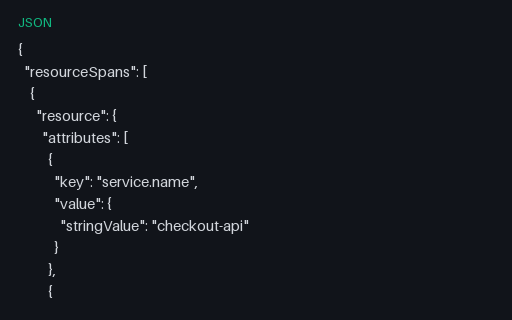
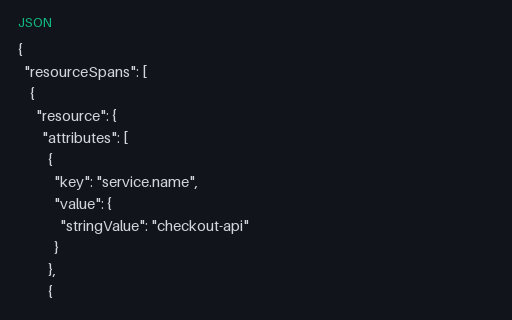
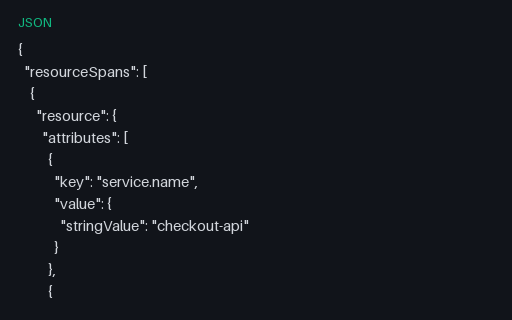
{
  "resourceSpans": [
    {
      "resource": {
        "attributes": [
          {
            "key": "service.name",
            "value": {
              "stringValue": "checkout-api"
            }
          },
          {
            "key": "service.namespace",
            "value": {
              "stringValue": "shop"
            }
          },
          {
            "key": "service.version",
            "value": {
              "stringValue": "1.14.2"
            }
          },
          {
            "key": "service.instance.id",
            "value": {
              "stringValue": "checkout-api-7d9f4c-2xk"
            }
          },
          {
            "key": "deployment.environment.name",
            "value": {
              "stringValue": "staging"
            }
          },
          {
            "key": "host.name",
            "value": {
              "stringValue": "node-a1"
            }
          },
          {
            "key": "host.ip",
            "value": {
              "stringValue": "192.0.2.11"
            }
          },
          {
            "key": "cloud.region",
"value": {Specifications
- Spans
- 13
- Error Spans
- 4
- Exception Events
- 1
- Stacktrace Lines
- 8
- Multiline Attribute
- true
- Root Status
- ERROR
- Root Http Status
- 502
- Retries
- 2
Testing contract
Expected to pass- Scenario
- Ingest the trace and surface its errors in a trace viewer or error grouper.
- Expected result
- Exactly 4 spans report status ERROR, one exception event is attached to span a3b4c5d6e7f8091a, and the 8-line stack trace survives as a single attribute value with its newlines intact.
What is a .json file?
JSON (JavaScript Object Notation) is a lightweight, text-based data-interchange format representing objects, arrays, strings, numbers, booleans, and null. It is language-independent, human-readable, and the dominant format for web APIs and configuration. It requires a single well-formed root value.
How to use this file
Use an example JSON file to test parsers and serializers, schema validation, Unicode and number-precision handling, and API request or response processing.
How to use this file for testing
“OTLP Trace — ERROR Status and Exception Event (json)” is a deterministic Novus Examples fixture for Observability, Error handling, JSON parsing. Structured and plain-text telemetry with known timestamps, levels, request identifiers, and error states for testing log ingestion, correlation, dashboards, and alert pipelines.
Documented properties for this file: JSON · 30,494 bytes. Compare results against paired or grouped companions on this page when present (clean↔damaged, searchable↔scanned, or format twins) so scores stay reproducible across runs.
Download the file once, keep the path stable in CI or local scripts, and treat the spec table as the contract: dimensions, seeds, field lists, and roles are intentional. Corrupt or invalid samples are labelled as such — expect parsers to fail loudly rather than silently accept them.
Telemetry fixtures use fixed trace IDs, span IDs, and timestamps so ingestion is reproducible run to run. Point your collector, parser, or query layer at the file and assert the documented span tree, metric families, or severity mix; service and host names are invented.
Code examples
import json

with open("otlp-trace-error-payment.json") as f:
    data = json.load(f)
print(type(data), len(data))
Related files
- jsonOTLP Trace — Clock Skew, Child Starts Before Its Parent (json)Two hosts whose clocks disagree by 12 ms, so a server span appears to start before the client span that called it. Nothing in the payload is malformed — this is the most common real cause of a negative-latency gap in a waterfall, and viewers must show it rather than crash or silently reorder.
- jsonOTLP Trace — Orphan Span with a Missing Parent (json)The checkout trace with one intermediate span dropped, as happens when an exporter's queue overflows. Three spans now reference a parent that is not in the payload — a partial trace that a store must render rather than reject.
- jsonOTLP Trace — Truncated Mid-Object, Intentionally Corrupt (json)An OTLP/JSON export cut off in the middle of an object, the way a file sink looks when the collector is killed mid-write. This file is intentionally corrupt and small: it exists so an ingestion path can be tested for a clean parse error with a byte offset instead of a hang or a half-committed batch.
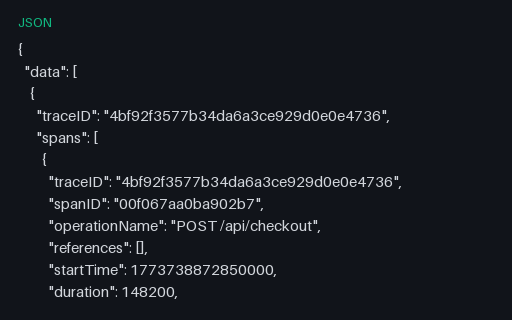
- jsonJaeger JSON Trace — Same 13-Span Checkout (json)The checkout trace in the Jaeger query-API shape — a data array holding one trace, spans carrying microsecond startTime and duration, CHILD_OF references, typed tags and a per-service processes map. The same span tree as the OTLP and Zipkin twins, so a converter can be scored exactly.
- jsonOTLP Trace — 48-Span Linear Chain (json)A single-service trace 48 levels deep — a recursive GraphQL-style resolver where every span is the child of the one before it. A depth fixture for waterfall renderers, tree-layout code and any parser that recurses over parentage.
- jsonOTLP Trace — 60-Way Parallel Fan-Out (json)One root span with 60 overlapping children — a scatter-gather query across database shards. The counterpart to the deep-chain fixture: shallow but very wide, which is what breaks waterfall layouts that assume spans do not overlap in time.
Generated by generation/observability.py. Free for any use, no attribution required — license.