
Flamegraph Hierarchy — Nested name/value/children Tree (json)
The folded CPU profile after aggregation into the nested name, value and children hierarchy that d3-flame-graph and most web viewers consume. Every node's value equals its own self time plus its children's, which is the invariant a converter must preserve.
{
  "name": "root",
  "value": 20560,
  "children": [
    {
      "name": "main",
      "value": 20560,
      "children": [
        {
          "name": "runtime.main",
          "value": 20560,
          "children": [
            {
              "name": "http.ListenAndServe",
              "value": 17290,
              "children": [
                {
                  "name": "http.(*conn).serve",
                  "value": 17290,
                  "children": [
                    {
                      "name": "checkout.Handle",
                      "value": 15700,
                      "children": [
                        {
                          "name": "checkout.price",
                          "value": 8440,
                          "children": [
                            {
                              "name": "pricing.applyDiscount",
                              "value": 4120
                            },
                            {
                              "name": "pricing.lookupRate",
                              "value": 4320,
                              "children": [
                                {
                                  "name": "sql.(*DB).QueryContext",
                                  "value": 2880
                                },
                                {
                                  "name": "cache.Get",
                                  "value": 1440
                                }
                              ]
                            }
                          ]
                        },
                        {
"name": "encoding/json.Marshal",Specifications
- Nodes
- 29
- Max Depth
- 9
- Root Value
- 20560
- Children Sum To Parent
- true
- Shape
- d3-flame-graph nested hierarchy
- Derived From
- cpu-folded-stacks-before
Testing contract
Expected to pass- Scenario
- Validate the hierarchy and compare it with the folded profile it was built from.
- Expected result
- The root value of 20560 equals the folded profile's sample total, the tree is 9 levels deep, and no node's value is less than the sum of its children's.
What is a .json file?
JSON (JavaScript Object Notation) is a lightweight, text-based data-interchange format representing objects, arrays, strings, numbers, booleans, and null. It is language-independent, human-readable, and the dominant format for web APIs and configuration. It requires a single well-formed root value.
How to use this file
Use an example JSON file to test parsers and serializers, schema validation, Unicode and number-precision handling, and API request or response processing.
How to use this file for testing
“Flamegraph Hierarchy — Nested name/value/children Tree (json)” is a deterministic Novus Examples fixture for Observability, JSON parsing, Graph data. Structured and plain-text telemetry with known timestamps, levels, request identifiers, and error states for testing log ingestion, correlation, dashboards, and alert pipelines.
Documented properties for this file: 29 nodes. Compare results against paired or grouped companions on this page when present (clean↔damaged, searchable↔scanned, or format twins) so scores stay reproducible across runs.
Download the file once, keep the path stable in CI or local scripts, and treat the spec table as the contract: dimensions, seeds, field lists, and roles are intentional. Corrupt or invalid samples are labelled as such — expect parsers to fail loudly rather than silently accept them.
Telemetry fixtures use fixed trace IDs, span IDs, and timestamps so ingestion is reproducible run to run. Point your collector, parser, or query layer at the file and assert the documented span tree, metric families, or severity mix; service and host names are invented.
Code examples
import json

with open("flamegraph-hierarchy.json") as f:
    data = json.load(f)
print(type(data), len(data))
Related files
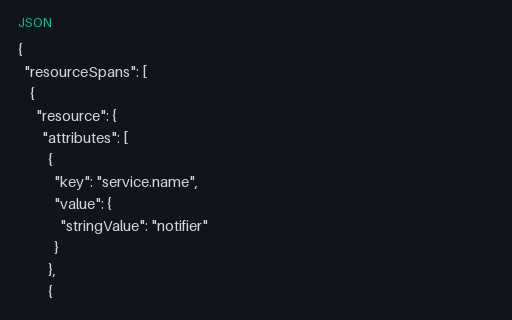
- jsonOTLP Trace — Span Links from a Batch Consumer (json)The consumer half of the checkout flow, in its own trace. Its root CONSUMER span carries a link — not a parent reference — back to the producer span in the checkout trace, which is how a batching consumer joins work produced elsewhere. A fixture for link resolution and cross-trace navigation.
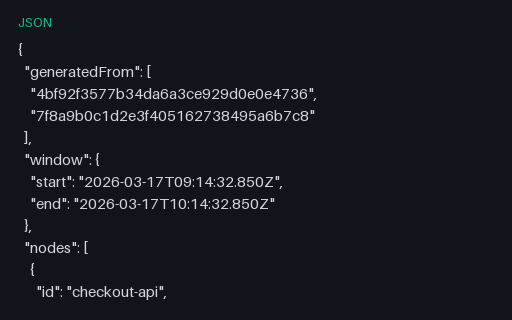
- jsonService Dependency Graph — Derived from the Trace Set (json)The service map you get by aggregating the trace fixtures in this category — five service nodes and the edges between them with call counts and latency percentiles, including the messaging edge that exists only because of a span link. Ground truth for a service-graph processor.
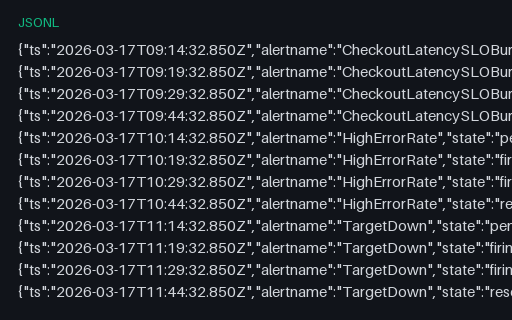
- jsonlAlert State History — Pending, Firing and Resolved Transitions (jsonl)Sixteen state transitions across four alerts, each moving inactive to pending to firing to resolved with the previous state recorded. The pending stage is where a for: duration is being served and no notification is sent, which is what makes alert-noise analysis possible.
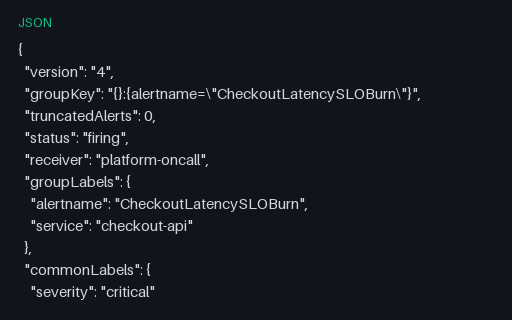
- jsonAlertmanager Webhook — Firing Notification (json)The JSON body Alertmanager POSTs to a webhook when an alert fires, including the detail that catches everyone: endsAt is Go's zero time rather than null or absent, so a receiver that parses it as a real timestamp records an alert that ended in the year 1.
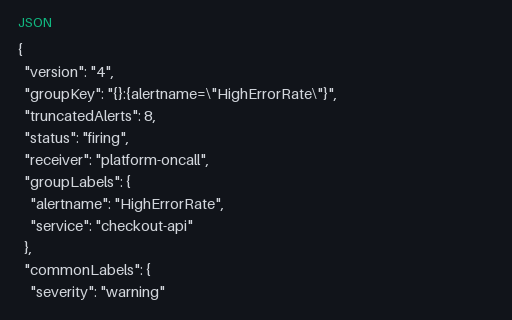
- jsonAlertmanager Webhook — Grouped Batch with Truncation (json)One notification carrying twelve grouped alerts with truncatedAlerts set to 8, meaning twenty were firing. Receivers that count the alerts array report a smaller incident than actually exists — the field is there precisely so that does not have to happen.
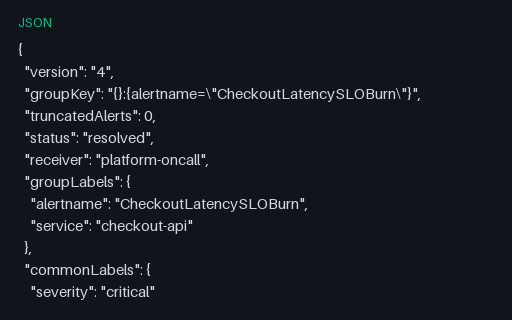
- jsonAlertmanager Webhook — Resolved Notification (json)The resolved notification for the same alert half an hour later, carrying an identical fingerprint and group key with endsAt now populated. Paired with the firing payload so incident-tracking code can be tested for correctly closing the incident it opened.
Generated by generation/observability.py. Free for any use, no attribution required — license.