
Alertmanager Webhook — Firing Notification (json)
The JSON body Alertmanager POSTs to a webhook when an alert fires, including the detail that catches everyone: endsAt is Go's zero time rather than null or absent, so a receiver that parses it as a real timestamp records an alert that ended in the year 1.
{
  "version": "4",
  "groupKey": "{}:{alertname=\"CheckoutLatencySLOBurn\"}",
  "truncatedAlerts": 0,
  "status": "firing",
  "receiver": "platform-oncall",
  "groupLabels": {
    "alertname": "CheckoutLatencySLOBurn",
    "service": "checkout-api"
  },
  "commonLabels": {
    "severity": "critical"
  },
  "commonAnnotations": {},
  "externalURL": "https://alertmanager.example.com",
  "alerts": [
    {
      "status": "firing",
      "labels": {
        "alertname": "CheckoutLatencySLOBurn",
        "service": "checkout-api",
        "severity": "critical",
        "team": "shop",
        "slo": "checkout-latency",
        "instance": "192.0.2.11:9090",
        "job": "shop-services"
      },
      "annotations": {
        "summary": "checkout-api p99 latency is above one second",
        "runbook_url": "https://runbooks.example.com/shop/checkout-latency"
      },
      "startsAt": "2026-03-17T09:14:32.850Z",
      "endsAt": "0001-01-01T00:00:00Z",
      "generatorURL": "https://prometheus.example.com/graph?g0.expr=histogram_quantile%280.99%2C+sum+by+%28le%29+%28rate%28http_request_duration_seconds_bucket%5B5m%5D%29%29%29",
      "fingerprint": "9f31a7c4e6b84f1d"
    }
  ]
}
Specifications
- Version
- 4
- Alerts
- 1
- Status
- firing
- Ends At Is Zero Value
- true
- Has Fingerprint
- true
- Zero Time
- 0001-01-01T00:00:00Z
Testing contract
Expected to pass- Scenario
- Receive the webhook and store the alert's start and end times.
- Expected result
- endsAt is recognised as the zero value meaning still firing, rather than stored as a date in the year 1, and the fingerprint is used to match the paired resolved notification.
What is a .json file?
JSON (JavaScript Object Notation) is a lightweight, text-based data-interchange format representing objects, arrays, strings, numbers, booleans, and null. It is language-independent, human-readable, and the dominant format for web APIs and configuration. It requires a single well-formed root value.
How to use this file
Use an example JSON file to test parsers and serializers, schema validation, Unicode and number-precision handling, and API request or response processing.
How to use this file for testing
“Alertmanager Webhook — Firing Notification (json)” is a deterministic Novus Examples fixture for Observability, JSON parsing, API testing. Structured and plain-text telemetry with known timestamps, levels, request identifiers, and error states for testing log ingestion, correlation, dashboards, and alert pipelines.
Documented properties for this file: JSON · 1,195 bytes. Compare results against paired or grouped companions on this page when present (clean↔damaged, searchable↔scanned, or format twins) so scores stay reproducible across runs.
Download the file once, keep the path stable in CI or local scripts, and treat the spec table as the contract: dimensions, seeds, field lists, and roles are intentional. Corrupt or invalid samples are labelled as such — expect parsers to fail loudly rather than silently accept them.
Telemetry fixtures use fixed trace IDs, span IDs, and timestamps so ingestion is reproducible run to run. Point your collector, parser, or query layer at the file and assert the documented span tree, metric families, or severity mix; service and host names are invented.
Code examples
import json

with open("alertmanager-webhook-firing.json") as f:
    data = json.load(f)
print(type(data), len(data))
Related files
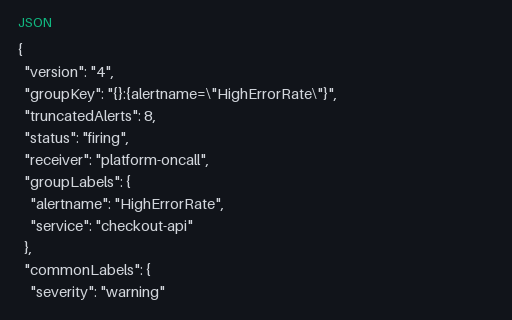
- jsonAlertmanager Webhook — Grouped Batch with Truncation (json)One notification carrying twelve grouped alerts with truncatedAlerts set to 8, meaning twenty were firing. Receivers that count the alerts array report a smaller incident than actually exists — the field is there precisely so that does not have to happen.
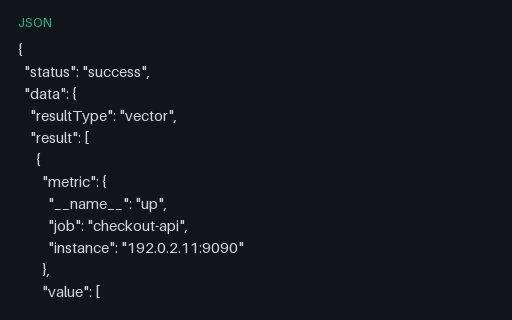
- jsonPrometheus HTTP API — Instant Query Vector with Warnings (json)An instant-query response: five up series at a single evaluation timestamp, one of them zero, plus a warnings array that clients routinely ignore. A successful response can carry warnings, and dropping them hides truncated results.
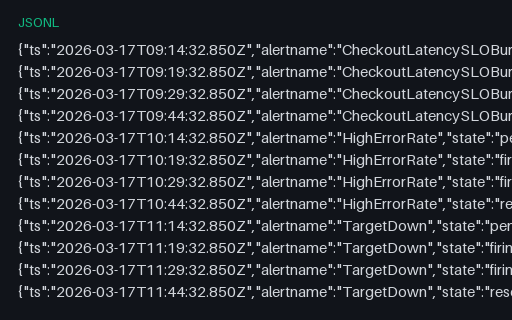
- jsonlAlert State History — Pending, Firing and Resolved Transitions (jsonl)Sixteen state transitions across four alerts, each moving inactive to pending to firing to resolved with the previous state recorded. The pending stage is where a for: duration is being served and no notification is sent, which is what makes alert-noise analysis possible.
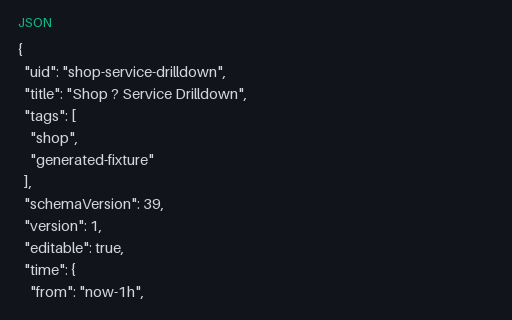
- jsonDashboard JSON — Chained Template Variables (json)A dashboard driven by four template variables, one of which queries using the value of another — the chained dependency that must be resolved in order. Multi-select variables interpolate as regex alternations, which is why every query here uses =~ rather than =.
- jsonDashboard JSON — Five-Panel Service Overview (json)A dashboard document in the Grafana JSON model: five panels on the 24-column grid, each with a datasource reference by UID, a PromQL target and a unit. Three panels query the recording rules in this category, so the dashboard and the rule file can be validated against each other.
- jsonChrome DevTools CPU Profile — Node Tree with Sample Deltas (json)The .cpuprofile shape V8 emits: a node tree with call frames, a samples array of node IDs and a parallel timeDeltas array, plus the synthesized (idle), (program) and (garbage collector) nodes. Counting those synthetic frames as application time is the classic misreading.
Generated by generation/observability.py. Free for any use, no attribution required — license.