
Structured Log — Schema and Type Drift Across Records (jsonl)
Six records that all mean the same thing and disagree about how to say it: status as a number, a string, a float and the text OK; user as a string, an object and null; tags as an array and a scalar; and the level and message fields renamed. The mapping conflict that stops an index mid-ingest.
{"ts":"2026-03-17T09:14:32.850Z","level":"info","msg":"order accepted","status":200,"user":"cust-000418","tags":["checkout","eu"],"retry":false}
{"ts":"2026-03-17T09:14:33.350Z","level":"info","msg":"order accepted","status":"200","user":{"id":"cust-000418","tier":"gold"},"tags":"checkout","retry":0}
{"ts":"2026-03-17T09:14:33.750Z","level":"INFO","msg":"order accepted","status":200.0,"user":null,"tags":[],"retry":"false"}
{"ts":"2026-03-17T09:14:34.250Z","level":"informational","message":"order accepted","http_status":200,"user_id":"cust-000418"}
{"ts":"2026-03-17T09:14:34.750Z","severity":"INFO","msg":"order accepted","status":"OK","user":"cust-000418","tags":["checkout"],"retry":null}
{"ts":"2026-03-17T09:14:35.150Z","level":"info","msg":"order accepted","status":200,"user":"cust-000418","tags":["checkout"],"retry":false,"extra":{"deep":{"deeper":{"value":1}}}}
Specifications
- Lines
- 6
- Drifting Fields
- 5
- Status Types
- number, string, float, text
- Level Field Names
- level, severity
- Message Field Names
- msg, message
- Type Conflicts Per Field
- 3
Testing contract
Expected to recover- Scenario
- Ingest all six records into a store with dynamic field mapping.
- Expected result
- The type conflict on status is reported per record rather than failing the whole batch, and a normalising pipeline maps severity to level and message to msg so all six records land in one schema.
What is a .jsonl file?
JSONL (JSON Lines) is a text format where each line is a complete, independent JSON value, allowing records to be streamed and appended without parsing the whole file. It is not itself a JSON array and each line must stand alone. It is common in logging, machine learning datasets, and data pipelines.
How to use this file
Use an example JSONL to test line-by-line streaming parsers, append-and-resume ingestion, and batch pipelines that process one record per line.
How to use this file for testing
“Structured Log — Schema and Type Drift Across Records (jsonl)” is a deterministic Novus Examples fixture for Observability, Log parsing, Schema validation. Structured and plain-text telemetry with known timestamps, levels, request identifiers, and error states for testing log ingestion, correlation, dashboards, and alert pipelines.
Documented properties for this file: JSONL · 877 bytes. Compare results against paired or grouped companions on this page when present (clean↔damaged, searchable↔scanned, or format twins) so scores stay reproducible across runs.
Download the file once, keep the path stable in CI or local scripts, and treat the spec table as the contract: dimensions, seeds, field lists, and roles are intentional. Corrupt or invalid samples are labelled as such — expect parsers to fail loudly rather than silently accept them.
Telemetry fixtures use fixed trace IDs, span IDs, and timestamps so ingestion is reproducible run to run. Point your collector, parser, or query layer at the file and assert the documented span tree, metric families, or severity mix; service and host names are invented.
Code examples
import json

with open("app-schema-drift.jsonl") as f:
    rows = [json.loads(line) for line in f]
print(len(rows), rows[0])
Related files
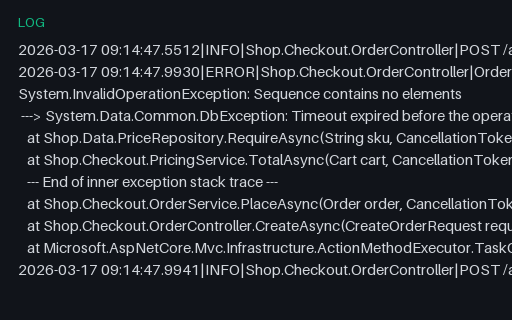
- log.NET Exception with an Inner Exception Chain (log)A .NET exception whose inner exception is introduced by the ---> marker and closed by End of inner exception stack trace, wrapped in pipe-delimited log lines. Error groupers that key on the outermost message alone merge two genuinely different faults here.
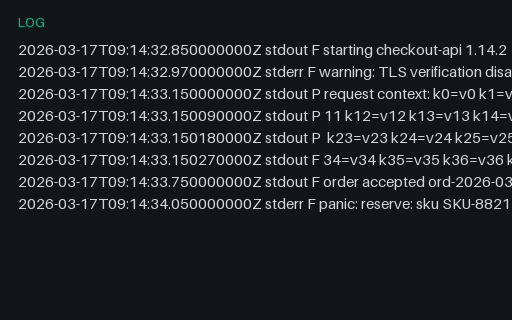
- logCRI Container Log — Partial Lines and Two Streams (log)The CRI log format Kubernetes nodes actually write: an RFC 3339 nanosecond timestamp, a stream name, and an F or P tag marking whether the line is full or a partial continuation. One long message is split across several P lines that must be rejoined before parsing.
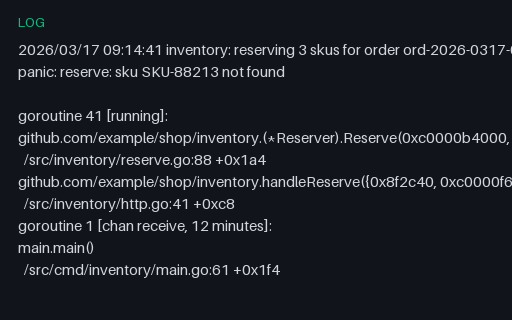
- logGo Panic with Full Goroutine Dump (log)A Go panic followed by the runtime's full goroutine dump — four goroutines with their wait states, two-line frames and a created by attribution, separated by blank lines. Blank-line separation defeats multi-line rules that treat an empty line as the end of an event.
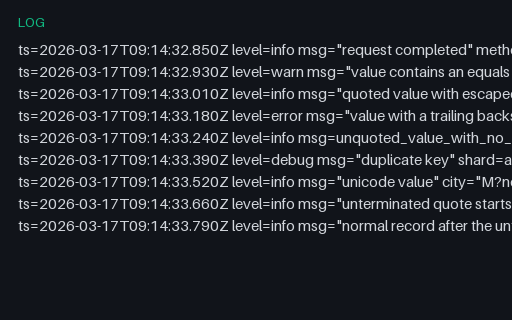
- loglogfmt — Quoting, Escaping and Bare-Key Edge Cases (log)logfmt lines built to break naive splitting on spaces and equals signs: a value containing an equals sign, escaped quotes, a trailing backslash before the closing quote, a bare key with no value, duplicate keys, non-ASCII values and one unterminated quote followed by a clean line.
- jsonOTLP Logs — Export Document with Severity and Trace Correlation (json)An OTLP logs export across two resources: five records spanning DEBUG to FATAL with both severityNumber and severityText, separate event and observed timestamps, trace and span correlation, and one record whose body is a full multi-line Python traceback.
- logPlain-Text Log — ANSI Colour Codes in the Stream (log)A developer-mode log where the level and service are wrapped in ANSI colour codes, ending with one uncoloured line. Colour codes sit inside the field a parser wants to read, so level extraction fails unless the sequences are stripped first — the classic symptom of a container run without a TTY check.
Generated by generation/observability.py. Free for any use, no attribution required — license.