
Apple .strings — positional arguments that reorder (German)
A German .strings file whose replace_confirm value puts %2$@ before %1$@, because German inverts the pair English uses. Also covers %% as a literal percent, an escaped double quote, a doubled-backslash UNC path and an escaped newline inside a value.
/* Novus example app - German (de) Localizable.strings
   POSITIONAL FORMAT SPECIFIERS. English reads "Replace A with B"; German inverts the pair, so the
   German value uses %2$@ before %1$@. A translator who writes plain %@ %@ here silently swaps the
   two file names at runtime, and nothing in the build catches it. */

"browser_title" = "Dateien";
"move_to_trash" = "In den Papierkorb verschieben";

/* en: "Move %1$@ to %2$@?" — same order */
"move_confirm" = "%1$@ nach %2$@ verschieben?";

/* en: "Replace %1$@ with %2$@?" — REVERSED order in German */
"replace_confirm" = "%2$@ anstelle von %1$@ einsetzen?";

/* en: "%1$@ used %2$ld%% of the quota" — %% is a literal percent sign */
"quota_used" = "%1$@ hat %2$ld%% des Kontingents belegt";

/* Escaped double quote and a literal backslash in a Windows-style path. */
"wrote_file" = "\"%1$@\" wurde gespeichert";
"unc_path" = "\\\\server\\share\\%1$@";

/* Multi-line value: \n is an escape sequence inside the quoted value, not a real line break. */
"disk_full" = "Kein Speicherplatz mehr.\nGeben Sie mindestens 500 MB frei.";
Specifications
- Format
- Apple .strings
- Locale
- de
- Encoding
- UTF-8
- Canonical Name
- Localizable.strings
- Keys
- 7
- Placeholder
- %1$@ / %2$ld (positional)
- Features
- argument reordering | %% literal | escaped quotes | UNC backslashes
- Seed
- 20260807
- Wave
- p7
- Line Endings
- LF
Testing contract
Expected to pass- Scenario
- Format each key with two distinct arguments and compare against the English source ordering.
- Expected result
- replace_confirm swaps the two arguments relative to English while move_confirm keeps their order — a translation that used bare %@ instead of %1$@/%2$@ would silently substitute the wrong file name with no build error.
What is a .strings file?
An Apple .strings file is a plain-text localization catalog used by iOS and macOS apps. Each line maps a quoted key to a quoted translated value with a trailing semicolon, optionally preceded by a comment, and placeholders use printf-style tokens like %@ and %d. It is typically stored per-locale in an .lproj folder.
How to use this file
Use an example .strings file to test Apple localization parsers, Xcode string catalogs, .strings-to-XLIFF converters, and tooling that reads iOS/macOS translations.
How to use this file for testing
“Apple .strings — positional arguments that reorder (German)” is a deterministic Novus Examples fixture for Internationalization, Localization catalogs. Parallel text and accented, multi-script content — for testing translation pipelines, Unicode handling, and localization tooling.
Documented properties for this file: seed 20260807 · UTF-8 · LF · placeholder %1$@ / %2$ld (positional). Compare results against paired or grouped companions on this page when present (clean↔damaged, searchable↔scanned, or format twins) so scores stay reproducible across runs.
Download the file once, keep the path stable in CI or local scripts, and treat the spec table as the contract: dimensions, seeds, field lists, and roles are intentional. Corrupt or invalid samples are labelled as such — expect parsers to fail loudly rather than silently accept them.
Translation-catalog fixtures carry the same message set across formats, each with its native placeholder syntax. Test your i18n loader, catalog converter, or translation-memory tool, and use the RTL and CJK variants to check bidirectional text and Unicode handling.
Load the catalog with your i18n framework and verify placeholder interpolation and plural handling; the RTL and CJK variants exercise bidirectional text and font fallback.
Code examples
plutil -lint Localizable-de.strings    # macOS validation
cat Localizable-de.strings             # "key" = "value";  pairs
Related files
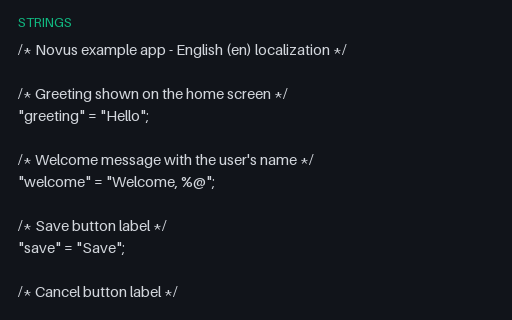
- stringsApple .strings — EnglishAn Apple Localizable.strings file (English) — quoted key = value pairs with comments and %@ placeholders, as iOS/macOS apps use per-locale in .lproj folders.
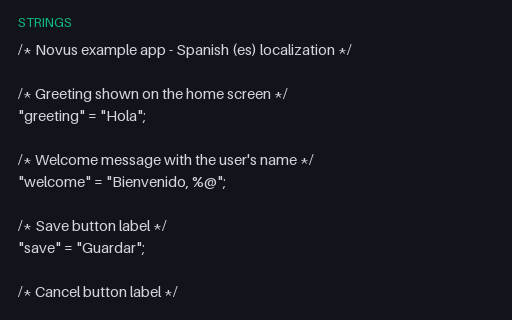
- stringsApple .strings — SpanishThe Spanish twin of the Apple .strings catalog — for testing .strings parsers and en/es diffing against the same keys.
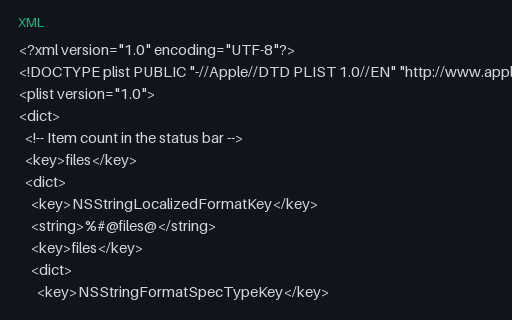
- xmlApple .stringsdict — Arabic (6 rules)Arabic Apple plural rules as a .stringsdict property list — the only place iOS and macOS accept plural variants, since a plain .strings file has no plural concept at all. Ships as .xml because the bytes are an XML plist; rename to Localizable.stringsdict to use it.
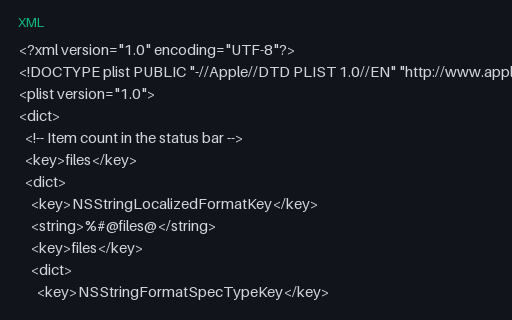
- xmlApple .stringsdict — English (2 rules)English Apple plural rules as a .stringsdict property list — the only place iOS and macOS accept plural variants, since a plain .strings file has no plural concept at all. Ships as .xml because the bytes are an XML plist; rename to Localizable.stringsdict to use it.
- xmlApple .stringsdict — Polish (4 rules)Polish Apple plural rules as a .stringsdict property list — the only place iOS and macOS accept plural variants, since a plain .strings file has no plural concept at all. Ships as .xml because the bytes are an XML plist; rename to Localizable.stringsdict to use it.
- xmlApple .stringsdict — Russian (4 rules)Russian Apple plural rules as a .stringsdict property list — the only place iOS and macOS accept plural variants, since a plain .strings file has no plural concept at all. Ships as .xml because the bytes are an XML plist; rename to Localizable.stringsdict to use it.
Generated by generation/localization_p7.py. Free for any use, no attribution required — license.