
Form Extractor Conformance Suite (JSON)
Eighteen numbered assertions, each naming one fixture in this wave and the single behaviour it proves. Enough to drive a form extractor's test suite without inventing expectations first.
{
  "schemaVersion": 1,
  "generatedBy": "generation/forms_p7.py",
  "note": "SAMPLE conformance checklist for a form extractor, keyed to the P7 fixtures in this catalog.",
  "cases": [
    {
      "id": "C01",
      "fixture": "required-constraint-matrix.html",
      "assert": "11 fields are found and 8 of them are mandatory"
    },
    {
      "id": "C02",
      "fixture": "pattern-constraint-matrix.html",
      "assert": "every pattern is read verbatim, with no delimiters added or anchors stripped"
    },
    {
      "id": "C03",
      "fixture": "numeric-range-step-matrix.html",
      "assert": "min, max and step survive as numbers on the numeric controls and as strings on the temporal ones"
    },
    {
      "id": "C04",
      "fixture": "input-types-choice.html",
      "assert": "the prompt row is not reported as a choice, and option values are kept where they differ from labels"
    },
    {
      "id": "C05",
      "fixture": "form-buttons-and-controls.html",
      "assert": "exactly 2 fields are reported; the four button-shaped inputs are not fields"
    },
    {
      "id": "C06",
      "fixture": "input-types-specialised.html",
      "assert": "hidden controls carry values but are not offered to a user as fields"
    },
    {
      "id": "C07",
      "fixture": "form-attribute-association.html",
      "assert": "the two controls outside the form element are still associated with it"
    },
    {
      "id": "C08",
      "fixture": "labelling-aria-labelledby.html",
      "assert": "each accessible name comes from the referenced elements, in reference order"
    },
    {
      "id": "C09",
      "fixture": "labelling-placeholder-only.html",
      "assert": "every control is reported as having no accessible name"
},Specifications
- Kind
- conformance suite
- Cases
- 18
- Schema Version
- 1
What is a .json file?
JSON (JavaScript Object Notation) is a lightweight, text-based data-interchange format representing objects, arrays, strings, numbers, booleans, and null. It is language-independent, human-readable, and the dominant format for web APIs and configuration. It requires a single well-formed root value.
How to use this file
Use an example JSON file to test parsers and serializers, schema validation, Unicode and number-precision handling, and API request or response processing.
How to use this file for testing
“Form Extractor Conformance Suite (JSON)” is a deterministic Novus Examples fixture for Form parsing, Form testing, JSON parsing. PDF AcroForms with documented fields and live HTML forms for testing form parsers and fillers.
Documented properties for this file: JSON · 3,219 bytes. Compare results against paired or grouped companions on this page when present (clean↔damaged, searchable↔scanned, or format twins) so scores stay reproducible across runs.
Download the file once, keep the path stable in CI or local scripts, and treat the spec table as the contract: dimensions, seeds, field lists, and roles are intentional. Corrupt or invalid samples are labelled as such — expect parsers to fail loudly rather than silently accept them.
This form is fictional SAMPLE content for tooling tests (autofill, scrapers, PDF fillers). It is not an official government, bank, or clinic form. Open the HTML offline or fill the PDF in any viewer; the demo submit path never stores data.
Code examples
import json

with open("form-extractor-conformance.json") as f:
    data = json.load(f)
print(type(data), len(data))
Related files
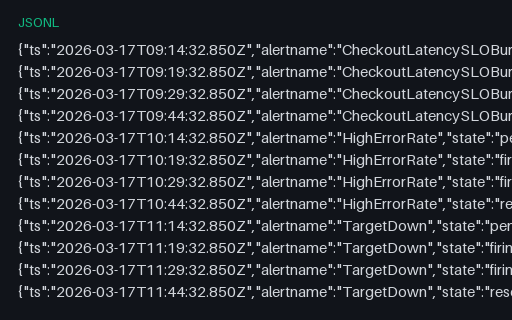
- jsonlAlert State History — Pending, Firing and Resolved Transitions (jsonl)Sixteen state transitions across four alerts, each moving inactive to pending to firing to resolved with the previous state recorded. The pending stage is where a for: duration is being served and no notification is sent, which is what makes alert-noise analysis possible.
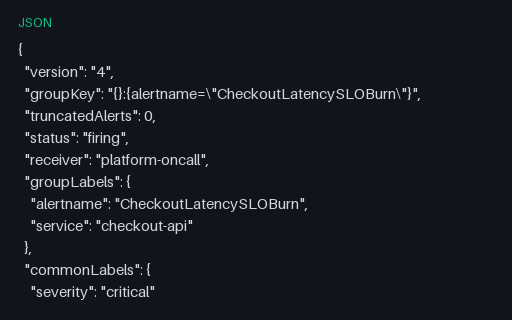
- jsonAlertmanager Webhook — Firing Notification (json)The JSON body Alertmanager POSTs to a webhook when an alert fires, including the detail that catches everyone: endsAt is Go's zero time rather than null or absent, so a receiver that parses it as a real timestamp records an alert that ended in the year 1.
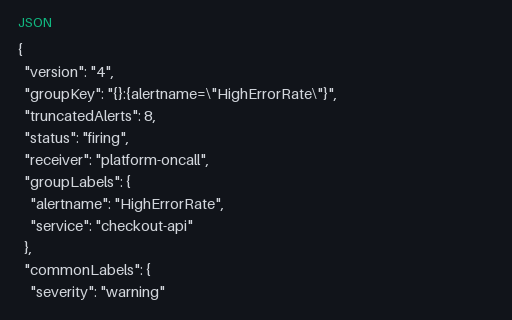
- jsonAlertmanager Webhook — Grouped Batch with Truncation (json)One notification carrying twelve grouped alerts with truncatedAlerts set to 8, meaning twenty were firing. Receivers that count the alerts array report a smaller incident than actually exists — the field is there precisely so that does not have to happen.
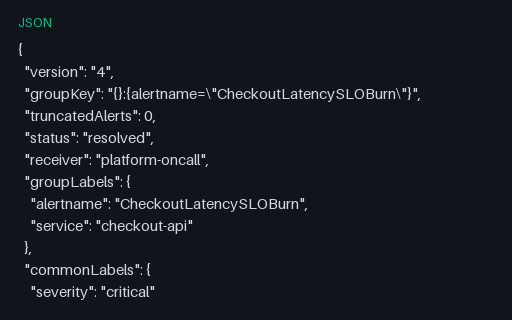
- jsonAlertmanager Webhook — Resolved Notification (json)The resolved notification for the same alert half an hour later, carrying an identical fingerprint and group key with endsAt now populated. Paired with the firing payload so incident-tracking code can be tested for correctly closing the incident it opened.
- jsonApi Batch ResponseBatch API response mixing success and failure per sub-request.
- jsonAPI Cursor Pagination — Page 1 (JSON)Cursor-paginated SAMPLE API response page 1 with nextCursor metadata.
Generated by generation/forms_p7.py. Free for any use, no attribution required — license.