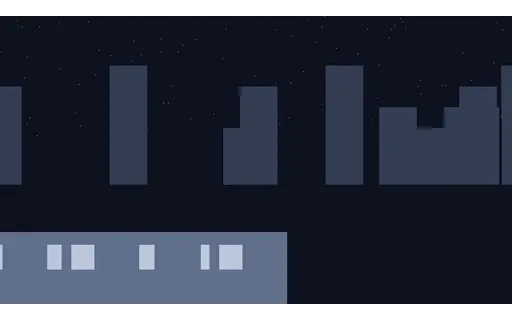

Layered scenes whose planes translate at documented, fixed ratios, so relative depth is defined by measurable motion rather than inferred from pictorial cues — giving depth-from-video output an objective reference.
The depth map for the parallax plate, encoded brighter-is-nearer across three layers. These values are not an estimate — they are derived from the layer velocities the generator used, so the depth ordering is exact by construction. Relative depth is what matters here: the layers move at 0.6, 2.4 and 6.0 pixels per frame, a 1 : 4 : 10 ratio.
Three planes translating at 0.6, 2.4 and 6.0 pixels per frame — a 1 : 4 : 10 velocity ratio that defines their relative depth by motion alone. There are no pictorial depth cues to fall back on: no perspective convergence, no shading, no familiar object sizes. A monocular depth model that has learned pictorial cues rather than motion parallax will do poorly here, which is precisely what makes the fixture informative.
We use Google Analytics and show ads via Adsterra and Infolinks. Non-essential cookies and ad scripts run only after you allow the matching categories. See our cookie policy.