
EML — References Chain With Repeated Message-IDs
A References header that lists the same two Message-IDs twice, in a repeating order — what a client produces when it appends without checking. A threader that treats the chain as a literal path builds a cycle or reports a depth of four for a two-deep thread.
From: Sam Rivera <sam@meridiansupply.example>
To: Maya Chen <maya@brightside.example>
Subject: Re: Standing order for Q1 (SAMPLE)
Date: Sun, 15 Feb 2026 09:00:00 -0800
Message-ID: <p7-thread-dup@meridiansupply.example>
In-Reply-To: <p7-thread-002@meridiansupply.example>
References: <p7-thread-root@brightside.example>
 <p7-thread-002@meridiansupply.example>
 <p7-thread-root@brightside.example>
 <p7-thread-002@meridiansupply.example>
MIME-Version: 1.0
Content-Type: text/plain; charset="us-ascii"
Content-Transfer-Encoding: 7bit

Reply body. What matters here is which threading headers are present
and what they point at; the text is the same across the set on purpose.
Specifications
- Wave
- p7
- Seed
- 20260807
- Reference Entries
- 4
- Distinct References
- 2
- Duplicated
- true
- Ordering
- root, parent, root, parent
- Line Endings
- CRLF (RFC 5322)
Testing contract
Expected to recover- Scenario
- Build ancestry from a References chain that repeats Message-IDs instead of listing each ancestor once.
- Expected result
- Duplicates collapse to two distinct ancestors and reported thread depth is 2, with no cycle and no infinite walk.
What is a .eml file?
An EML file is a single email message stored in the RFC 822 / MIME format — plain-text headers (From, To, Subject, Date, Message-ID) followed by the body, which may be plain text, HTML, or a multipart structure with alternative bodies and file attachments encoded in base64.
How to use this file
Use an example EML to test email header parsing, MIME decoding, HTML-part handling, attachment extraction, and EML-to-other-format conversion.
How to use this file for testing
“EML — References Chain With Repeated Message-IDs” is a deterministic Novus Examples fixture for Email parsing, Error handling, Conversion testing. Standards-compliant RFC 822 messages — plain, multipart text+HTML, and with an attachment — plus an MBOX mailbox, for testing header parsing, MIME decoding, attachment extraction, and mailbox splitting.
Documented properties for this file: seed 20260807 · CRLF (RFC 5322). Compare results against paired or grouped companions on this page when present (clean↔damaged, searchable↔scanned, or format twins) so scores stay reproducible across runs.
Download the file once, keep the path stable in CI or local scripts, and treat the spec table as the contract: dimensions, seeds, field lists, and roles are intentional. Corrupt or invalid samples are labelled as such — expect parsers to fail loudly rather than silently accept them.
Email fixtures use fixed dates, message IDs, and MIME boundaries so runs are reproducible, and every address is fictional. Test header parsing, MIME decoding, attachment extraction, and EML/MBOX conversion against the documented structure.
Code examples
from email import policy
from email.parser import BytesParser

msg = BytesParser(policy=policy.default).parse(open("p7-duplicate-reference.eml", "rb"))
print(msg["subject"], msg["from"])
Related files
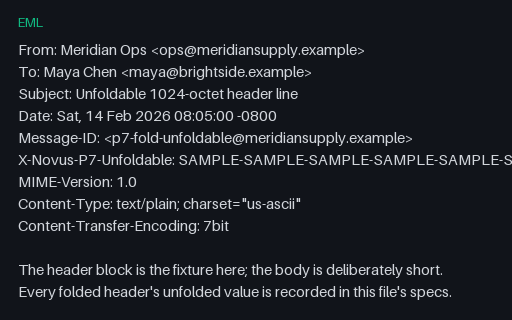
- emlEML — 1,024-Octet Header Line With No Fold PointA single header whose value is one 1,001-character token with no whitespace, making the line 1,024 octets — past the 998-octet limit RFC 5322 sets and impossible to fold. Fixed-size line buffers truncate here, and the truncation is silent.
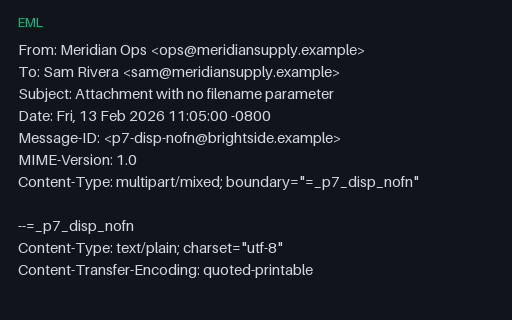
- emlEML — Attachment With No Filename At AllAn attachment with a bare Content-Disposition: attachment and no name in either header. A client has to invent a filename, and the extension it invents decides whether the saved file opens as a spreadsheet or as unknown binary.
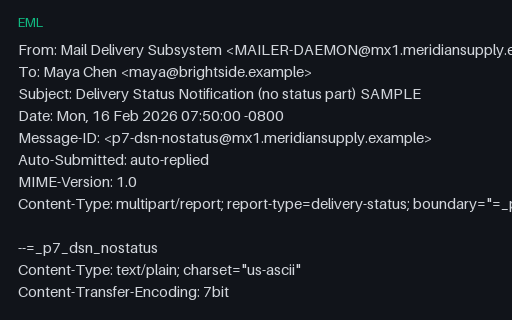
- emlEML — DSN Missing Its message/delivery-status Part (Deliberately Incomplete)A multipart/report that advertises report-type=delivery-status but is deliberately incomplete: the required message/delivery-status part is missing, leaving only human prose and the returned headers. Real MTAs emit this, and a parser must not assume the part exists.
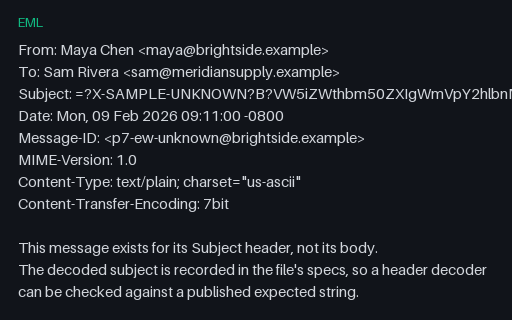
- emlEML — Encoded-Word With an Unregistered CharsetAn encoded-word naming a charset no registry knows. The payload happens to be UTF-8, so a decoder has a choice: fall back and show readable text, or leave the raw encoded-word visible. What it must not do is raise and drop the whole header.
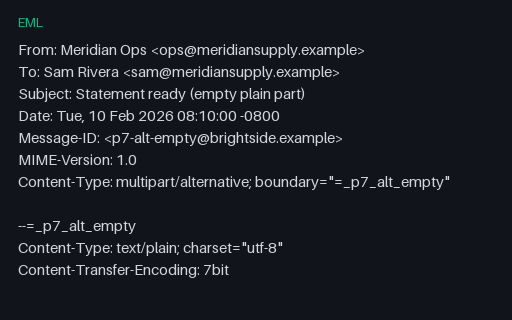
- emlEML — multipart/alternative With an Empty text/plain PartA zero-length text/plain alternative next to a real HTML part — the shape produced by senders that add a plain part only to satisfy spam filters. Anything preferring plain text renders a blank message unless it falls back when the chosen part is empty.
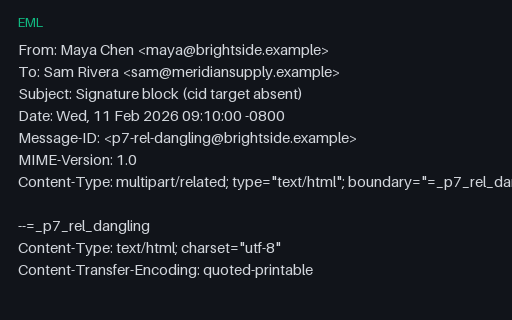
- emlEML — multipart/related With a Dangling cid: ReferenceThe HTML body references a Content-ID that no part in the message provides — the everyday result of a forward that dropped an attachment. A renderer should show the alt text and carry on, not emit a broken external request or fail the whole message.
Generated by generation/email_p7.py. Free for any use, no attribution required — license.