
FB2 - Three-Level Nested Sections with a Notes Body
A FictionBook nested three sections deep, with prose directly inside an outer section, an epigraph, a cite block, and a footnote linking into a second body named notes. The FB2 equivalents of a multi-level table of contents and non-linear back matter, in one file.
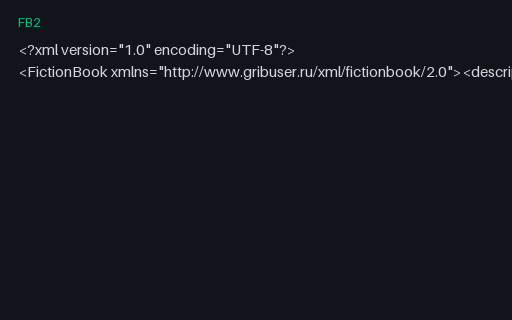
<?xml version="1.0" encoding="UTF-8"?>
<FictionBook xmlns="http://www.gribuser.ru/xml/fictionbook/2.0" xmlns:l="http://www.w3.org/1999/xlink">
  <description>
    <title-info>
      <genre>sci_philosophy</genre>
      <author><first-name>Ilse</first-name><last-name>Brandt-Nakamura</last-name></author>
      <book-title>A FictionBook Nested Three Deep</book-title>
      <lang>en</lang>
    </title-info>
    <document-info>
      <author><nickname>novus</nickname></author>
      <date value="2026-08-07">2026</date>
      <id>novus-p7-fb2-nested</id>
      <version>1.0</version>
    </document-info>
  </description>
  <body>
    <title><p>A FictionBook Nested Three Deep</p></title>
    <section>
      <title><p>Part One. Outer Section</p></title>
      <epigraph><p>Nesting is how FictionBook expresses a hierarchy: sections inside sections, with no separate table of contents to keep in step.</p></epigraph>
      <p>The outer section carries prose of its own before the inner ones begin, which is legal and is where converters that assume leaf-only content lose text.</p>
      <section>
        <title><p>1. Inner Section</p></title>
        <p>An inner section with a footnote reference<a l:href="#note1" type="note">[1]</a> pointing into the notes body.</p>
        <section>
          <title><p>1.1 Deepest Section</p></title>
          <p>Three levels down. A generated table of contents should still reach this heading.</p>
        </section>
      </section>
    </section>
    <section>
      <title><p>Part Two. Sibling Section</p></title>
      <cite><p>A cited block, which FB2 models as its own element rather than as a class on a paragraph.</p></cite>
    </section>
  </body>
  <body name="notes">
    <title><p>Notes</p></title>
    <section id="note1">
      <title><p>1</p></title>
      <p>The note itself lives in a second body element named notes - FictionBook's equivalent of an EPUB endnotes document marked linear="no".</p>
    </section>
  </body>
</FictionBook>
Specifications
- Seed
- 20260807
- Format
- FictionBook 2.0
- Encoding
- UTF-8
- Section Depth
- 3
- Bodies
- 2
- Notes Body Name
- notes
- Has Epigraph
- true
- Has Cite
- true
- Footnote Links
- 1
- Line Endings
- LF
Testing contract
Expected to pass- Scenario
- Generate a table of contents from the file and convert it to EPUB 3.
- Expected result
- All three heading levels appear in the contents, the outer section's own prose is not lost, and the notes body converts to an endnotes document reached by the footnote link rather than appearing in the main reading order.
What is a .fb2 file?
FB2 (FictionBook) is an XML-based e-book format that stores an entire book, including metadata and embedded images, in a single well-structured XML file. It emphasizes semantic markup of book structure over fixed presentation. It is especially popular in the Russian-speaking e-book community.
How to use this file
Use an example FB2 to test XML e-book parsing, embedded-image extraction, metadata handling, and converters between FB2 and EPUB.
How to use this file for testing
“FB2 - Three-Level Nested Sections with a Notes Body” is a deterministic Novus Examples fixture for Conversion testing, Editor testing. The same content exported across many formats and linked as a group, so you can convert one and diff against the expected twin.
Documented properties for this file: seed 20260807 · UTF-8 · LF. Compare results against paired or grouped companions on this page when present (clean↔damaged, searchable↔scanned, or format twins) so scores stay reproducible across runs.
Download the file once, keep the path stable in CI or local scripts, and treat the spec table as the contract: dimensions, seeds, field lists, and roles are intentional. Corrupt or invalid samples are labelled as such — expect parsers to fail loudly rather than silently accept them.
E-book fixtures are structured archives documented down to their spine and manifest. Test readers and converters, and where a valid↔intentionally-invalid pair exists, assert graceful handling of the malformed container.
Related files
- fb2FictionBook — Short SAMPLE (FB2)A minimal FictionBook (.fb2) SAMPLE with one section — for FB2/XML ebook importers.
- txtEPUB Conformance Matrix (wave p7) - Fixture IndexA plain-text index of every EPUB and FB2 fixture in this wave: its validity class, its subcategory, and the scenario and expected result published for it. Generated from the same entry list that builds the catalogue, so it cannot describe a file that is not there.
- svgAnimated Spinner (SVG)An animated loading spinner using SMIL (animateTransform) — a self-contained animated SVG for testing whether a renderer or converter handles SVG animation, and how it rasterises an animated frame.

- adocAsciiDoc Guide (ADOC source)An AsciiDoc getting-started guide with source blocks, an admonition, and a table — for testing AsciiDoc renderers (Asciidoctor), editors, and conversion to HTML/PDF.
- assASS Subtitles (Advanced SSA)An Advanced SubStation Alpha (.ass) subtitle with a styles section and three timed Dialogue events — the styled format libass renders — carrying the same captions as the SRT/VTT twins.
- svgBar Chart (SVG)A bar chart drawn as vector SVG — axis, gridlines, labelled bars — the scalable counterpart to the raster chart images, for testing SVG chart rendering and vector conversion.
Generated by generation/ebooks_p7.py. Free for any use, no attribution required — license.