
reStructuredText Doc (RST source)
A reStructuredText document with directives, a code block, a note admonition, and a table — for testing docutils/Sphinx rendering, reST parsers, and editors.
Novus Widget Documentation
==========================

A sample reStructuredText document for testing docutils, Sphinx, and editors.

Introduction
------------

The **Novus Widget** renders a configurable component. This file exercises reST
constructs: headings, lists, code blocks, and admonitions.

Installation
------------

Install from the package index::

    pip install novus-widget

Quick start
-----------

#. Import the widget.
#. Create an instance.
#. Call ``render()``.

.. code-block:: python

    from novus_widget import Widget
    Widget("#app").render()

.. note::

   Call ``render()`` after the page has loaded.

Options
-------

===========  =========  ==============================
Option       Default    Description
===========  =========  ==============================
theme        light      Colour theme (light or dark)
size         md         One of sm, md, lg
===========  =========  ==============================

License
-------

Free for any use. This text is synthetic sample content.
Specifications
- Format
- reStructuredText
- Features
- headings, code-block, note, table
What is a .rst file?
reStructuredText (reST) is a plain-text markup language from the Python community, used heavily for software documentation and by the Sphinx documentation generator. It uses indentation and simple punctuation for structure — headings, directives, roles, and cross-references. The .rst extension is standard.
How to use this file
Use an example .rst file to test reStructuredText parsers and editors, Sphinx or docutils rendering, and syntax highlighting.
How to use this file for testing
“reStructuredText Doc (RST source)” is a deterministic Novus Examples fixture for Editor testing, Conversion testing. Text-based files you can open, edit, and download directly in the browser editor.
Documented properties for this file: reStructuredText. Compare results against paired or grouped companions on this page when present (clean↔damaged, searchable↔scanned, or format twins) so scores stay reproducible across runs.
Download the file once, keep the path stable in CI or local scripts, and treat the spec table as the contract: dimensions, seeds, field lists, and roles are intentional. Corrupt or invalid samples are labelled as such — expect parsers to fail loudly rather than silently accept them.
Document fixtures list their internal structure (pages, fields, tracked changes, embedded objects) in the spec table. Test extractors, converters, and OCR against that known structure, and compare searchable↔scanned or format-twin companions when present.
Code examples
rst2html documentation.rst out.html # docutilsRelated files
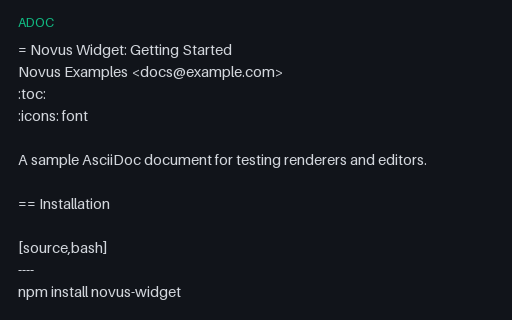
- adocAsciiDoc Guide (ADOC source)An AsciiDoc getting-started guide with source blocks, an admonition, and a table — for testing AsciiDoc renderers (Asciidoctor), editors, and conversion to HTML/PDF.
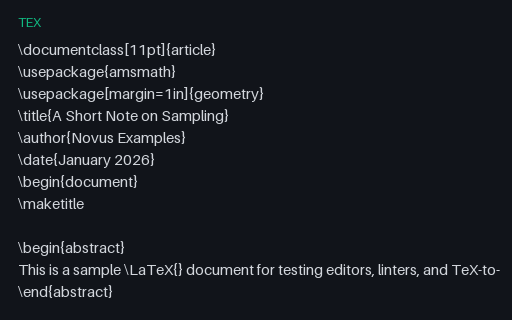
- texLaTeX Article (TEX source)A small LaTeX article source with an abstract, a numbered equation (the Nyquist criterion), and a table — for testing LaTeX editors, syntax highlighters, and TeX-to-PDF pipelines.
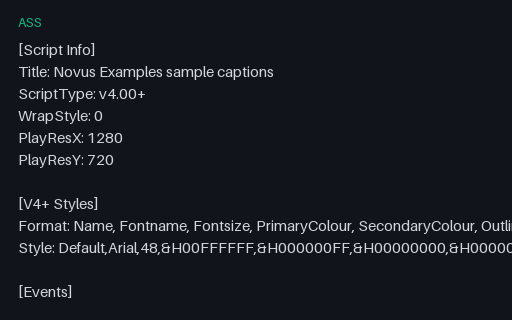
- assASS Subtitles (Advanced SSA)An Advanced SubStation Alpha (.ass) subtitle with a styles section and three timed Dialogue events — the styled format libass renders — carrying the same captions as the SRT/VTT twins.
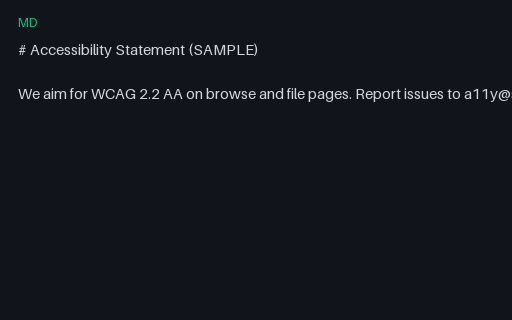
- mdLegal Markdown — Accessibility StatementFictional SAMPLE legal/policy markdown (accessibility-statement) — not legal advice.
- mdLegal Markdown — Cookie Notice SampleFictional SAMPLE legal/policy markdown (cookie-notice-sample) — not legal advice.
- mdLegal Markdown — Dpa Definitions SampleFictional SAMPLE legal/policy markdown (dpa-definitions-sample) — not legal advice.
Generated by generation/docs_realworld.py. Free for any use, no attribution required — license.