
NetCDF Gridded Data (.nc)
A NetCDF-3 (classic) file holding a small CF-convention gridded temperature field over latitude, longitude, and time, with named dimensions and units — for testing NetCDF readers like netCDF4 and xarray.
| Field | Value |
|---|---|
| Format | NetCDF-3 classic (CDF-1) |
| Conventions | CF-1.6 |
| Dimensions | time=3, lat=4, lon=5 |
| Variables | lat, lon, time, temperature |
| temperature | float32 (time, lat, lon), units K |
| Title | Sample gridded surface temperature |
Specifications
- Format
- NetCDF-3 classic
- Conventions
- CF-1.6
- Dims
- time=3, lat=4, lon=5
- Variables
- lat, lon, time, temperature (K)
What is a .nc file?
NetCDF (.nc, Network Common Data Form) is a binary, self-describing format for array-oriented scientific data. It stores multidimensional variables (like temperature over latitude, longitude, and time) with named dimensions, units, and metadata attributes, and is a standard in climate, ocean, and geoscience.
How to use this file
Use an example .nc file to test NetCDF readers (netCDF4, xarray, Panoply), CF-convention validators, and gridded-data pipelines, or to verify dimension and variable extraction.
How to use this file for testing
“NetCDF Gridded Data (.nc)” is a deterministic Novus Examples fixture for Scientific data. Citation catalogs (BibTeX, RIS), chemistry structures (MDL Molfile, PDB), and gridded binary data (NetCDF, FITS) — for testing reference managers, molecule viewers, and scientific-data loaders.
Documented properties for this file: NetCDF-3 classic. Compare results against paired or grouped companions on this page when present (clean↔damaged, searchable↔scanned, or format twins) so scores stay reproducible across runs.
Download the file once, keep the path stable in CI or local scripts, and treat the spec table as the contract: dimensions, seeds, field lists, and roles are intentional. Corrupt or invalid samples are labelled as such — expect parsers to fail loudly rather than silently accept them.
Data fixtures document their exact quirks — delimiters, encodings, null handling, schema, and row counts — in the spec table. Point your parser or importer at the file and assert it handles the documented edge cases; clean and deliberately-messy siblings make before/after diffs straightforward.
Related files
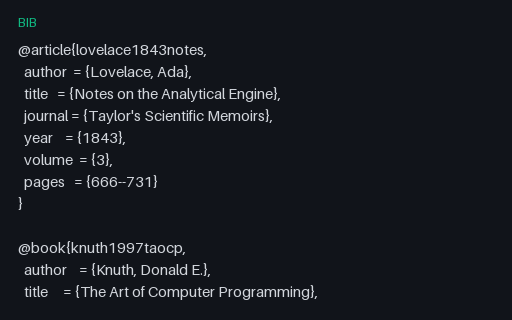
- bibBibTeX Bibliography (.bib)A BibTeX bibliography with three real citations (Lovelace, Knuth, Shannon) across article, book, and inproceedings types — for testing BibTeX parsers, reference managers, and citation converters.
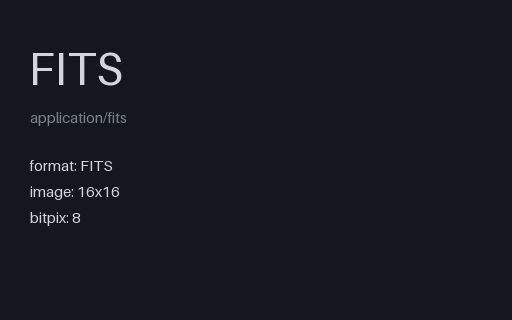
- fitsFITS Image (.fits)A minimal but valid FITS image — a primary header of 80-character cards padded to a 2880-byte block, followed by a 16x16 unsigned-byte pixel gradient — for testing FITS readers and header-card parsers.
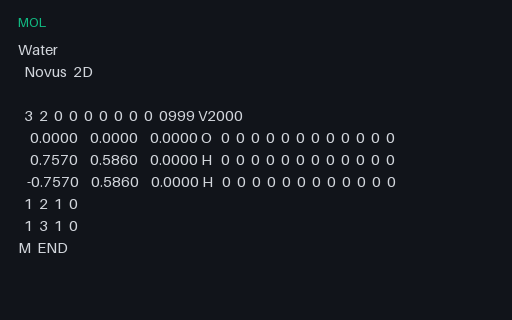
- molMDL Molfile — Water (.mol)An MDL Molfile (V2000) of a water molecule with standard geometry — a counts line, atom block with 2D coordinates, and bond block — for testing cheminformatics parsers and MOL/SDF converters.
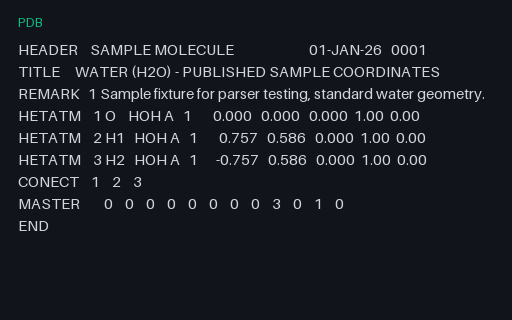
- pdbPDB Structure — Water (.pdb)The same water molecule in PDB format with fixed-column HETATM coordinate records and a CONECT bond record — for testing molecular-structure parsers and viewers and PDB/MOL conversion.
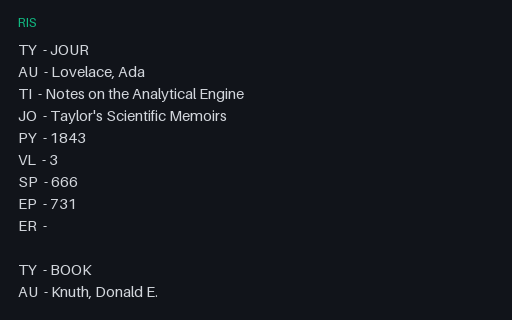
- risRIS Citations (.ris)The same three references as an RIS citation file with two-letter tags and ER record terminators — the twin of the BibTeX file, for testing RIS import and BibTeX/RIS conversion.
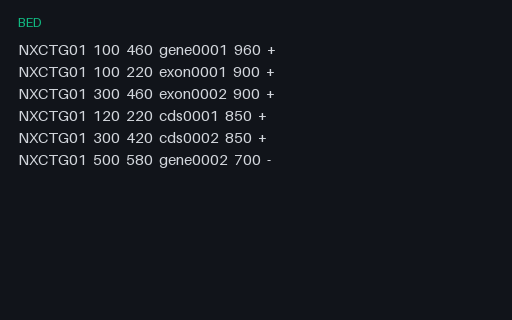
- bedBED6 Intervals — 0-Based Half-Open Coordinates (.bed)The same six features as the GFF3 file expressed in BED's 0-based half-open coordinates, where the start is one lower and the end is unchanged. Confusing the two conventions shifts every interval by a base, and this pair makes that shift a visible diff.
Generated by generation/sci_data.py. Free for any use, no attribution required — license.