
FITS Image (.fits)
A minimal but valid FITS image — a primary header of 80-character cards padded to a 2880-byte block, followed by a 16x16 unsigned-byte pixel gradient — for testing FITS readers and header-card parsers.
| Card | Value |
|---|---|
| SIMPLE | T (conforms to FITS) |
| BITPIX | 8 (unsigned bytes) |
| NAXIS | 2 |
| NAXIS1 x NAXIS2 | 16 x 16 |
| OBJECT | Sample Gradient |
| TELESCOP | NOVUS-SIM |
Specifications
- Format
- FITS
- Image
- 16x16
- Bitpix
- 8
- Block Size
- 2880
- Object
- Sample Gradient
What is a .fits file?
FITS (.fits, Flexible Image Transport System) is the standard binary format in astronomy. It pairs human-readable 80-character header cards (in 2880-byte blocks) with binary image or table data, storing pixel arrays, coordinates, and instrument metadata. It has been the astronomical archive format for decades.
How to use this file
Use an example .fits file to test FITS readers (astropy, CFITSIO, DS9), header-card parsing, and image or table extraction, or to verify block-alignment handling.
How to use this file for testing
“FITS Image (.fits)” is a deterministic Novus Examples fixture for Scientific data. Citation catalogs (BibTeX, RIS), chemistry structures (MDL Molfile, PDB), and gridded binary data (NetCDF, FITS) — for testing reference managers, molecule viewers, and scientific-data loaders.
Documented properties for this file: FITS. Compare results against paired or grouped companions on this page when present (clean↔damaged, searchable↔scanned, or format twins) so scores stay reproducible across runs.
Download the file once, keep the path stable in CI or local scripts, and treat the spec table as the contract: dimensions, seeds, field lists, and roles are intentional. Corrupt or invalid samples are labelled as such — expect parsers to fail loudly rather than silently accept them.
Data fixtures document their exact quirks — delimiters, encodings, null handling, schema, and row counts — in the spec table. Point your parser or importer at the file and assert it handles the documented edge cases; clean and deliberately-messy siblings make before/after diffs straightforward.
Related files
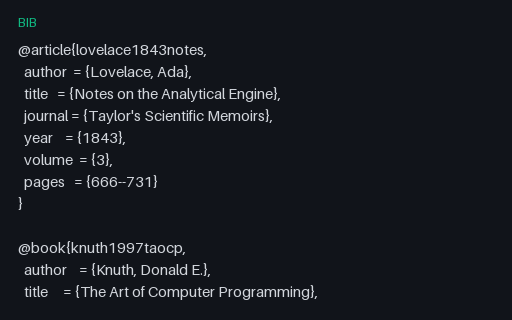
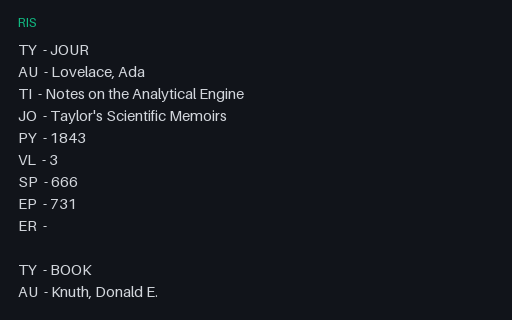
- bibBibTeX Bibliography (.bib)A BibTeX bibliography with three real citations (Lovelace, Knuth, Shannon) across article, book, and inproceedings types — for testing BibTeX parsers, reference managers, and citation converters.
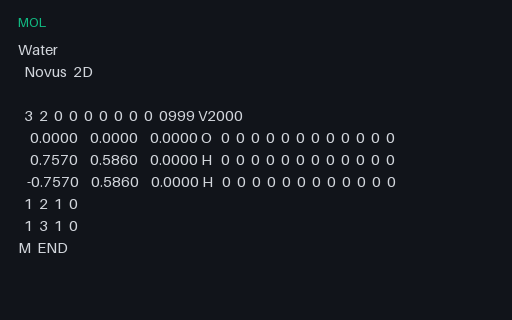
- molMDL Molfile — Water (.mol)An MDL Molfile (V2000) of a water molecule with standard geometry — a counts line, atom block with 2D coordinates, and bond block — for testing cheminformatics parsers and MOL/SDF converters.
- ncNetCDF Gridded Data (.nc)A NetCDF-3 (classic) file holding a small CF-convention gridded temperature field over latitude, longitude, and time, with named dimensions and units — for testing NetCDF readers like netCDF4 and xarray.
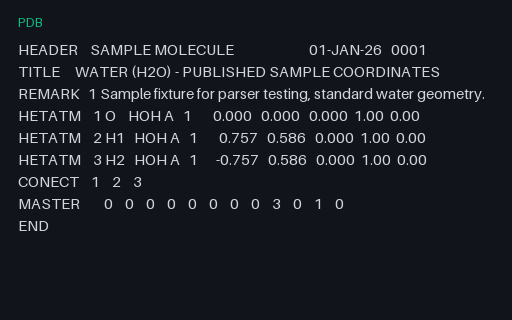
- pdbPDB Structure — Water (.pdb)The same water molecule in PDB format with fixed-column HETATM coordinate records and a CONECT bond record — for testing molecular-structure parsers and viewers and PDB/MOL conversion.
- risRIS Citations (.ris)The same three references as an RIS citation file with two-letter tags and ER record terminators — the twin of the BibTeX file, for testing RIS import and BibTeX/RIS conversion.
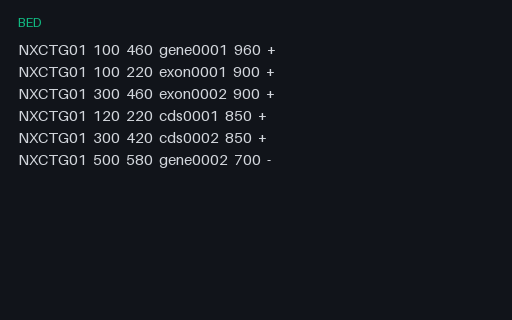
- bedBED6 Intervals — 0-Based Half-Open Coordinates (.bed)The same six features as the GFF3 file expressed in BED's 0-based half-open coordinates, where the start is one lower and the end is unchanged. Confusing the two conventions shifts every interval by a base, and this pair makes that shift a visible diff.
Generated by generation/sci_data.py. Free for any use, no attribution required — license.